Hunting Nighthawks:
On the Road with Edward Hopper
I sensed trouble. The couple in the restaurant looked fine enough. But she slumped and stared into the distance, and his torso leaned jauntily as if he didn't notice her detachment or care. I suspected they wouldn't be together much longer. I had no real reason to believe this. I couldn't even make out their faces. Besides, they were in a painting: Edward Hopper's Edward Who?pper And who was Edward Hopper? Born in 1882 to religious parents of Dutch descent in the Hudson River town of Nyack, New York, Hopper grew up loving water and boats, which appear in many of his paintings. He reached the ungainly height of over six feet by the age of twelve, resulting in the usual story of a teacher asking him to sit down when he already was. Maybe because of his freakish height (he topped out at about 6'5"), Edward grew withdrawn and remained taciturn throughout his life. Also possibly related, he developed a gift for expressing himself through drawing. [Hopper's late painting Two Comedians] [Frauenthal Theater Interior] The Persistence of Memory A Dream The Call [Indiana Capitol] * * * [Swope Museum front] Washington, DC: Approaching a City [Approaching a City by Edward Hopper] [Edward Hopper, Self Portrait, 1903-1906] [Mecca] The Out-of-Towners The In-Towner The About-Towner New York Restaurant.
Maybe I felt that way because Hopper's paintings are notorious for showing people isolated from each other and from society. I saw that most notably in his masterpiece Nighthawks, a scene of four lonely souls loitering around an all-night diner counter, which I had pondered often in my hometown Chicago where it hung.
But maybe I interpreted his works that way because I was an aging bachelor and struggling artist who felt unappreciated, much like Hopper, who only became famous for his oil paintings in his late thirties and didn't marry until age 43. I had often been called "intense," "cynical," and other epithets that implied I related to Hopper and his remote characters more than did most; maybe I was even like Hopper or a Hopper character. Or maybe I was falling for the cliché that made Hopper bemoan, "The loneliness thing has been stressed too much."
Was I an unhappy misanthrope, a lone societal castoff, or did others feel isolated in a Hopperesque way? I decided to survey people as an excuse to see in person Hopper's paintings in 47 towns spanning the United States.
I would have no trouble approaching strangers because I'm more loquacious than the notoriously reticent Hopper, though I certainly sympathize with his feeling that folks aren't going to understand when you express yourself in speech or art. My interpretation of the supposed isolation in his paintings was that he captured how unknowable anyone's inner self is. My journey and interviews were attempts, invitations even, to bridge that gap, to offer my inner self and allow others to share theirs with me. I hoped to write about people's answers and my experiences, so that my art would mirror Hopper's, who said, "I never tried to do the American scene. I always wanted to do myself."
(If you have a friend who doesn't know or like Hopper or Nighthawks, ask them to read this entry.)
Maybe you don't like Hopper. That's OK, but you can't deny his influence on the popular culture around you. Nighthawks has been reproduced substituting  movie stars, Santa and his reindeer; and even dogs playing poker (I couldn’t find an image of those, but I've seen them). His
  House by the Railroad was (allegedly) the inspiration for the house in
  Psycho--as well as
  Giant and
 Addams Family. He's inspired other artists to base work on his like Tom Waits's album (and performance)
  Nighthawks at the Diner, shots from Steve Martin's
  Pennies from Heaven and Stuart Dybek's short story "Nighthawks." He's also inspired other artists in how they see the world and create their works. Earlier Impressionist paintings' urban scenes of vibrant street life, swirling colors and thick paint he trimmed down to static folks, broad colors, and flat surfaces. It's like the difference between flowers by
  Louis Sullivan and his student
  Frank Lloyd Wright. This would lead to straight renderings of color fields, Abstract painting
 . Many, including John Updike and Joyce Carol Oates, have been inspired like me to write by merely musing on his paintings. Poet Laureate Mark Strand's slim book Hopper is by far the best of these.
At eighteen, he left for New York City to study art, and afterwards traveled to Europe three times, returning with his Impressionist-style canvases showing his fascination with the unique light and sordid street life he saw there. One such canvas sold in the famous Armory Show of 1913 that introduced European Modernism to America. But he didn't sell another oil on canvas for ten years. Meanwhile, he took up etching, and a show of those at the Frank K.M. Rehn Gallery sold out. Rehn put up a show of Hopper's watercolors. That show nearly sold out, and Rehn remained Hopper's lifelong representative after that. Now established as a fine artist with a dealer, Hopper turned his efforts back to oil paint and coupled the luminescence of his watercolors with the urban scenes, minimal compositions, and human figures of his etchings. He had found his mature style and subject: oil paintings depicting America and its people.
He moved into a studio atop 3 Washington Square North in lower Manhattan in 1913 and called that home until he died there in 1967, though he later spent summers at a studio he had built in Cape Cod. In 1924, he married fellow aging art school classmate Josephine Nivison, a painter in her own right. 
[Portrait of Jo by their art teacher Robert Henri]
She was as short as Hopper was tall and as social as he was retiring. Jo's journals and their visitors' tales told of constant bickering and savage fights. Yet they remained married until death did them part, and she posed for every woman character in his mature oil canvases.
He and Jo saw a wide variety of the film and theater that New York had to offer. The visual storytelling of these mediums seems to have influenced how Hopper portrayed scenes on his canvases. Some commentators suggest he got ideas for his settings from plays. Many have likened his paintings to film stills, and many film images have been based on his paintings.
Like Jo, I had been an actor in my twenties, so I loved Hopper's theatrical tableaus and the stages on which they were placed, such as theaters, old buildings, travelers' way stations, and coffee shops. It would be a joy for me to seek out similar scenes in the towns I was headed to.
When I was eighteen, my parents and I visited my uncle Ed and his family who lived in a suburb of Toledo, Ohio. I had befriended a budding painter in high school, so I asked if on this visit we could take in the art museum, which we had never done. There, I caught sight down a long row of galleries of a beautiful old-time theater, where people were taking their seats. I would be starting that fall majoring in Theatre at Northwestern University, and it looked like some performance was about to begin, so I went to check it out. As I walked closer, I realized that it wasn't an auditorium after all, but a painting hung perfectly to trick my eye into thinking that it was real.
The painting was Hopper's  Two on the Aisle, and the mini-drama that the characters played out, with a man glancing sidelong at a single woman while his wife looked down at her chair, made me sense that Hopper noticed the same things about life that had drawn me to the arts and theater in particular: that everybody led a secret, internal life invisible to those around them. People feel unknowable and therefore alienated. As an actor, I was charged with embodying the inner lives of characters. As a painter, Hopper was charged with portraying scenes in a way that captured hidden meaning. Seeing Two on the Aisle vaulted Hopper atop my list of favorite painters, and finding it in Toledo made me realize that revelatory art works would pop up in unexpected, out-of-the-way places.
Later, in college, a friend gave me a calendar of Hopper paintings, and I noticed that many hung in just such overlooked places: San Marino, California; Montgomery, Alabama; Manchester, New Hampshire; and Lincoln, Nebraska--among others.
If Hopper could home in on what was most important about a scene (as I felt he had in Two on the Aisle), maybe the clichéd interpretation that his scenes and characters epitomize a uniquely American form of isolation held a key to our culture--our communal inner life.
"Although Muskegon, Michigan was and still is far from major art centers, there are cases where remarkable foresight has put this museum ahead of its time."
-Sign under painting by Henry Ossawa Tanner obtained by Muskegon's Hackley Art Museum one year after the artist's death and decades before his first retrospective.
And so I found myself searching for clues as I stared at a New York Restaurant in Muskegon, Michigan.
True to its title, the painting depicts a New York restaurant. Slightly right of center, past the back of a woman's red hat, the face of her patrician male dining companion tilts toward his food. A waitress to the left of the man turns toward him the big white bow on the back of her apron, like a present to be untied. In a dim booth at back, a dark couple silently looks in different directions. Balancing the waitress's white uniform is a mysterious black figure running the length of the right edge that I thought might be Hopper himself. It turned out to be an uninhabited rumpled coat and hat on a rack.
The colors are muddier and the composition a little more cluttered than Hopper's later light and airy paintings. But the sunlight was undoubtedly his, streaming through the café window to the right of the dining couple and brightening not only the waitress at center, but also the table at the painting's far left edge. This was also his first oil painting depicting Americans going about daily life in a modern city.
Hopper said, "The idea was to attempt to make visual the crowded glamour of a New York restaurant during the noon hour. I am hoping that ideas less easy to define have, perhaps, crept in also." So, despite later protestations, maybe he hoped to express the characters' isolation. The plane of the central couple's table is sharply tilted toward the viewer and white on a dark background, making it seem to float--as if an absence or a void existed between the two figures, something unsaid perhaps.
The security guard at the museum's front desk (whose nametag read "Bill") was a bear-like man, with a large ruddy face below thick white hair. When I explained my project and asked him where the painting hung, he exploded out of his chair and pulled me by my elbow. Since he was still at the ready by my side, I asked if the painting related to life in Muskegon. "Well," he warmed up, "this whole museum does. It was given to the town by Charles Hackley. He was a lumber baron who showed up with seven dollars in his pocket and died here worth $12 million. Most of the lumber that was used to rebuild Chicago after its great fire sailed out of Muskegon's harbor." He added in a whisper, "There's a lot of old money here."
"Is this the museum's most famous painting?"
"No," he said, and dragged me over to a large painting by the American regionalist John Steuart Curry. The painting resembled a 1930s ad for milk or meat.  [Tornado Over Kansas, John Steuart Curry]
It shows a tornado coming across an open field toward a farmer with swelling forearms. The farmer's waifish but stern-faced wife holds open the cellar door for their children, who clutch animals as if Christian beneficence personified. "When kids come in on school trips, they always tug my sleeve, 'Mr. Guard, Mr. Guard, where's the tornado picture?'"
Duty called Bill back to his desk, and I was left in front of the painting with a grandmotherly woman with wispy white hair, the strap of her purse dangling over a forearm like a maitre'd holding a dinner napkin. She was orbited by two school-age girls who played with their fingers to keep from touching the art. When I approached and asked her if there were any place in town like the one in the painting, the woman clutched her purse a little tighter, and murmured, "No, not any more." Then she ushered the girls out.
Just then, Bill's clacking heels approached, and his big padded hand grabbed the back of my neck.
"I have a friend who can get you a deal at his motel tonight," he informed me. I politely refused and ducked into the museum store to look for a post card of New York Restaurant. Bill followed. I had worried about getting people to talk or help with my project. Now I had to worry about getting them to stop.
The store was sold out of the card, so Bill hustled off to requisition one from storage. But not before introducing me to Sonya, the cherubic, middle-aged, African-American woman behind the counter. "He's working on a book about Hopper," Bill whispered conspiratorially as he left. Sonya flashed a winning, serene smile that bore his exuberance with the patience of a mother towards her child.
When I asked her about the Hopper, she sighed, "I have to confess, it's not one of my favorites. It's more like in a big city. I used to live in Chicago, but I moved back here. In Chicago, you’ll be walking downtown and you know you're annoying people who are trying to walk faster. They don’t say anything, but you can feel it. Muskegon has the best of both worlds. People are friendlier here, but it still has a lot to offer culturally."
Bill came back not only waving the card, but also towing a spry, gray-haired woman he had recruited to be part of the project. She weighed me through big, slightly skewed glasses, which she gingerly adjusted with the tips of her two middle fingers.
"Hi," she croaked and announced her name in a voice redolent of ash and gravel. "Micki. I moved here from Detroit and worked in this store for eight years. What do you wanna know about Hopper? I love his work, and New York Restaurant is certainly one of the more popular works here. When it went to a show in Japan, it was chosen for the cover of the exhibition catalog. All of my children have prints of it, and they live now in Denver and California. I think everyone can relate to his paintings. The things are recognizable, and he puts you right there. You can imagine that you are in his paintings. You can imagine what the man and the woman in New York Restaurant are like."
"Is there a place like that in Muskegon?"
"No. There used to be. It was called 'On the Avenue' and had big windows, with the café curtains and a banana tree plant and a fireplace. But you don't see those places any more."
I thanked her for her time and paid Sonya for the card Bill had fetched. Then, I set off to get a feel for the town.
Long ago, the area's Ottawa and Pottawatomie joined the French in annihilating other local tribes until the French asked them, too, to move on. In the middle 1800s, easterners came to log. During Hackley's lumbering era, Muskegon boasted of having more millionaires than any other town in America and was called "Lumber Queen of the World" and "the Riviera of the Midwest."
But when Hackley and other barons used up the local forests, the economy faltered, and Muskegon wooed industrial factories. The booms during two world wars were offset by lulls during The Great Depression and the 1970s, and Muskegon when I visited was a rustbelt city rebounding as best it could. Civic leaders pinned their hopes on a former lakeside industrial scrap yard rehabbed and re-dubbed "Heritage Landing," with new buildings for businesses, condominiums, and restaurants.
Also out by Heritage Landing was a lighthouse, like Hopper often portrayed, and Muskegon is one of the few Midwestern towns that boasts several. This one lay on the end of Muskegon's pier. A mere 100 yards across the water, I could see the pier of the city of North Muskegon, but no bridge connected the towns. "Sometimes a ferry runs between the two," Micki had told me. "But that's not in operation right now."
Muskegon's most famous lighthouse lay out at the tip of the bay jutting into Lake Michigan, in Pere Marquette Park.  In April 1675, the famous French explorer spent a night here two days before his death. Now, teenagers cruise the triangular parking lot blaring rock and roll out of convertibles, and people of all ages swim from the grand beach, stroll the dunes or pier, or visit the retired submarine Silversides.
 As I circled back from Pere Marquette into town, I passed a sign for Art Cats Gallery. I decided to stop in and see what a Hopper stand-in would experience as an artist in Muskegon. Also, the name of the gallery reminded me of Hopper's wife, Jo, who often included cats, especially her beloved Arthur, in her paintings. Until she married Hopper, that cat was her only companion. But Arthur soon after wandered into a cold New York night never to return.
Art Cats' owner, Louise, was firing pots when I walked in, but she stepped from the linoleum-tiled studio in back to meet me under the low ceiling of the carpeted showroom where thrift store shelves held furniture, paintings, sculptures, and jewelry. She had the air of an aging beauty. Her long legs were jammed into jeans caked with clay, an apron draped her torso, and her hair was wrapped in a sporty kerchief. From the studio came the sound of music by Seal, and, soon after I asked if she had a second to talk, there emerged a longhaired man in a black biker T-shirt who leaned silently against the doorjamb throughout my interview.
Wiping away some plaster from her cheek, Louise grinned at my question about the arts scene in Muskegon and answered, "Progressing," as if there was nowhere to go but up. "The area from here to Pere Marquette Park used to be a thriving arts colony in the days when Buster Keaton lived here. Then it became a factory city, blue-collar." Even as she said this, my throat was tickled by the tang from the paper mill smokestack on the waterfront across the road.
"Now, there aren't a lot of galleries in Muskegon," she continued. "I've lived here 15 years and just opened the gallery in December. A gallery on Apple Street only lasted three days. There is a hard-core group of arts supporters here, though, and it is a nice museum that the Hopper's in. Muskegon is 'in transition' now. There's been an influx of people from other areas with more interest in culture. People are hungry for something more like what we offer rather than regular stores." I left her to her kiln and continued back downtown, where the recently renovated Frauenthal Theater was open. This 1,800-hundred-seat theater is the prize jewel of Muskegon's downtown. A crew was loading in a touring Broadway production of Grease to be performed that night, so I found a side door open and entered.
Gilt pillars lined the walls, and a huge crystal chandelier hung from a recessed cupola in front of the sweeping balcony (Hopper's usual seat). The Frauenthal looked like the theatre in Hopper's Two on the Aisle, and I was seeing it from the same oblique vantage point he painted that painting from.
I walked from the Frauenthal to the storefront coffee shop on the next block that Bill had recommended that morning. "Ask for Kim," he had added with a wink. "She's a friend of mine."
The place had the musty smell of an old general store, which it once was. Thickly painted white shelves now held books, knickknacks, coffee, and antiques. At one of the big wooden tables scattered about, a college-aged girl bent close to her homework, and at another a longhaired man read a self-help paperback plucked from his backpack. On the stage, rigged up in the front window that once displayed store items, a baby-faced kid with a buzz cut and earring played guitar and crooned with his eyes closed. He had plenty of feeling and a guileless rapport with the audience, like he was just thinking out loud. His lyrics spoke of Midwestern landscapes and artistic dreams.
I worked my way to the back, where at the serving counter I found Kim. She looked solid beneath her billowy salmon shirt under loose overall cut-offs. Her pale cheeks flushed with sunburn or intensity, and her brown curly hair quivered as she fixed me with her stare and answered my question.
"I started this place to overcome isolation," she declared, "to get involved more in the community. I am trying to bring people together who are disconnected. With the Web, I've had some people meet in here after meeting online. People twenty-five to thirty-five are using the Web to be social rather than antisocial; they're starting to go out more and get involved in the arts. You might see a group of high school kids in here and a family and some senior citizens--all at the same time. One of my best customers is ninety-two and lives in the retirement home, but she still paints watercolors and they're good. But I'm really into mentoring young people. Anyone who asks to play, I give 'em a chance."
Kim had to serve some new customers, so I sidled off and listened to the music. When the musician sat his guitar aside between sets, the girl doing homework picked it up and sang a song she had written herself. Her voice was as sweet and clear as any I have heard, and she sang from a depth alarming in someone so young, holding the whole café in thrall and inspiring our spontaneous applause afterwards. She shrugged off the appreciation and went back to work.
Kim beckoned me over and introduced me to a thin, sunken-eyed woman and a grade-school girl. "This is Mary and her daughter Diane." Diane was reading a book off the shelf because (she said yawningly), "I've already gone through all the ones in the library." Kim had been telling Mary about my interest in isolation and prodded her, "Tell him about your sister."
Mary rolled her eyes and said, "Oh, her. She moved out to the country a couple years back, and now she won't visit me in the city. She says there are gangs downtown. She knows there's no gangs here; she grew up here. I think she's just gone country, too much time alone. She's getting real conservative." After that, new customers broke up our group, and I headed to the restaurant in my hotel for a late dinner.
My waitress was a petite young woman with a pixie nose, sun-freckled cheeks, and bushy copper-colored hair. I grabbed two crayons from their holder between the salt and pepper shakers and started to sketch her on the butcher paper tablecloth. I can't draw; words are my medium. But I had captured the color of her hair. I looked at the two crayons I had picked: "rose" and "brown." Back in the museum, I had spied a particularly lovely Whistler painting titled A Study in Rose and Brown. The title was a pun by Whistler on the name of the model, Rosie Rendell, and the painting's predominant color. The project was creating startling coincidences.
I went upstairs to my room, which had a Formica dresser and boxy bed, both bolted through industrial carpet onto the floor. Above the bed was a poster reproduction of a painting by Henri de Toulouse-Lautrec, giving the room a frisson of high art. I opened the curtains onto the endless asphalt parking lot of the 24-hour supermarket across the way. The lot's mercury lamps flooded through my hotel room window to radiate me, a lone traveler staring out the window of a nondescript hotel room. I wasn't just studying Hopper paintings. I was living in them. The next morning, I went for a getaway breakfast at a Hopperesque diner. I was seated beside a group of white-haired women in their Sunday finery who I had heard in line talking about the sermon they all had just sat through. Noticing that I was alone, they kindly engaged me in conversation. When I told them why I was in town, they perked up.
"Ooh!" shouted one spry, sharp-chinned woman, raising her eyebrows and adjusting her white knit shawl. "What do you want to know? I'm a docent at the Hackley."
They were just such nice ladies that I couldn't bring myself to disturb their Sunday morning breakfast by asking about Hopper and isolation. Instead, I said that I wanted to tell people about the fine art in smaller towns; that Muskegon, Michigan might actually have a New York Restaurant. They were very glad to hear it. One woman insisted I look up her brother in New Haven, Connecticut, when I went there to see the four Hoppers in Yale's collection. The project was gaining momentum.
Out in the parking lot, I ran into Miriam, one of the women from that group, by herself. She had kept quiet during our earlier talk, but the pouting lips on her round face made me think she had strong opinions. Maybe because she was alone or because I was getting ready to leave town, I drew the courage to ask her outright, "Do you feel that people in your community are as isolated as Hopper's characters?"
"Ooooh yes," she replied without hesitation. "Emotionally isolated," she emphasized. "We have this community spirit, but inside I think each of us is lonely."
With that, her friends called her back over, and we went to our separate cars. Before I drove away, she came back to my open car window, put a warm wrinkled hand on my arm, and looked into my eyes. "Please," she said. "Please tell them about us."
Forty-seven towns. Over one hundred Hopper paintings. Nearly a thousand interviews.
A mere four-hour drive from Chicago, Muskegon had been a trial run. Without too much investment, I could see whether people were interested in Hopper's art and my question. But Miriam's plea made me feel that I had an obligation to see this through.
Little did she know it, but she launched me on an adventure that would take me backstage at New York's Museum of Modern Art; into a bank president's office; on a tour of the strictest town in America with the former mayor as my chauffeur; inside a major corporation's headquarters; onto the campus of posh Phillips Andover prep school; and down an endless road of dingy travelers' hotels, restaurants, and roadside attractions. I would meet a man who was a freelance art curator and got into the business by going blind; a Yale professor who hosted a dinner party to discuss my subject; a woman who was an up-and-coming star on the national fine arts scene; a man working as a greeter on the deck of the very ship where he had been the crew's dentist 40 years previously; a homeless man who was a big art fan; and a million other people with stories as compelling as the characters in Hopper's paintings. The weekend after visiting Muskegon, I took another four-hour drive, this time south.
I woke up in Indianapolis in a highway motel and partook of the free continental breakfast in the lobby. The tiny room was bisected by a Formica-covered reception desk, with thin industrial carpet laid over the hard floor. One humming fluorescent tube in the middle of the ceiling threw light that grew dim by the time it reached the concrete wall slathered with white latex paint. There stood a table of food. Tiny fruit flies swirled around bananas in a bowl next to plastic-wrapped Danishes, coffee maker, orange juice pitcher, and cereal dispensed from a retired lemonade churner.
This was hardly the kind of hotel lobby I came to Indianapolis to find. But then, the one I came to find was in the Hopper painting Hotel Lobby that hung in the Indianapolis museum. That lobby was spacious, with wood trim, thick carpet, and tasteful furniture. In it, an elderly man stands by a seated older woman. In an early sketch, the man's hand touched the woman. In the final painting, Hopper separated the two. Across the lobby from them lolls a young blond reading alone. This was painted in 1943: most men her age were overseas fighting. A bellboy behind the counter is all but invisible.
Indianapolis is one of only two towns west of Washington D.C. to have more than one Hopper painting in its art museum. Beside Hotel Lobby in the museum hung New York, New Haven, and Hartford, named for the rail line that ran past Hopper's Cape Cod house. (Hopper sent the museum a note stating, "If any serious objection arises regarding the title, it can easily be changed.")
Dawn light broadsides a house on a bluff above railroad tracks,  making the hillside grass and trees burn at their fringes. The scene resembles the farmhouses, fields, and sky I drove through to reach Indianapolis from Chicago.
As I pondered the paintings, over waddled a man in jeans with a large shoulder bag slung over his starched shirt. The graying, rust-colored beard covering his chubby cheeks made him look like an aging red squirrel. I asked him about Indianapolis's Hoppers and isolation.
"Ooh, boy." He shook his head, so I switched to an easier question.
"How long have you lived here?"
"Almost 35 years," he chuckled flamboyantly. "I've been through the times when you wanted to be from Indianapolis; you didn't want to be in Indianapolis. People were all moving to the suburbs. And really there was no downtown any more. Now that's all changed, and the downtown is very active. Musicians and artists are moving to the Fountain Square neighborhood. Not quite New York, but at least they're characters that give a city flavor."
He wrinkled his brow. "Now, ask your original question again."
"Do you feel that people in Indianapolis are isolated like Hopper's characters?"
"I don't think so. This community is quite cohesive. Unlike in Hopper's other paintings, I feel like those two in Hotel Lobby are talking to each other. In this city, everybody talks. 'Hoosier Hospitality' is something we're known for."
"Do you know any lobbies like that in town?" I asked.
"Not those typical small twenties- and thirties-type places. Those kinds of intimate places still may be left in New York and Chicago. But I think intimate spaces here are gone."
He continued his viewing, and I was left thinking that the characters in the hotel lobby that he considered "intimate" were anything but. Soon, an older woman wandered into the gallery. Her legs were blanketed in a tweed skirt, and a green badge pinned to the mud brown vest covering her satiny shirt proclaimed "docent." I asked if people in Indianapolis were as isolated as Hopper characters. She breathlessly demurred, "Oh, I can't say."
For a town where "everyone talks," no one seemed to want to answer my question.
"Well," I asked, "as a docent, what would you tell people about these paintings?"
"It looks like a hotel you just wouldn't want to stay in," she despaired. "You have four people, and nobody is paying attention to anyone else. If there were a human touch, it would make all the difference in the world. I find myself avoiding a lot of Hoppers. They make me feel lonely."
"Are there any old hotels like that downtown?" I inquired.
"Not any more. There was one: Forty-ninth and Meridian. I think they made it into apartments." She nodded goodbye, and I headed downtown, hoping to find a Hopperesque hotel lobby of my own.
 The International Association of Architects designated the gray block Scottish Rite Cathedral "one of the seven most beautiful buildings in the world" shortly after its completion in 1929.
  The Indiana Theater is a rococo confection on Washington Street, and the 1909 Murat Theatre is a vision from the tales of Aladdin.
Minarets launch up from the Murat's light-and-dark striped walls riddled with windows flaunting leaded glass images of a curved sword dangling a crescent moon and star. 
This ornate piece of Morocco dropped on New Jersey Street is a perfect Hopper subject: breathtakingly beautiful and horrifyingly out of context.
Right across from the Murat stands the 1897 Renaissance Revival-style German cultural center, the Athenaeum (changed from Das Deutsche Haus due to World War I anti-German sentiments).  The building was designed by Bernhard Vonnegut, grandfather of writer Kurt Vonnegut Jr.--probably Indianapolis's most famous son besides David Letterman, who once bagged groceries and spouted weather forecasts here.
Now, Indianapolis has made itself famous as the nation's amateur athletics capital and home to the world's largest single-day sporting event: the Indianapolis 500 car race. The college basketball tournament also often comes here, where basketball fever is known as "Hoosier hysteria," inspiring Hollywood to name its film devoted to high school basketball Hoosiers. (The origin of the word "Hoosier" is unknown, and there are dozens of theories about it.)  [Hopper drew this illustration]
As I walked the city's open spaces, flat terrain, and sparsely populated streets, the place felt as if the air had been sucked out. This may explain "Hoosier hospitality:" in this atmosphere, even the least interaction with another person qualifies as entertainment. I started my search for a Hopperesque hotel lobby at Circle Center, the retail mall that is the focus of Indianapolis's downtown renewal. A tourism information booth was set up in the glass-encased Indianapolis Arts Garden, where skywalks converge above the busy intersection below.
There, two African-American women sat between two potted palms at a table displaying handouts for local arts organizations and day-of-show theater tickets. One woman was large and dark, in her mid-thirties, with straight hair, big glasses, and a dark blue dress. Her lighter-skinned junior partner wore a lightweight flowery blouse and had corkscrewed hair atop her head. They didn't know of any hotel lobbies downtown like I sought.
"Are you from Indianapolis?" I asked.
They looked askance at each other. "Born and raised," the older one answered.
"Do you think that people in Indianapolis are isolated?"
The young one giggled and responded, "It is cliquish. I think that people are more in cliques than they are isolated. Like there's neighborhoods: the Riverside area, the historic area. To a certain extent, I think it is isolated. But I think that's human nature.
"What about the African-American community? Are they isolated from the Whites?"
The older one shook her head. "I just never thought about it, 'cause I mean I interact with everybody, so…. I don't really stick to one race. You just go. And I say everybody's pretty much open and together."
The young one tittered again, "Unless they're in their clique. You know?"
I was glad to hear them confirm the tourism office's claim that Indianapolis is proud of its African-American heritage. Ransom Place, the traditionally black neighborhood just west of downtown, is home to jazz joints where The Ink Spots and Wes Montgomery got their starts. Weekly "Jazz on the Avenue" concerts are still held at the Madame Walker Theatre Center, named for a local African-American woman whose hair care products made her America's first female self-made millionaire. Up the street from the tourism office, I spotted two men sharing a bench. One was gangly, with white hair and a red face. He wore blocky wraparound sunglasses, a car dealership shirt, and an Indianapolis 500 cap. The younger one was a stocky, dark East Indian wearing slim shades and a polo shirt.
When I asked if people were isolated in Indy, the old man looked off to the side, twisting a silver watch back and forth around his wrist. Then he growled in response, "Nah, I wouldn't say that. There's a lot of different neighborhoods in the city. There's a neat old neighborhood over on the east side called Irvington. West side is Sawville, which is where I grew up. It was originally settled by Germans, Polish. Now it's mainly black. I live in Speedway, which is the little burg that the Indianapolis Motor Speedway is located in. There's quite a few race fans live there. There's a little burg up on the canal called Rocky Ripple that is sort of a town unto itself within a town. Then of course there's the outlying suburbs. Brownsburg is in another county, but it's still part of the metropolitan area. Carmel and Fishers is a really fast-growing area."
At this, the young man chimed in with statements that curled up like questions. "Right now? Cities in the outer parts? are growing so fast that, where most towns it would take ten years? they're doing it in two. They're full in a year, and all the sudden the schools are too small. I've seen it, and I've only been here two and a half years. I was transferred here for a job with a big car dealership. After a year, they decided to close. But we liked it so much we just stayed. I was born and raised in Orange County, California. I was telling this guy that? Today? Perfect beach weather. Only there's no beach."
"So the outlying area is growing faster than the city?" I asked.
The younger man snorted. "The city's done."
The old man reined him in. "I wouldn't say the city's done, but I think we've got as much population inside Marion County as we need. Seven, eight hundred thousand people: that's enough as far as I'm concerned. This town in 30 years has just completely reinvented itself. It's really grown up. Every big town has its problems. They do a pretty good job here of trying to recognize the problems and take care of them." "This one is too new," I pouted about a hotel that looked like a 1960s office building. "This one is too old," I lamented about a "European Luxury Hotel" that waxed a little too opulent to be Hopperesque. But I exclaimed, "This one is just right," when I found the Ramada in the former American Fletcher Bank building. Like Hopper's Hotel Lobby, it was festooned with dark wood, brass railings, dim lamps, and a little clock on the wall. Unlike Hopper's lanky male desk attendant, the Ramada's greeter was a plump young woman. When I told her of my search, she directed me to the Crowne Plaza Hotel in the old train depot.
"They've got railroad cars you can stay in," she chirped. "You should see if they'll let you go in one."
[Crowne Plaza lobby]
I reveled in finding both Hopper subjects in one place: a hotel lobby and railroad tracks. A low brick extension in back that formerly covered passenger platforms now sheltered the plush Pullman railcar hotel rooms that I aimed to see. I asked the young goateed manager behind the front desk if I could tour one.
"Well, someone has it booked soon, but if you're only going to be a short time..."
I was handed the key to car #001, also named for Charlie Chaplin. Film fan Hopper would approve. Being number #001, the car hunkered at the end of the track. I ascended the narrow metal stairs feeling like a President going to campaign from the train's back platform.
Inside, the room definitely evoked Chaplin: decorated in black and white and filled with canes, bowler hats, and other memorabilia. Modern sprinklers and fire alarms had been added; otherwise, the car seemed frozen in the heyday of American train travel, Chaplin's films, and Hopper's scenes.
A wiry old man with a bushy white mustache trundled in with a small bag wedged under one arm and a big suitcase in the other hand. He looked just like the man in Hotel Lobby. His eyes widened in alarm when he saw me.
"Excuse me," he objected. "Is this your room?"
I apologized and scurried out. I felt like I had found my room--one from Hopper's world. I seemed to have entered Indianapolis's Hopper paintings and made contact with one of his characters. I strolled out through the hotel lobby. From Indy, I followed the rails about an hour's drive west.
I didn't have high hopes for my visit to Terre Haute. Comedian Steve Martin called it "the most nowhere place in America."  Mr. Martin, who owns two Edward Hopper paintings, might be surprised to know that Terre Haute's Swope Art Museum is home to Hopper's Route 6, Eastham. But then, the town surprised me at every turn, maybe partly because my first dealing with someone from there was a museum employee e-mailing back about where I might interview residents who knew the painting, "Most people in Terre Haute have never been to the Swope. It's really out-of-towners like you who know about our collection."
I arrived at dusk on a Saturday night and headed for the one local brewpub, hoping to find some people to interview, even if they didn't know anything about art. To bypass a long wait, I accepted a seat in the smoking section. In the booth across from mine sat a wiry young man with a goatee, smoking a cigarette and wearing a loose-fitting yellow button-down shirt. He nodded in greeting as if we had met before. His tanned female companion flashed a flirtatious smile beneath dark eyes. I covered my confusion and aloneness by digging into my Caesar salad.
When the man left the table, the woman leaned over and asked with a foreign accent, "Can I ask what you are doing in this town?"
When I explained why I was there, she said, "My husband is an art curator."
I wondered, "At the Swope?" Nope. He returned and explained that he worked at a local college, the Rose-Hulman Institute of Technology. He introduced himself as Matt and his wife as Alexandra. She excitedly told him I had come to see the "Edward Hooper" at the Swope. He ignored her mistake.
"Are you from here?" I asked him.
"Born and raised. I left though and came back. I can tell you all about this town." He sidled forward and drew hard on his cigarette, obviously eager to share his views.
"Route 40 through town was the National Road, and Route 41 followed the Wabash River, so Terre Haute became known as the 'Crossroads of America.' Eugene V. Debs was born here and began the American Socialist Party here. Because of that, Terre Haute has a larger liberal contingent than its neighbor cities. In the 1920s, it became known for prostitution and gambling. Mob guys from Chicago would vacation here. Vice was the major local industry. Then in the sixties, some local ladies decided to sweep the city clean. Since the 1970s, it has been less plagued by vice, but also less patronized by business. Now?" he concluded with another long drag on his cigarette, "Terre Haute isn't so much isolated as forgotten."
"You're obviously not from here," I said to his wife.
She again looked down and batted her eyelids. "No. I am from Colombia."
Matt interjected, "We met in California: one of my times away. When we wanted to start a family, we came back here. Grandma's baby-sitting right now."
Matt tsked when I asked about the art scene in town. "The town's most famous painter was a realist watercolorist named D. Omer Seamon. He chose as his nickname, of all things, 'Salty'.  Salty Seamon's wife was the only previous curator at Rose-Hulman, so I'm mostly in charge of where to hang the huge selection of Seamon watercolors the college owns."
Alexandra nudged Matt, and he said sheepishly, "We have to go back to put the baby to bed. Grandma's about at her limit."
I drove back to my motel and retired, marveling that the first resident I interviewed was in the arts and wondering what surprises I would find sightseeing the next day. I started at the obvious place: "The Crossroads of America," the brass sign at Wabash Avenue and Seventh Street. Circling outward from that, I learned that Terre Haute was home to two theaters Hopper would have loved:
  the 1922 Indiana and the 1914 Hippodrome--the oldest surviving vaudeville theater in the U.S.
  I also discovered half-numbered streets (7½, 10½) and Square Donuts,
  which actually serves square donuts.
Terre Haute's unique museums included one devoted to the child victims of Nazi doctor experiments and one honoring the hometown author of Indiana's state song "On the Banks of the Wabash," Paul Dresser. Dresser's brother Theodore Dreiser never Americanized his name or attitudes and wrote epic novels detailing the perversions of capitalism. Hopper read Dreiser's books and called them "a little too Midwestern" but later said they were "all right."
Dreiser's fellow enemy of capitalism, Socialist Eugene V. Debs, lived in a tiny white-sided farmhouse here that was now a museum bristling beneath the towering rust-marked concrete dorms of Indiana State University.  As this typographically challenged sign notes, Debs ran the activist railroad union, and he refused to support World War I. But that didn't hurt his candidacy in the next election of 1920, when he garnered nearly a million votes while jailed for those pacifist activities.
After passing the factory where  is made (founded by Herman Hulman, whose largesse earned him co-billing at Rose-Hulman), I parked downtown and wandered the streets, deserted on a Sunday morning.
  Everywhere stood examples of the adaptability of America's small towns. Lawyers worked out of old restaurant spaces. A former retail storefront had been converted to a bookstore in whose display case rested a book of Hopper reproductions, as if a mysterious hand had foreseen my visit. I headed to the Swope and the Hopper that had drawn me here.
 A surprisingly fine example of Hopper's work, Route 6, Eastham was newly cleaned when I saw it. (The Swope's building also had just undergone extensive renovations. Echoing the museum employee's warning, one of the out-of-town construction crew called the Swope "one of the best-kept secrets around.") Slightly larger than two feet by three feet, the painting shows a white clapboard farmhouse on a flat stretch of highway. Such New England farmsteads are nicknamed for their buildings: "big house-little house-back house-barn." The apparently pastoral subject is given a dark undertone because the farm is devoid of people or tools and the scene is dominated by the paved highway. A triangle of pale yellow wildflowers at bottom implies that the viewer stands across the highway. The conflict is whether to appreciate the simple beauty of the outdated farmstead or head down the long bleak modern road.
I asked the fiftyish woman sitting at the museum's front desk if she was from Terre Haute. She folded her arms across her turquoise T-shirt, which was draped with a lightweight lilac sweater. "I'm from here, but left." The Crossroads of America seemed to be the crossroads of its residents' lives: many people who left here returned. "Married military." She spoke in clipped phrases after bouts of silence during which she withdrew deep into herself. "Lived in California, Hawaii, and the Far East. I came back because my parents were in failing health. Fully intended to move back to California, but it didn't happen that way. So I'm here. And lo and behold liking it," she said, raising an eyebrow. Apparently Terre Haute can surprise even the natives.
"Do you know much about art in general or this Hopper painting?"
She narrowed her eyes. "I actually majored in Art."
"Is this anything like how you paint?"
"No. I got hooked on flowers. Flowers and artichokes. I like the feeling of isolation in Hopper's spaces, especially when he puts people in them. A lot of visitors think it's a regional piece, from the local area."
"Do you think people in your community are as isolated as Hopper's characters?" I asked.
"Absolutely not. I thought I would feel that way when I came back, but I don't. I wouldn't feel isolated except maybe in Siberia. We have a lot of culture that comes in to Terre Haute; we have a lot of culture that exists in Terre Haute. Earlier in life, I had to have the excitement of big towns; now, I prefer small towns. My kids don't live around here. I like the proximity to the airport. I can be anywhere I want to be in a short time. I like that you can drive so many neat areas around here. As an example, we went up to see Ernie Pyle's home and museum. You look at that house and you see a Hopper subject."
I left her to her duties and went to see the rest of the collection. Though the museum was small, and whole time periods and art movements that would be given a wing or a room in other museums were here given only a wall, the collection held several pleasant surprises. The Swope's Grant Wood painting Spring in Town was chosen to represent Wood in the Whitney Museum's 1999 survey of twentieth-century American art. Robert Motherwell's excellent Caprice #4 is named for the caprice that produced a beautiful spray of pitch black on a field of pure white.
I was not familiar with Gordon Samstag, but his painting titled Young Man Desires Position caught my eye.  It shows a young man in a dark suit slumped into a chair with his portfolio at his feet. Samstag said it was an art school classmate who dropped by after a day of frustrating calls on artist wanted ads. "The title," Samstag said, "was intended to point out the twist to which the art student is subjected after leaving art school." Hopper was subjected to the same "twist," working illustration jobs after art school and not becoming appreciated as a painter until he was forty.
Back in front of Route 6, Eastham, the demographically pure family had materialized: man, woman, son, and daughter. The father was wiry and tanned with a full beard on his creased face beneath a seed company cap. The small wife had pasted a smile beneath her quickly blinking eyes. The parents introduced themselves as John and Linda and the children as Joy and True. I told them about my project and asked if they were from Terre Haute.
"We're much more rural than Terre Haute," the dad drawled.
"So that looks like your house?" I joked.
"Well, it kind of looks like where I grew up," he conceded.
"What do you think of this piece?"
He squinted at it. "You can tell he likes his subject; it's all clean lines and bright colors."
I was surprised at how succinctly he articulated the allure of Hopper's paintings. A lot of art critics had wasted a lot more words trying to explain it.
"I see here," he continued, "a mind that sees in rural lifestyle advantages but also an intellectual loneliness. It's a combination of an attraction and a repulsion. There's obviously something about Hopper's art or person that you are intrigued by," he mused, turning to me.
Nodding emphatically, his wife assured me, "I can see you're going to have quite a spiritual brotherhood with the paintings of Edgar Hopper."
I hadn't realized before visiting Terre Haute how susceptible Hopper's simple name was to variations like hers and Alexandra's from the night before.
"It's nice to have friends," John summed up, shepherding his family out the front door. "Even when they're dead."
John's wording startled me. I hadn't thought of my journey as chasing Hopper's ghost, but maybe he was right. I wouldn't have been surprised to find Hopper's spirit wandering Terre Haute; I found so many other surprises here. Like in Hopper's paintings, it is astounding how much can be revealed by even a seemingly simple scene. A lot more is going on than you would guess at first glance at this "nowhere place."
John's answers awakened me to a belief I held that partly motivated my undertaking: people will give of their deepest selves if you ask them questions more meaningful than their preference of laundry detergent or politician. It also made me think that I might find more level-headed views of Hopper from average folks than from art critics.
Hopper's subjects can mostly be divided into three groups: women, city scenes, and landscapes. Critics have disparaged his paintings of females as voyeuristic, as if you are in the painting, implicated in a drama. They also have noted that his city buildings look more animated than his people (who often have indistinct faces). And his landscapes have been called nostalgic. All three points have been made derogatorily. But critics damn Hopper and his paintings for one reason: his paintings make us uncomfortable. They make us squirm. They make us sad. They hit home. And I wanted to know what "home" people felt being hit. No one had asked the American people, the kind of people you might find in his paintings, whether the isolation depicted in Hopper's works was reflected in their lives. I thought that was a better measure of his legacy than what critics said, even his biographer.
Gail Levin wrote the definitive biography of Hopper. I am indebted to her for what I know about Hopper's life. But I also saw an opportunity for a new look at Hopper. Her biography portrayed Edward as a controlling, violent man--so much so that the New York Times headline for the book review was titled "Mean Man with a Brush." Hopper's wife Jo was portrayed as decidedly dramatic, argumentative, and looking toward posterity. So why base a biography on her journals? She had every reason and inclination to paint herself as a hero and Edward as a monster. And would anyone want their spouse's view of them to be the legacy of their life?
Hopper, a frugal and slightly paranoid man, bought a ledger in which he kept track of every painting he was working on and how much it sold for when done.  After their marriage, Jo started a similar ledger. Many critics have wondered why she needed her own.
I was not just on a mission for Miriam in Muskegon. But also for Edward.
One of the most famous photos of Hopper was taken by Arnold Newman at the studio in Truro. The photographer later related that he had trouble getting Jo to leave him and Ed alone to shoot. So he asked Edward outside, far from the house. As you can see, Jo still tried to get in the act, calling out to them from up the hill. Newman, being an artist, pulled back the focus to include her form on the horizon. He came for a celebrity portrait and left with an image that captured poignantly the experience of being Edward Hopper.
Combined, Hopper's etchings, watercolors, sketches and oils number over 1,000. I had to limit my search to oil paintings on canvas after 1922 that hang in public museums. I excluded private collections because my interest was in what the average American felt, and I wanted the painting to hang in a place where any average American could go see it. I also started from 1922 because I felt when looking through his work (and most art historians agree) that Hopper's mature style really began then, with New York Restaurant. This left me with 47 cities.
To fund the trips to see the paintings, I kept my day job as a medical editor and divided the country into regions that I could drive around when I had enough money and vacation time: New England, The Great Plains, Ohio, the Mid-Atlantic, California, Texas, Virginia, and a few stray cities on their own. I would be tracking Hopper, who often drove across the country, ogling the people and places. Many times, I felt I had entered his footsteps or paintings. I stayed in Hopperesque lonely hotel rooms. I toured garish roadside attractions. I ate in a million Nighthawks cafes.
The weekend after my outing to Indiana, I already held an airplane ticket to Washington, DC to visit my brother. It had become a passport to more Hoppers. The nation's capital is home to more Hopper paintings in more museums than any other city but New York. This makes sense for a painter who seems to have said as much about our nation as about aesthetics. Hopper wrote, "a nation's art is greatest when it most reflects the character of its people."
Like many artists, Hopper cared little for politics and left nary a quote about the two world wars that took place during his lifetime. He pointed out, "The terms radical and conservative have almost no meaning as applied to the work of the individual in art…."
The brother I was going to visit is named Irish. His birth certificate says "James," but if you ask anyone if they know Jim Grandfield, they'll be thinking of my father. Irish and I had been the only two kids in the family to go away to prep school: St. Andrew's School in Middletown, Delaware (called "SAS"). It was such the archetypal prep school that director Peter Weir chose it as the set for his film Dead Poets Society.
Like most people in the area, Irish had a governmental job, but his was not federal. He was an environmental planner for suburban Fairfax County, Virginia, about 30 miles east of DC. He lived nearby in Leesburg, a city where historic colonial brick buildings lined the town square, while out along the interstate, strip malls and suburban housing plats sprouted daily.
When asked about isolation, he stroked a cupped hand down his chin, indicating that he didn't feel qualified to answer. "How? Emotionally? Mentally? Spiritually? Yes, at times. But not as a pervasive, all-encompassing reality as depicted in Hopper's works. DC is not empty enough to allow you to be as isolated as Hopper's characters.
"I know that the 'isolation' that many people relate with Hopper's works does not refer to how crowded our lives and spaces are. But for me, that is a part of the physical isolation that manifests itself in so many of Hopper's works.
"Hopper's paintings reflect a time that is long gone; when there perhaps were fewer than one billion people on this earth, as opposed to the six billion now. There is another key difference in the isolation I sense today. People today exhibit a degree of anxiety and aggression that none of Hopper's characters seem to exhibit."
 My brother's housemate was the woman who held the position he just left: Leesburg city planner. She was originally from Madras, India, and her name was coincidentally Jo. She was short with a heart-shaped face mottled different shades of brown beneath a full mane of wavy, coal-colored hair. She answered my question very formally.
"Oh, I don’t think you are [isolated]. I think you recognize how hard it is to get together here and plan accordingly. Even your malls are at least gathering places. Now, am I isolated because I'm from India? Yes, if you mean am I literally far from my family back home. But we stay in touch on the phone, and I visit quite often, and I have plenty of Indian friends here. But you know, there are Americans (and English and others) working in India too. It's no longer just the U.S. that is a melting pot."
Hopper's 1946 Approaching a City adorns a back corner of an upstairs room in the museum founder's mansion that now shelters the Phillips Collection near DuPont Circle. The painting's wide-angle view of a line of buildings brooding above a train tunnel is not Hopper's most romantic scene, but it evoked for me my train arrivals in European cities. Hopper put it this way: "There is a certain fear and anxiety, and a great visual interest in the things one sees coming into the city."
Hopper's dealer Frank K.M. Rehn was, according to Jo, "enthusiastic, altho it isn't a picture that will sell readily." Ironically, it was acquired the very next year by this museum's founder, Duncan Phillips, who championed Hopper. Duncan called Hopper: "A new type of American painter and etcher. He depicts American architectural horror…. Hopper defies our preconceptions of the picturesque and unflinchingly accepts the challenge of American subjects which seem almost too far beyond the scope even of the realistic artist's 'alchemy.'"
Despite his praise, Phillips's appreciation of Hopper was often misguided. Phillips claimed that a "portrait of a locomotive" was from "romantic California" when Hopper hadn't yet been there, and he thought Hopper's  Sunday was set in the Midwest, when it was painted in Hoboken, New Jersey. Hopper almost called the painting Hoboken Façade. The irony is that Phillips had bought Sunday back in 1926 (the same year that it was painted).
Sunday portrays a bald-headed fellow chomping a cigar and sitting on a boardwalk in front of vacant storefronts bathed in lime-colored sunlight. The perspective tilts the man forward as if the sidewalk wants to shrug him off, but he seems set. It was not on display during my visit.
Standing in the Phillips, I was literally following in Hopper's footsteps. He and Jo visited here in 1937. Jo's only note was that they liked Renoir's  Luncheon of the Boating Party.
I was visiting early on a weekday, so no one was in the galleries to interview, and I couldn't hang around in front of the painting. I had others to see. So I asked a young museum employee with a ring in each ear and a goatee on his chin if he was an artist. Atop a long neck, his head moved slowly as a snake's as he answered yes, so I asked about DC's art scene.
"Artists here have to live in the ghetto. I'm not kidding. It's the only place they can afford. There aren't a lot of galleries in town; most are right around here."
"Do you think people here are as isolated as in Hopper's paintings?"
"That's what we're about here in DC. We're all isolated. We can afford to be. We're the capitol of the new Holy Roman Empire, so we don't need to deal with anyone else." When I came up from the underground Metro stop by the Corcoran Gallery of Art, I was met by a DC cop on a bike and two burly guys in steel-gray uniforms with patches on their short sleeves that said "Secret Service." I asked them, "What's this neighborhood like?"
They all chimed in reassuringly: "Oh, it's safe. You don't gotta worry."
Their answer seemed paranoid. (This was before 9/11.) "No," I said, "Are the people who live around here isolated?"
They snorted, "No one lives around here." I looked around and saw only high-rise office buildings. But at the next corner, the White House appeared on my left. "No one lives around here," the cops might have said, "except the country's leader!" And that resident is definitely isolated.
The White House is more correctly for most visitors  "The Black Fence," for that is what separates you from it--that and a billion dollars in campaign contributions.
In the park across the street, two homeless people were practicing their freedom of speech, displaying signs critical of the government, as if they weren't themselves signs critical of the government. The Greek Revival White House, with its fluted pillars and triangles atop rectangles, is a subject Hopper might have chosen.
I was writing down these observations, and I suddenly swung around to make sure that those Secret Service guys weren't tailing me. They weren't; nevertheless, I pocketed the notebook and headed for the Corcoran.
Hopper had a long association with the Corcoran. In the spring of 1937, his painting  Cape Cod Afternoon won the museum's first-ever W.A. Clark Gold Medal Prize. Later, he would serve as a judge for that award. In an introduction to a Corcoran catalog, Hopper made one of his rare forays into putting in writing his beliefs about painting: "Broadly stated, art is one's effort to communicate to others one's emotional reaction to life and the world."
The Hopper here was the 1939  Ground Swell, about three feet by four, larger than most of his. The painting shows a boat with a white sail riding out the slow rolling wave of the title beneath even noonday sunlight. Ground Swell hung by itself on a powder blue wall about five feet off the ground beneath the Corcoran's twenty-foot-high ceilings, so the sky above the boat seemed to go on forever.
In Ground Swell, four boys with tanned torsos stare at a large russet buoy topped by a green copper bell. A girl (easily overlooked) lies across the cabin roof, counterbalancing the boys. Their common focus (a visual "anchor," if you will) brings a tranquil balance to the whole composition. The incredibly pleasing mix of sea green, sky blue, and foam white in the painting cannot be described nor reproduced. The day is bright, the sea is calm, the people are in the same boat, and they have the sea to themselves. How much better could life get in a Hopper painting?
I waited around for other people, but no one was there besides me and the security guard, a lanky young kid with a wispy mustache. His stiff blue coat was too tight on his active body and too short for his gangly arms. The plastic badge over his heart said "Juan." When I asked him if he liked the Hopper painting, he shifted from solemnity to rocking with the enthusiasm of a man singing. "Oh yeah, man; it's a beaut."
"Do a lot of visitors ask to see this?"
"Most of 'em wanna see the 
Sargent [Oyster Gatherers of Cancale]. You gotta see the Niagara [Frederic Edwin Church's depiction of Horseshoe Falls]; it makes you feel like you are right there," he added with a nod.
Being in DC, the Corcoran emphasizes American paintings and themes. I passed Gilbert Stuart's famous portrait of  George Washington. Beneath the bright eyes and rosy cheeks, dour downturned lips made George look like a hard taskmaster. By Church's Niagara, I saw Albert Bierstadt's
  The Last of the Buffalo, which portrays a Native American killing buffalo, with five or six already on the ground. The sign beside the painting claims that Bierstadt was being "ironic" in portraying Native Americans killing off the Buffalo when in fact European colonizers killed off both.
 While Hopper was judging an art competition for the Corcoran in February 1951, he was struggling with the flu and his own painting First Row Orchestra, which I headed off to see over at DC's Hirshhorn Museum on the National Mall.
The mall stretches from the Washington Monument at one end, to Capitol Hill
 on the other: from the founding of our country and its myth of "I cannot tell a lie" to the modern day ruling class selling to the highest bidder. The large number of ex-military people who work in DC, and the city's emphasis on appearance, make it work-out-obsessed, and the green's sandy paths were overrun with people jogging.
This mall is as close as you get to a public square in this so-called "city," (really a "district"). You might say DC is only "approaching a city." It is not a state; that's for sure. During my visit, I saw people with gear that sported the slogan "taxation without representation." It is an administrative center, where representatives from all other cities come to form a temporary city. John Kennedy called it, "a town of Southern efficiency and Northern charm."
Jeff, a fellow writer and SAS classmate of mine who grew up in the DC area as the son of a diplomat, called it a "transient town." "Hopper and isolation in DC?," he said. "How about Hopper and segregation in DC? It's a very segregated town, with no industrial heart. Industries have traditionally attracted immigrants who build a sense of community, which might serve to counteract the tendency towards isolation. America itself, with its ethic of rugged individualism and independence, seems a breeding ground for isolation. Washington is a place of power, but the job of running our country seems to be a lonely one."
As Jeff noted, the United States's very founding is linked with isolationism: the colonists and ensuing immigrants isolated themselves from their former cultures, towns, families, and homes. This led to further isolation in the new culture, as citizens cocooned themselves in enclaves based on those former cultures, nationalities, and allegiances.
Our history is also full of examples of the "do-it-yourself" ethic and ardent individualists: Henry David Thoreau; John Brown; Jesse James; Mormons; Davidians. Today, we have shore to shore to ourselves and so are neither used to nor good at sharing. We have no welfare system and fewer societal safety nets as each Congress passes. Perhaps what unites us Americans most is exactly our fractionalism. I found Hopper's First Row Orchestra in a deserted gallery within the Hirshhorn Museum. In the painting, four theatergoers huddle at the far end of the front row's plush seats. Hopper and Jo usually purchased balcony tickets to save money, but a visiting friend bought them main-floor seats shortly before Hopper painted this canvas. For lifelong spendthrift Hopper, this experience made a big enough impression to serve as a subject for an oil painting. First Row Orchestra doesn't seem as dark in mood as other Hopper paintings, but doesn't seem as compelling either.
The Hirshhorn also owned a 1951 Hopper oil called  City Sunlight. It shows a woman seated at a round oak table and resting an arm on a windowsill as she stares out into Hopper's beloved sunlight. Most consider this one of Hopper's lesser works, and it is almost never displayed.
However, a couple of Hopper's better paintings are displayed a couple of galleries over from First Row Orchestra. In Eleven A.M., a woman on the edge of her overstuffed chair stares at the city outside her window. She is naked except for her pointy red shoes, which glow supernaturally atop the lime green carpet. Her auburn hair eclipses her face except for the nose. The painting, suggestively erotic, originally showed at a Valentine's Day opening 1927 in Rehn's gallery.
Hanging by its side was Hopper's  Hotel by a Railroad. In it, an older woman sits reading in her pink satiny slip, her gray hair limp. An erudite man in a vest, delicately holding his cigarette far from his face, stares out the room's unusually large window overlooking railroad tracks onto which he might easily throw himself. The two are alone in separate thoughts, as isolated as the woman in Eleven A.M., if not more isolated by virtue of being alone together.
Seeing as I was in the same room with another person, a beefy man, gentle and bearded, I asked him if he liked the painting.
"I like Edward Hopper, yah," he said.
He said he was in town for a conference. "I am an American, but I moved to Canada in 1970 and have lived there ever since. I'm a Sociology professor at a university in Toronto."
(Note to self: When writing a book about the sociological implications of Edward Hopper's paintings, ask a sociologist.)
"He's a highly sociological painter," he continued. "One of the things that attracts me to him is that depiction of obviously lonely people. American individualism is what it is. The isolationism of the 1950s and the Cold War. Nobody looks at one another. In First Row Orchestra, they're sitting close together but she's reading a program, he's looking somewhere else, and the man in back is not looking at anyone."
"Would a Canadian paint this isolation?"
"Well, famous Canadian artists are famous because they live in New York. If you mean, 'Are Canadians more collectively oriented?' The answer is yes. My wife and I come back frequently, and the country that I come back to is not the country that I left," he lamented. "I hadn't seen these particular paintings before, but I saw them from around the corner and knew they must be Edward Hoppers. I like all of his. It's high bourgeois taste," he snickered and extended a puffy paw for me to shake goodbye. "Good luck with your sociology study. Nothingness is really quite interesting, but, you know, not everything's a statement." After him, a plump fortyish woman entered the gallery and closely studied the Hoppers then stepped back and sighed. When she turned to answer my question whether these paintings related to the town, I saw that one eye bulged out and the other was closed.
"I don't think Hopper's paintings have anything to do with what goes on here. Everything here is political; it's groups. It's striving for power. To the extent that they exist here, people like this are forgotten. It reminds me of people you would see in New York.
"I was going to another exhibit, but I just can't pass one of his paintings. In Hotel by a Railroad, there's so much mystery. What is going on between these two? And in Eleven A.M., what is she looking at? What does she care about? Is she expecting something or did she just leave something?
"I have a poster of Hopper's paintings of storefronts,  Early Sunday Morning, up on my wall at work. Everybody sees something different in it. One fellow said, 'From an engineer's perspective, that drawing is completely off. The point of stress on the building would go right through the window.'
"I find his paintings very appealing because of the light. I think that's what appeals to people: it takes a moment from a day they remember as being extremely striking. The moment, the moment, is crystallized.
"I traveled to New York to see the big retrospective. It turns out that the curator of that exhibit graduated the year before me and was someone I knew."
"Gail?" I asked.
"Yes," she exclaimed. "Gail Levin. She has the life I wish I had. I don't study these things; I just enjoy them. I'm just a government employee. This is where I would rather be, but I only come here on my lunch hour. Actually, I haven't been here in a while. I meant to write a letter to the director. They had a number of exhibits recently that have really disgusted me. They had one here that was an entire room filled with what was basically a dress.  It was kind of like, 'OK, that's pretty.' Whereas you can, and we have, spent hours in front of these paintings talking about narrative and color and everything."
After the Hirshhorn, I headed to the National Museum of American Art (NMAA), home to Hopper's People in the Sun and Cape Cod Morning. Hopper imagined the scene in People in the Sun as taking place in Tucson, Arizona. The characters lift their heads as if to enjoy the sun, but their clothes prevent them from soaking in the warmth. Something Puritanical prevents them from doffing their clothes and/or running off into the field. One person does not look up: a younger man alone at far left in the back row looks down at his book. His huddle implies a communing with ideas; literature has provided him a contentment the others are missing.
In  Cape Cod Morning, a woman, boxed in by a bay window, leans on a chair back and stares into a sunlight so selective she seems to be being radiated--by divine knowledge or atomic annihilation we don't know. Edward wanted the sun to be "straight in her eyes." It is the most expressive face in any of his paintings. The woman's arms seem to clutch the chair rather than merely lean on it.
As Jo posed for Cape Cod Morning, she asked if Edward wanted her to be thinking of a French poem. He protested, "That woman doesn't know a word of French." Edward also was unhappy with Jo's hair--"too like a mop"--and went rummaging through popular magazines to find the hairdo he wanted. In a later interview, when asked which of his paintings pleased him more than others, he picked up Cape Cod Morning in reply.
The NMAA was closed for renovations, so I couldn't view the paintings or interview locals in front of them. The paintings were out touring America, like me, and like Hopper himself loved to do. I caught up with those two paintings on their tour a year and a half later. When I did, I also saw yet another Hopper that the museum had meantime acquired:  Ryder's House.
It might have been able to be acquired because it is not a great example of Hopper's work. I doubled back to the National Gallery, one of the places where this project started. A high school field trip sent us to the Smithsonian Institution, with strict instructions what science museums we had to attend. My painter friend Bruce tapped my shoulder before we left the bus and grumbled, "Come on. We're going to the National Gallery of Art." There is nothing like spending a day looking at a broad spectrum of art with someone who really appreciates it to inspire you, and I came away with my own growing fondness for art and a desire to see and learn more.
That first visit, Bruce taught me the basics: composition, balance, color, etc. But I couldn't have picked out a Hopper from a da Vinci. Since then, I had taught myself about artist's techniques, individual styles, and how their work related to other artists and to their societies. And I had identified Hopper as one who called to me.
The National Gallery holds Hopper's 1939  Cape Cod Evening. It is a textbook example of Hopper's disconnected figures. The dog not listening to the man calling it implies that his masters don't listen to each other either. There is no sidewalk, walkway, or driveway. Jo and Ed's house on Cape Cod was similarly isolated, and the relationship in the painting seems an apt view of Jo and Edward's often stormy marriage.
I stopped back at the front desk and inquired where I might find Cape Cod Evening hanging in the cavernous museum.
"It just went into storage," the sentry informed me from behind thick security glass. He was a stocky middle-aged African-American with a bushy mustache and night-dark eyes. His manner was officious but seemingly trying to make me feel unthreatened. As a result, I of course felt on guard.
"Could I call to see whether I could arrange a viewing?"
"Sure," he grunted and pointed to a phone on a table outside his booth. After several calls, I was connected to the woman in charge of such things. "We can't arrange a viewing on such short notice," she protested, but I did wheedle a token quote out of her. "Being a national gallery," she stated, "it's fitting that the Hoppers are here because he's so identified as an American painter."
In DC, even the art galleries act like they hold military secrets. I had to leave DC and get back to Irish's. I headed out of the National Gallery, walking beneath the huge Alexander Calder mobile suspended above the atrium, each element isolated, swinging precariously above our heads, but all in balance so that it doesn't fall. It seemed a lot like these United States.
My first big tour took in the town and region most important to Hopper's life and art: New York and New England. In addition to living in New York City from age 18 until his death, Hopper later in life summered in South Truro on Cape Cod in a studio he and Jo had built. As a student, he had painted at the New England sites that were de rigueur for artists at that time, such as Gloucester, Massachusetts, and Ogunquit, Maine.
From Maine lighthouses to New York's tenements, he surveyed the landscape and took his subjects from what surrounded him. Some of his most famous paintings are his New England lighthouses, like in  Captain Upton's House, Lighthouse at Two Lights, and Lighthouse Hill. He also painted other coastal vistas like in Bootleggers, Ground Swell, The Long Leg, and
  5 A.M. In industrial towns, he mined scenes like Freight Cars, Gloucester; Dawn in Pennsylvania; Sunday; and
 Office in a Small City. He captured on canvas quaint New England scenes like Portrait of Orleans and
  Sun on Prospect Street. On Cape Cod (an isolated piece of land jutting into the ocean), he was drawn to isolated houses like in Cape Cod Morning, Cape Cod Sunset, Mrs. Scott's House, Rooms by the Sea, Ryder's House, and
  Cape Cod Afternoon. He also portrayed lonely landscapes like Camel's Hump; Corn Hill, Truro; Cobb's Barn and Distant Houses; Hills, South Truro; New York, New Haven, and Hartford; and Portrait of Orleans
 . In old-money enclaves, he found the grandiose old houses he portrayed in paintings like Pretty Penny, Second Story Sunlight, Rooms for Tourists, and
  House by the Railroad.
Hopper wrote of the paintings of his friend Charles Burchfield (though he could have said the same about his own): 
[Charles Burchfield's Street Scene]
"Our native architecture with its hideous beauty, its fantastic roofs, pseudo-Gothic, French Mansard, Colonial, mongrel or what not, with eye-searing color or delicate harmonies of faded paint, shouldering one another along interminable streets that taper off into swamps or dump heaps--these appear again and again, as they should in any honest delineation of the American scene."
Not only did New England provide subjects for his canvasses, but it seems to have tinged his view of things. He was a reticent and conventional man from an area full of such people. Perhaps the region's conservatism contributed to his paintings' sense of isolation. He often portrayed the local houses and their residents as isolated or sheltered. One such painting he titled  Two Puritans. It seems he used such subjects to represent the aloofness and stifling morality of the region--and by extension the country's.
 Of course, Hopper's hometown of New York City provided many subjects, too.
Nighthawks was suggested by a local restaurant on Greenwich where two streets meet (by some accounts a coffee shop called the Dixie Kitchen).  Similarly,
  Automat was inspired by a place on Broadway near Washington Square, and the famous storefronts in Early Sunday Morning were nearby Seventh Avenue shops (a title Hopper considered using).
 Chop Suey was based on a second-floor Chinese restaurant on Columbus Circle where he and Jo used to eat before attending theater shows. Walks along Riverside Drive inspired his paintings House at Dusk and
  August in the City (I saw the most likely candidate for the house in that painting at Seventy-seventh and Riverside),
 while Sunlight on Brownstones was taken from near there in the lower West Eighties. The titles of other paintings of his give away their New York subjects: New York Office, The Circle Theater; Sheridan Theater; Room in Brooklyn; From Williamsburg Bridge; Blackwell's Island (now Roosevelt's Island); and Macomb's Dam Bridge (now the 155th St. Bridge in Harlem).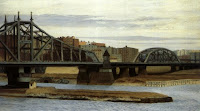
Like New England's conservatism, New York's massive impersonality and anonymity may have filtered through to his paintings. One critic noted that New York City has "often served as a symbol of the nation as a whole."

Hopper's studio was in a building that is now the offices of New York University's Social Work Department. NYU took over the building near the end of his life. Jo wrote, "The war of Washington square is going on. …nefarious NY University has obtained a lease on our house and is trying to throw us all out [from] where everyone has turned up at one time or another: Eakins painted a portrait, Paderowski gave a recital, Dos Passos wrote Three Soldiers, Guy Du Bois, William Glackens, Ernest Lawson, Eleanore Mylie, Frank Harris, The Dial born in the first floor, etc." But Hopper managed to live there until the end of his life in 1967, and Jo died in the apartment the next year.
I nervously asked the co-ed at the front counter whether I could see the studio, and she sighed with the world-weariness of a New York cop, "Take that elevator to the top floor; studio's on your right." The elevator seemed old enough to be from Hopper's days, though they didn't have one, which Jo so lamented that she immortalized it in a picture titled 40 Steps up to Chez Hopper.
The room had the Spartan, light-filled feel for which Hopper's paintings are famous. A huge slanted skylight sifted sunrays onto the white plaster walls and bowing wooden floor slathered in gray paint.
Here, out a sooty back window latticed with black wires, lay the view that he immortalized in paintings like City Roofs; My Roof; Skylights; and  Roofs, Washington Square. Here, dominating the studio's front room, squatted his huge printing press through which he rolled the etchings that launched his career, and here also loomed the ten-foot-high easel built by Hopper's own hands shortly after moving in here.
  This top-story studio was a perfect perch for a voyeuristic painter like Hopper, and here out the front windows remained the view of Washington Square that he painted in his canvases Shakespeare at Dusk and
  November, Washington Square. Maybe he used people he spied below in the park or sidewalks as models for characters in other paintings.
Here also huddled the tiny fireplace, untouched, above it a portrait of Hopper by Jo.  And here, in a little nook between the back and front rooms, sat a dorm-room-sized frig and zinc sink. A tiny decrepit oven rested behind the other door. These appeared to be the same appliances as were left there when Jo died.
 As soon as I stepped into the front room, a stubby woman with curly gray hair blocked my path and glared at me through her oval spectacles with her hands on her hips. "What are you doing here?" she barked.
"Researching a book on Edward Hopper," I stammered.
"Well, I have an issue with you being in here. I'm meeting with a student. Who said you could be here?"
Taken aback, I blurted out the last in the string of people who had told me it was OK. "The receptionist out front." Almost immediately, I realized my mistake.
"Come with me," the stumpy academic said, like a third-grade teacher curling a finger before her eye, and we marched back out to the Latina in a silky orange mini-skirt working behind a shoulder-high brown metal divider who had pointed me to the studio.
"No one is to be allowed into that room when I am having a meeting with a student," the older woman chastised the younger. The trollish social worker waddled on back down the hall, and the Latina receptionist shrugged.
The NYU takeover of the studio was complete.
The Whitney grew out of the Whitney Studio Club, begun in 1918 by Gertrude Vanderbilt Whitney, who championed Hopper. Jo jealously felt Gertrude had other designs on Edward, too. He became one of the earliest members, and in 1920, the club gave him one of his first one-man exhibitions. Reviews were underwhelming. But the Whitney made his Early Sunday Morning one of their first purchases. They also sponsored a nighttime studio that the poor bachelor Hopper could attend for free to sketch nude models. (The woman in charge of the classes said Hopper never missed one.) Hopper remained devoted to Gertrude and her museum throughout his life. He said, "I guess they considered me a safe man to deal with."
On the Whitney's second floor, in a white-walled room whose hardwood floors resounded with heels clacking like cue balls, I stood in a gallery devoted solely to Hopper's paintings. Here were  Seven A.M.: a storefront eerie in the thin morning sunlight;
  Early Sunday Morning: "The most famous row of windows in American painting," Hopper's biographer Gail Levin rightly notes;
  South Carolina Morning: Hopper's only painting with an African-American character;
  A Woman in the Sun: a merciless depiction of a nude woman having her morning cigarette;
  Second Story Sunlight: a disorienting view of a second-floor balcony holding a buxom young girl and an older woman; and
 Cobb's Barn and Distant Houses: a Cape Cod landscape.
It was like entering a different land: Hopperville. The sun is always brilliant. Houses are kept immaculately in the era in which they were built. No words are ever exchanged. People do normal things like eat, go to theaters, work jobs, and lie on beaches. But they never seem happy about it. They almost seem not to know why they do it or even that they are doing it. Occasionally, you glimpse the neighbors. But mostly when they don’t know you're looking. You hang inside, too, and hope nobody finds you here, on the lam from a crime you committed somewhere else and long ago. And a boat always stands ready in the harbor to steal you away.
Everybody knows somebody who lives in New York. And I arranged to meet my friend Julia, a poet and painter from the Bronx who I met through my brother, Irish. One day at work, a young co-worker had a bad headache, so Irish drove her to the emergency room. She died that night from a condition so rare that the doctors claimed she may well have been the only person in the U.S. to die from it that year. That co-worker was Julia's daughter, and at the funeral Irish gave her my number as a fellow writer. We traded e-mails and phone calls for three years, but I had never set eyes on her before our meeting at the Whitney lobby.
I spotted her exactly how she said I would: "I'll be the only one wearing a big white floppy hat." Julia had the big unjudging eyes of a deadpan comic and a narrow face, sanguine and brown, that reminded me that she often mentioned her immigrant Italian parents. I sought out her thoughts as a painter about the Hoppers.
"You get a sensation of being alone," she calculated about all the Hoppers in the gallery. "In Early Sunday Morning, you would know all of the shop owners. It's a town we all recognize, and you can still find hints of it in our cities. I grew up in this place. But I wonder: will the next generation have the same response?"
Julia noted about Second Story Sunlight, "You can't be seeing the house from where you think you're seeing it from. You're raised up. So we're standing in a building across the way in the second floor leaning over our own little balcony. He moves things around to make the paintings work." She shrugged and added like someone who has done the same for her art, "You make things up in order to make it right. That's why the painting is on the wall there in Woman in the Sun. Your eye makes sense of the light falling equidistantly from that painting. It doesn't read as incorrect that that painting's the source of light. There's something so wrong about it and you wonder, 'well what is it?' Everything is just wrong about it. This is not a facial expression," she concluded about the woman in the sun. "But it tells you about her," she nodded slyly, "It tells you a great deal."
"We're in town to study these too," she cooed. "I'm supposed to give a mini-lecture in conjunction with a film about him at the art institute in Kalamazoo. We had a visiting curator, and he boldly titled his lecture, 'The Ten Most Significant Paintings of the Twentieth Century,' which of course is the way to get yourself into trouble right away. He picked Early Sunday Morning as one of them. He talked about how it was American Realism, but it bridges to more abstract ways of looking at things.
"I was just saying to Tom that, 'cause I've seen them mostly in reproductions in glossy books, they look much harder, less painterly. I think Hopper always kind of goes, 'unh'." She makes a fist to show how solidly Hopper places his shapes.
Tom finally jumped in, "The way in which he placed things is so much more sophisticated. It's like the way the Orientals look at balance. He has such big spaces that are not busy. You have maybe two main figures. It's difficult to achieve balance with such big spaces. There's a confidence in his drawing, and drawing is so important. They [Hopper's paintings] really open up the more time you spend in front of them."
The woman frowned, "There's a very old film interview with him. He totally sounds like he's inarticulate. But he isn't; he just doesn't know what to say. Maybe one of the fascinations with him is that he's such a mystery. In America, we don't like that much."
"I'm no expert," he shrugged when I asked about the paintings. But when I clarified that I was interested in how they related to New York, he exclaimed, "That's my town! A little different than Hopper's towns." He spoke with the clipped phrases of an entrepreneur spouting business aphorisms. "That's very New York," he asserted. "Claustrophobic."
I pointed to Early Sunday Morning. "That's Seventh Avenue."
"New York?! If it is, it's not there any more."
"Do you feel people in your community are isolated like these characters?"
He screwed up his face. "Contrary to how it might seem, New York is kind of a lonely place. Despite being around people constantly. Generally it's got a neighborhoody feeling--possibility of. I don't think of Hopper as really gloomy. I guess they do seem isolated, but you get the sense of a community somewhere around them. Seems that there is an environment around them of people, and that's what they are isolated from." He bobbed his head goodbye and bounced off to the next gallery.
"Can I ask you about these paintings?" I asked.
"About Hoppah?" Used to having her opinion solicited, she continued without waiting for me to confirm. "Lonely. Sad. You kind of find yourself in the middle. And that's hahd in any situation. The middle…," she paused for dramatic effect and demonstrated with her hands, "opens out." Then she flicked a smile and stalked out. No one walked into the gallery for a while, so I approached the security guard. He had a long, gaunt face the color of burnished teak, and he answered enthusiastically with a slight accent. "Everybody loves Hopper. I hear people comment. That woman," he whispered conspiratorially, pointing to Woman in the Sun, "was his girlfriend. She lived in Europe. That was why Jo was so jealous. Jo didn't like him to use other women so she posed for him." This is an interesting theory, but by all accounts Jo herself posed for all Hopper's figures.
"When we had the big show of Hoppers, we had like a half a millions [sic] people come here for that. This guy [Hopper], he gets visitors from all over the world. Everybody that comes to New York wants to see Hopper. They got this tourist book comes in different languages, right? And they look at Hoppers in there, and I have to tell 'em, 'what's in the book is not out.' They get very disappointed. They say, 'Boo hoo. Where's the Hoppers? No Hoppers?! Boo hoo.'"
Directly opposite the elevator back to the lobby hung Hopper's Soir Bleu, an early work from his days in Europe that shows garish revelers in a Paris bar. In 1907, Hopper wrote to his mother from Paris of the Carnivale "the broad sun displays their defects--perhaps a neck too thin or painted face which shows ghastly white in the sunlight." Though painted before 1922 and therefore not on my list to study, Soir Bleu emerged from the pile of paintings inherited by the Whitney as one of Hopper's more popular and significant works.
An older couple stood discussing it. He was appareled in a tie and coat, and she flaunted a long elegant dress and flashes of diamonds on her wrists, ears, and heart. She also bore a badge saying, "Volunteer." I told them of my project, and she raised an eyebrow.
"Oh, you're a writer? What have you done?"
"A couple hundred book reviews, film reviews, travel pieces, cultural commentary…"
"Oh," she cut me off with a flick of her wrist, "you've done nothing yet. Where have you found the most Hoppers?" she wanted to know.
I may have done nothing, but I had done some research. "Well, your institution received the Hopper estate, so naturally they have the most in their collection."
"Really?" she squealed. "For the longest time, we didn't have any Hoppers up. I'm at the membership desk downstairs and people would come specifically and say, 'Where are the Hoppers?'" Turning to Soir Bleu, she pontificated, "The clown is very lovely. And the blue in the sky: the night we went out on the roof of our hotel and looked out over Montmartre, the light was a little like this. I can't believe so many people say he did the same thing over and over again. You go and see the repetitiveness of some modern artists. I'm just sick of people talking about Hopper's paintings' loneliness. Because that's not the big thing."
Her husband interjected, sounding like a British military officer from an old-time film. "I'm interested more by the drama."
She steamrolled over him, "I don't think you really say, 'what is this woman thinking?' I really don't care. The woman's just another element there for balance. So many pictures I look at, I just want to add something to. But not Hopper."
"He's a great composer," I commented.
"He is a composer," she chipped, surprised by my word. "This is music."
"The music of the spheres," the man declaimed, pleased with his cleverness.
"No," she undercut him. "Music of the rectangles."
I went down to the lobby to meet Julia for our farewell. As I waited, I stood next to a person I recognized from photos but couldn’t place. Then I realized: the photographer Annie Liebovitz! I did not think quickly enough, but I should have pretended to have no idea who she was and asked her to take my photo since I was alone on vacation in New York. When Julia arrived and I told her my idea, she rightly noted that Annie probably would have found an excuse to decline. But for a while I had hopes of receiving the cheapest Liebovitz portrait session ever.
Julia had proved as charming and New York brassy in person as in her e-mails. And her practical understanding of how Liebovitz would have dealt with me was something only a New Yorker would think so quickly about. In fact, seeing Annie was part of the charm of New York: celebrity seeking. But I was seeking Hopper. And normal people's thoughts about him. Enough attention has been paid to celebrities and their opinions.
Though an average person, I was made to feel a celebrity when I visited New York's prestigious Museum of Modern Art (MOMA). When I called to arrange a viewing, I was told that their Hoppers were all in storage; the museum was given over to a series of installations in the galleries. My heart fell. "Did you want to see them in storage?" the voice on the other end of the phone asked. "I was just about to ask that," I answered. The idea had, of course, never occurred to me, but I wasn't going to turn down the opportunity.
Susan, the woman who escorted me to storage wore a black turtleneck beneath a black-and-white checked coat, and her short black hair formed a shell around her head. Above her round cheeks, dark eyes bugged out due to her glasses' thick lenses or her infectious energy. "Take as much time as you need," she said cheerily on the elevator.
We made our way back to a space that reminded me of my college theater set-building shop. Twenty-foot-tall white walls led to a concrete ceiling humming with fluorescent tubes recessed in trenches. The racks of works that lined the back wall were like an index to twentieth-century art.
"Is that a…?" I began.
"Warhol, yes," Susan said offhandedly.
"And?"
"Yes," she assured me, "Rauschenberg."
We ignored the hundreds of museum-quality works looking over our shoulders to focus on the Hoppers that had been pulled out of the stacks by a worker Susan introduced as Elizabeth. Elizabeth wore blue jeans and thick-soled black shoes. Blond disheveled hair straggled down to the shoulders of her black sweater. When she learned I was from Chicago, she said that she grew up in Wicker Park, Chicago's Polish neighborhood.
"Are you Polish?" I asked.
She merely whipped off her black oblong glasses and leaned her face into mine, as if her craggy nose and strong jaw were evidence enough.
Elizabeth had placed two of the Hoppers upright on a cart and hung two others on the wall. This surprised Susan as being beyond the call of duty. The paintings were House by the Railroad, Gas, Night Windows, and New York Movie.
Hopper's  House by the Railroad was the first work to enter MOMA's permanent collection. It shows a house that the Addams Family might have lived in, and Norman Bates did: Hitchcock allegedly based the house in Psycho on this painting. Hopper's image of a hulking white house looming out of a featureless landscape above railroad tracks is also supposedly the source of the houses in the movies Giant and Days of Heaven.
Gas  shows a bald attendant in tie and vest fiddling with bright red gas pumps silhouetted against the evening sky that makes the tiny white boxlike office glow like a Swiss cheese lit from within. Jo said Ed was after "an effect of night on a gasoline station. He wanted to do one for years."
Night Windows  shows the backside of a woman in a hot pink slip glimpsed through a second-story window in a brightly lit room behind a dark urban façade at night. Sharing the room with her suggestively are a corner of a bed and a radiator.
 New York Movie I did not know of before starting this project, but it is a Hopper masterpiece. A contemplative female usher stands bathed in lamplight at the back of a movie theater. A stairway beside her leads up. (A punning "Ascension of Mary?" Three glowing lamps above her head mimic halos). She upstages the murky film on the screen behind her that everyone in the audience watches. Only viewers of Hopper's painting see the real drama, which is her in the theater. Not only is the film image on the screen a New York movie, the scene as a whole is a New York movie, and the usherette is the star.
"This is great," Liz raved, "getting these out. We never get to appreciate them because we're always processing them. I certainly love him as a painter. He's so much a part of our training, as American artists. He's part of the pantheon. These are like flash cards. This gal in New York Movie: I've known her since I was a kid. It was such a surprise for me to haul it out again. I really like the fact that when they're on the wall, the paintings maintain their scale. I really think that's something nice about Hopper: his paintings have an internal scale based on a certain kind of looking. In installation, they appear bigger. Their impact on the viewer really does magnify them. "
"Are the Odilon Redons gone yet?" Susan interrupted.
"They're just packing them up now," Elizabeth replied. "I'd love to see them, but what about him?"
They eyed me for a moment. "We'll have to take him with us." I mentioned that I had just seen a Redon show in Chicago, and Susan boasted, "I bought tickets to that, then I broke my foot. But I still flew to Chicago and hobbled around that show because I was not going to miss it."
Whereas I was banished from Hopper's studio, at MOMA I ended up getting a private viewing of not only the Hoppers, but also dozens of gorgeous Redons.

MOMA Nowhere

MOMA has other classic Hoppers that I didn't see that day. Railroad Sunset shows a railroad station's black outline looming in front of a sunset that traipses down the spectrum colors: robin eggs, fires, lemons, mints, and plums. MOMA Front [Hopper's East Wind Over Weehawken] Purchase, New York: Barber Shop Armonk, New York: When is a Painting not a Painting? New Haven, Connecticut: Gown and Town [Yale Dorm] [Yale Theater] Boston, MA: Very Very [Granary grave] [Andover school green] [Andover Town Hall] Northampton, Massachusetts: Pretty Penny [Sylvester's] Williamstown, Massachusetts: Morning in a City [Williams College art museum] [Williamstown in a postcard] Manchester, New Hampshire: Bootleggers [Andrew Wyeth, Braids (A Helga Portrait)] Brooklyn, New York: Macomb's Dam Bridge Montclair, New Jersey: Coast Guard Station [Montclair Art Museum] [Downtown Montclair] Newark, New Jersey: The Sheridan Theater [Newark Museum] [Newark Today] West Palm Beach, Florida: August in a City Cincinnati, Ohio: Prospect Street, Gloucester [Lockland, Ohio, my ancestors' hometown] The Bar I Visited Dayton, Ohio: High Noon I was reminded how polite and deferential Daytonians were when I stood in front of the painting to interview people and no one came over, as if only one person at a time were allowed to look at it. Finally, I approached a blond ponytailed girl. She wore a white T-shirt that said the name of her college and "2001 Australia." Every other cloth that she wore was also white: shorts, socks, and shoes. Her striking light blue eyes were upstaged by crooked lipstick beneath. Downtown Dayton, Days Gone By [Dayton Malleable Metal Factory] In the far corner of the narrow room hummed a cooler filled with Wild Irish Rose bottles and Busch beer cans. The man next to me sported a cheesy toupee. Down from us sat a gray-haired African American guy, wearing a floppy black Kangol hat. The cook made it four single males in the diner. Written in white chalk on a green board was a sign advertising the "Tyrone Special:" a pork chop tenderloin with gravy, parsley potatoes, buttered corn, and bread for $3.89. Toledo, Ohio: Two on the Aisle [Toledo Museum Wing] [Toledo's Terminal] Columbus, Ohio: Morning Sun [Candy Buckeye] [Ohio State Capital] Cleveland, Ohio: Hills, South Truro [The New Arabica] [Little Italy's Church: Holy Rosary] [Shaker Square] Youngstown, Ohio: Pennsylvania Coal Town Youngstown, Ohio: Pennsylvania Coal Town [Butler Institute of American Art] Pittsburgh, Pennsylvania: Cape Cod Afternoon [Carnegie Museum of Art] [Mount Washington funicular] [The Strip] [Me About to Cross the Mississippi] Des Moines, Iowa: Automat [Des Moines Skywalk] [Redheaded Beauty by Victor Lysakov ] [Java Joe's] [Fort Des Moines] [photo from my car driving to my hotel in Des Moines] Lincoln, Nebraska: Room in New York Wichita, Kansas: Conference at Night [Wichita Art Museum] Kansas City, Missouri: Light Battery at Gettysburg [Nelson-Atkins Museum] [Kemper Museum of Contemporary Art] [New York Life Insurance Building] Las Vegas, Nevada: Hotel Window [The Bellagio] [Rodin's Gates of Hell]
Also missing was  Office in a Small City, which shows a man sitting at a desk staring out at his office window. His dazed expression and slack posture suggest that he has no idea how he got to that desk job or how to get out. The huge square windows on either side of him ape huge blank eyes, glassless and vacant.
"Hopper's one of my favorites. He gives me actually a very nostalgic feel. I find in him a innocence. They seem to bring back a calmer, more peaceful time, a time that unfortunately is gone. One picture I really love: Sunday Morning. I know that it's supposedly down on Seventh Avenue near St. Vincent Hospital, but that to me reminds me of the house that I was born in in Manhattan. I was born in 1940. When I was very young, we used to go out to Long Island on Saturdays and Sundays for shrimps, and I can remember the Mobil sign, and the flying Pegasus like he's got in his paintings [Gas]. There is also the lady at the cafeteria all by herself [Automat  ]. I've done that. I've been by myself in a cafeteria just having a cup of coffee. Or sitting at the end of a counter at night. I love New York at night. And in the rain. He really captures that feel."
 The Metropolitan Museum of Art lobby roiled with babbling rising up to the vaulted ceiling and people wearing ethnic costumes like in the U.N. across town. I asked the East Indian woman in a smartly cut business suit behind the information desk, "Where can I find the paintings by Edward Hopper?"
"I don't know who he is."
"A famous American painter."
"Go up to the American wing."
There, I asked a stocky, gray-haired Slav wearing a gray suit trimmed with ornamental braiding that made him look like that most New York of occupations, a doorman, which gallery had the Hoppers.
He raised one bushy eyebrow. "He's not here. He's over in Twentieth Century."
"The woman at the front desk said he would be here," I explained.
"Do me favor," he said curtly. "Go back to front desk and tell woman she is donkey."
Ahh, New York charm. That's what I came here to find.
The Hopper paintings I came to find were Lighthouse at Two Lights, perhaps the pinnacle of Hopper's series of lighthouse paintings;  From Williamsburg Bridge, which shows not the bridge from afar as the main subject of the painting, but three nondescript building tops as seen from the bridge; and
  Tables for Ladies, in which a waitress leans forward into a restaurant display of grapefruits as perfectly yellow as her blond head or round as her breasts falling forward into her uniform. The title comes from a sign common in the early 1900s. Before then, a woman alone in a restaurant was most likely a prostitute. But, as single women increasingly came to the city to work, restaurants put up such signs to let women know they were welcome and men know the women were not soliciting. Hopper said of the painting, he "wanted the vulgar color of cheap restaurants." In detailing the life that she and Hopper dreamed up for the characters, Jo called the "very blond fine looking waitress all in white" "Olga." The cashier was "Anna Popebogales," and "Max Scherer and his wife Sadie" sat at the table in back.
I was joined in front of these three paintings by a thin older woman wearing cat eye glasses whose erect neck trembled slightly. Her bearing and glittering watch and earrings gave the impression that she wore a diamond tiara. She answered me with a little girl's voice, made even quainter by her soft "r"s.
"Do I think Americans are isolated? Not today. We're thrown with people all the time, unless you're a writer or something like that. But I think there's a strong identification with that isolation in his paintings. It certainly touches a node that you can identify with. And also the time period: things were so simple. You could see a simple lighthouse and building and not be surrounded by McMansions or billboards. I mean, Long Island, you know, doesn't look like that any more. So I think there's a kind of sentimentality in that scene. In that, 'These were the good old days.' This is not the way things look at all. But it captures the mood that he wanted to capture. Also there's a sensual element in this one [Tables for Ladies]. This very lovely young woman leaning over, very suggestively, is really the center of the picture. You have to go hunting for the tables."
After her, up walked a young Asian woman and a rugged man with a papoose in which a tiny baby slept on his chest. The man had earnest blue eyes, and wore a diamond stud earring. His thin lips pursed above a firm, blond-stubbled chin. The diminutive woman had flawless skin and wore her hair in ponytails. She was from Tokyo; he was from Louisiana.
"I was [in New York] for a conference," he explained, "and we extended our stay so we could see some museums."
She declared, "Hopper's one of my favorite painters. It's the light and the drawing. You know it's him. And that's a really hard thing to do. His human figures are more like landscapes, like mountains and trees."
He countered, "I like Edward Hopper because there's a static, cool quality, a lack of passion, even when you're looking at something that's full of life. He freezes the moment perfectly. In the lighthouse one, it looks like August, which is a good time of year, but also I'm feeling, 'Summer's going away.' There's something darker coming. It's funny because August is so oppressively humid and hot; people are just desperate for summer to end. And it's more like there's an eagerness and anticipation that in October there'll be a respite."
"There are times that you look at how light plays against different objects at certain times of the day, and you isolate. You say, 'Oh my god. I would never believe that if I saw that in a painting, yet there it is in actuality.' I mean, there are times that I look at the sunset, and I think, like with that sunset section in the painting [Lighthouse at Two Lights], 'My god, there's green and purple and everything sitting side by side.' And yet there it is."
Laurie, a New York theater director married to Sean, one of my many Northwestern theater major friends who moved to New York after graduation (and herself now a friend of mine as well), agreed to meet me to the Met and offered some direction on interpreting Hopper.
"The most honest thing an artist can do," she began, "is present something. Hopper simply presents us with an image, but we're left with all of these emotions. He's a very pleasing painter, but he's obviously manipulating you somehow. Look at From Williamsburg Bridge. The tallest window is the one that has the person in it. He's not just saying, 'Here's a building.' He's trying to lead your eye to that person--who you can't see on a postcard reproduction. That's why you go to see Hopper's paintings in person."
"You could say," she continued, "Lighthouse at Two Lights was a film set and instead of sunlight those are klieg lights broadsiding it. The director said, 'Make it look like autumn.' You can tell the exact rolling nature of the hill in Lighthouse at Two Lights: where there's a dip, etc. You also get a feel for the wind. I can see all this but I couldn't do it. Like I can't swim but I can teach you how."
What can you say about New York that it hasn't already said about itself? This is one city that I won't even try to summarize. New Yorkers love it here. And hate it. And they know the rest of the county hates it. And loves it. Where else could you come for so much culture in one city? And where else could you walk down a street and have a thief crash through a storefront window and take off down the cross-street, as happened right in front of me that day? The best and worst are distilled in this pressure cooker of a metropolis.
As the security guard at the Met showed, not even fellow New Yorkers are spared the wrath of New Yorkers. On the other hand, New Yorkers aren't as ornery as they're often made out to be; they've just seen everything. If you entered an establishment panicked because you had been shot, it may be your first time being shot, but it's not their first time seeing a shooting victim. So they seem to you not to care enough.
Of course, New Yorkers softened somewhat after the WTC attack, but like everyone else they soon went back to their old ways.
"Americans are probably more isolated than they want to be," she asserted. "A lot of people don't really like being alone. I don't mind. It's a good thing to be able to hang out by yourself and not freak out. A lot of my friends, they won't even go to the bathroom by themselves, much less go to the movies or out to dinner. America is not like how Hopper shows it. The mainstream, they need people: they need the constant stimulation from people, from TV, from radio. I could sit in a room quietly with a book, but I have a friend who'll talk on the Internet, watch TV, listen to the radio, and talk on the phone—all at the same time. Talking with somebody online when they're sitting at home by theirself is way different than going out to eat with somebody or going to the movies because, although you're talking to a person, you're not really 'talking' to a person. You're writing letters: really short ones, with really quick response time, but it's not anywhere near the same thing."
About Hopper, she noted, "You can always recognize his paintings. Some of his paintings, nobody looks happy. But nobody looks glum, or on the verge of doing anything awful. In each painting, the emptiness is always dark, and wherever the person is is always light."
I looked outside our lit room at the early fall night, already pitch black. We were exactly situated as she had just described.
"We might be a Hopper subject right now," I told her, "and we're sitting around the corner from a real one. On the bus ride back from the city, I saw the house along West End Drive that Hopper had painted in East Wind Over Weehawken.  That painting is in Philadelphia."
"Will you see that one?" she asked.
"I'll see them all," I answered. The Whitney has not only the most paintings by Hopper, but also one of the largest collections of information about him in their library. I had naively thought that I might be able to look through Jo's journals and decide for myself what portrait they painted of Edward. But they had been sold to a private person, which I would not find out until the very last city I visited. I did discover that every museum has a file related to each work and each artist in their collection. These files became the source of much of what I learned about Hopper and his paintings. I was starting to become as curious about who Hopper was as I was about who the American people were. I was surprised that much of what I found had been overlooked by art historians and critics.
I found in one museum's file a "new" Hopper (OK, technically, a note written in his distinctive handwriting). I found personal letters from Jo and Edward, or even just from museum-goers, that offered back story on Hopper's paintings. One museum's file contained a curator's chart clearly showing how Hopper's perspective lines (those "train tracks"  leading to a single point where all items in a painting vanish) converged at different places, disorienting the viewer slightly and visually isolating each subject in his paintings. Julia was right: he got things "wrong" to get them the way he wanted.
I had learned from my painter friend Bruce how an artist sees and thinks.  Whereas viewers may see scenes of isolation, an artist sees compositions, colors, lines. They are concerned with the realities and restrictions of putting gooey pigment onto a flat canvas and trying to represent an image of meaning to others. Painters divide a flat, two-dimensional surface into a tic-tac-toe board. Putting important elements where the lines intersect leads to a balanced combination. Bright colors take more of your attention than dark. Think of having to balance a see-saw with a small red ball of heavy lead on one side and a big blue balloon on the other.
  Shapes also demand balance. For example, a downward triangle at the top of the canvas would be balanced by an upward one at the bottom.
Color is ultimately what makes all of these trompe l'oeil effects trick you into seeing three dimensions on two. Color theory is a deep subject worth looking into if you admire art, but basic concepts include complementary colors and cool and hot colors. On a color wheel , the primary colors are red, blue and yellow. Their complementary colors are directly across from them, a combination of the other two primary colors. Hot colors often contain red, while cool ones contain blue.
Having visited the two cities (DC and New York) that combined held nearly half of the Hoppers I needed to see, I began to notice more Hopper's artistry and less his isolated scenes and characters. Many consider his compositions some of the finest in 20th-century art. Hopper divided the canvas into thirds and put important elements of the composition at the lines dividing the canvas into thirds, either vertically or horizontally
 . Hopper also connects these thirds by having one element span all three, like this lighthouse.
  Hopper's paintings are textbook examples of simple, well-balanced compositions. Turn his paintings upside down; they still look balanced.
Hopper often put part of an object in the foreground (at the very bottom). This gives you a visual element, an anchor, from which you can read the "depth" of the rest of the objects in the painting. It also adds to the feeling that you are in the painting and in its drama. You might be standing on these stairs at bottom left. 
Hopper often inserts "ladders," a series of horizontal lines that lead vertically. In  Room in New York, that seems to add to the feeling that the characters want to crawl out of their situation; they could use either the door or the window. A museum worker also noted that these ladders look like film cells. The windows in other paintings not only look like they are framed by film sprockets, but also seem to be viewed in the fashion of one convention for movie beginnings in the 1920s, where the camera floats to a window and then (magically, it would appear to an audience of that day) enters the room.
Some of his paintings have visual puns or implications: a radiator, fire, and bed in a room with a woman in her slip in  Night Windows; a row of round fruits by a buxom waitress leaning forward in
  Tables for Ladies; a banana and a bowl of red fruit behind a lone woman in
  Automat. A piece of paper on the floor in
  Office at Night begs the question whether the woman in the tight skirt will bend over to pick it up. Someone said that the Christmas (EX-MAS) lights in
  Drug Store (EX-LAX) look like enema bags and that the pennants in the window represent port and starboard flags on a ship.
Some forms in his paintings look like other things: the foliage in Hills, South Truro mimics the shape of a dog with a tail up and mouth open  ; a hill in Camel's Hump resembles an alligator's head
  .
.
His titles often included puns, too; Two on the Aisle was painted right after he got a married and could be read as "Two on the Isle" (a record I found in the museum's files actually spelled it that way). Morning in a City could be "Mourning in a City" as the woman is alone, and the painting was done during World War II. Thus, Morning Sun might be read "Mourning Son."
And then there are those "mistakes" Julia pointed out. Columns lead nowhere and office walls end before the ceiling  ; doors are unnaturally high
  ; beds are too small to sleep in
  ; shadows fall longer than possible
  .
.
The glass in is paintings never has reflections.  This is how we think of glass, but not how we actually see it. Windows paradoxically provide a physical barrier but a visual opening. Similarly, we look past the clutter of streetscapes, though they usually have people, cars, trash, and even kiosks. Hopper's scenes don't.
His characters' faces are indistinct.  They are not meant to invite narrative or musing about their lives. But this backfired, as their very anonymity or isolation is what makes people yearn to know their thoughts and feelings.
 There are no Hopper paintings in Nyack, New York, just north of New York City and across the Hudson River from wealthy suburban Westchester County. Rather, there are several, but none that I needed to see. The ones here were from very early in his life, and they hung on the walls of the home in which he was born and in which his older sister Marion lived her whole life. The house was scheduled for demolition, but locals stepped in and made it a museum. Today, the artist's birthplace is itself a work of art: Hopper House is on the National Register of Historical Places.
Just as Hopper's paintings make us think of a time gone by, the house is definitely of a different era. Originally built in 1858 by Edward's mom's dad, Hopper's father Garret moved in after marrying the owner's daughter, Elizabeth Smith, in 1878.
Some aspects of the house looked like elements from houses in Hopper's paintings: green full-length shutters on white clapboard siding. Broad planks of blonde wood covered the floors, and white plaster moulding outlined the ceilings. A steep imposing stairway barreled down into the front door. Mounted over the fireplace was one of Hopper's paintbrushes, a gift from one of his friends. Nothing on display here was donated by Hopper himself. He didn't much care for Nyack.
The room to the right of the front door was added when Edward was born and now held the reception desk, where a smiling blond woman in her sixties sat talking to a square-jawed young man who held a motorcycle helmet. The women introduced herself as Pat. The man never gave me a name, but said that he was an actor in New York City who had come up to Nyack for the day.
When I told them why I was visiting, Pat gushed, "People in Nyack aren't isolated. In Westchester, yes, people are isolated. We moved from there because we wanted more of a feeling of community. Neighbors said, 'Nyack! How the hell do you get there?' You know, to them, when you're talking over the river, you're talking another world."
About Hopper's work, she frowned, "It can be, I think, overwhelming."
"I just think Hopper's the greatest," the actor dove in. "There's so many layers of isolation, physical as well as emotional. The idea of people living in proximity over the course of an entire life, whether married or a family or a small town. The internal estrangement, the not-understanding, and the existential isolation. I've experienced that my whole life: the idea of being around so many people but being alone."
"Part of what I see Hopper saying," he raved, "is, 'America is so big, I'm just going to show you this small part.' Even if it's just a piece of a train track so there's the idea of distance or travel or something that can't be captured. People tend to want to attach certain events in Hopper's life to the ideas in his paintings. But when something becomes universal, it really has to stand on its own. When you turn to exposition, intuition evaporates: those things you're not defining but you are experiencing get lost when you try to formalize it in language. My dad was an artist for the first part of his life, but now both my parents are classical musicians."
"No wonder you're a thinker," Pat nodded.
Someone stopped in and asked Pat for directions to a local business. At this break in the action, two short, round-faced women approached me from the gift shop.
"Can you tell us which of these prints looks more like the real painting?" one asked. "We heard you say you were writing a book about Hopper." They showed me two posters of Hopper's  Rooms by the Sea. I pointed them to the one that was paler, in general a good bet: Hopper's paintings in person have a thin sheen of paint that is almost see-through.
They introduced themselves as Maria and Leslie, sisters. Maria was shorter and pregnant. She wore glasses and spoke in sweet little-girl tones. Leslie was taller, with round shoulders and a husky voice. They said they had to leave right then but offered to address my question later that night at Maria's house after dinner.
A card on Hopper House's front desk informed me that it was the one hundredth anniversary of actress Helen Hayes's birth year. She lived just a few houses north on the other side of the street in a house she and her husband playwright Charles MacArthur called "Pretty Penny."
At the urging of his dealer Rehn, Hopper painted a canvas of Pretty Penny just before World War II. It was the only work he ever did on commission. Pretty Penny (now in the collection of Hayes's alma mater Smith College in Northampton, Massachusetts) was also painted on the spot, whereas Hopper almost always painted from memory in the studio. When I saw the house that day, the front yard's pine tree prominent in Hopper's painting was noticeably bigger. It had also been joined by a line of other pines and a high brick wall with security gates and cameras to thwart prying eyes.
Pat at the desk had told me, "Story about Pretty Penny was that Helen and Charlie were looking for houses here, and they called it Pretty Penny because it cost so much: $38,000. She threw great parties and gave everyone who came a rose. Rosie O'Donnell just bought it for one or two million. She owned all the way to the river, and she sold off to the river. The town wanted to have a historic district and she really didn't want it. She would not allow people to come down to the river." Down the street from Pretty Penny sat a house where Carson McCullers, author of award-winning Broadway plays like Member of the Wedding, had lived. The house is a worthy subject for Hopper, with gables, bay windows, and a mansard roof. As I regarded it, a station wagon parked in front, and a woman got out carrying a load of laundry. I asked if she lived in town, and she said she lived in the house.
"People in Nyack aren't isolated," she insisted. "Just the opposite. We moved here because it's got such a thriving nexus. It is Main Street," she concluded, and took the laundry inside.
While I waited for my evening date at Maria's, I investigated Hopper's hometown.
A huge, horrific condominium had just gone in on the waterfront down the hill, and development was rampant farther from the river, on the road into town from the Interstate. Otherwise, Nyack was still in many ways a quaint river community centered on the business district up from the docks. The Broadway and Main storefronts provide a gathering spot, and on the mild Fall Saturday that I visited, they were overrun with bikers, either motorized or self-powered. Garret Hopper was a dry goods dealer, and that storefront still stands on Broadway.
I ducked into one of the three used book stores on Broadway. The owner bore an intimidating stare that felt like he had been cultivating his whole life. He told me that he chose his college because "my high school counselor pulled me out of class and wanted to know why I wanted to go a place so liberal and activist. That only made me want to go there all the more." Actually, he spoke with the aloof tone of a high school counselor as he told me about local Hopper lore.
"The storefront that Hopper used in Seven A.M. is at Broadway at the corner of School. I used to have that shop. A local minister received when Marion Hopper died a series of paintings on wood shingles that were said to be by Edward. They were just awful. They were unsigned, but that's what they were. I told Gail Levin this and mentioned that they were in a shop up on Franklin Street, and she was out of here like a shot. She didn't believe me about my former shop being the one in Seven A.M. But she did go after those paintings."
I went to see for myself the storefront that might have been in Seven A.M., and I have to admit it looked very like the one in the painting.  But there's a danger in trying to find a one-to-one relation between something in art and something in real life.
After my tour around Nyack, I made my way to Maria's, where she and Leslie and I were joined by Maria's husband, Grey--a lanky fellow with a balding forehead. He wore a yellow oxford shirt and punctuated his resonant speech with a sharp laugh and a forearm shooting upwards. Pregnant Maria sprawled on the couch beside him, while Leslie and I parked ourselves in separate chairs opposite.
"What you are doing has very few precedents," Grey said, "What'd you call it: 'anthropological art criticism?' It's that--slash--travelogue--slash--Working by Studs Terkel."
"Exactly," I responded. "I actually graduated from Northwestern with a degree in an obscure major all about oral storytelling: The Oral Interpretation of Literature."
"Ha," Grey roared. "I have a Theater degree from Northwestern."
We gossiped about teachers we knew in common and learned that I had seen a show in 1989 in Gloucester, Massachusetts, that Grey had directed.
Grey continued, "It's almost like this kind of joke Hopper is playing. 'My paintings will hang in all these different towns. And someone is going to come along and have to figure me out by traveling all around.' Hopper didn't stay put. And that was part of his message. 'I'm gonna do urban; I'm gonna do rural; I'm gonna do coast.' People in his day were trying to figure out 'How do I live in the city?'"
Leslie noted, "His rural is never as lonely as being alone in the city."
"But that's the thing about the city and the country," Maria pointed out. "It's dislocation. And that's the American dream, in an odd way."
Grey said, "Hopper's rural stuff is like the country store in Seven A.M."
Maria turned to Leslie, "That's the place where I told you I looked at the painting and said, 'I know that place'."
Leslie objected, "But it's not … true. That cannot be (what do you call it?) 'certified.' Nobody knows exactly where something was painted."
"Hopper," Maria observed, "had a woman that was very devoted to him and that he also loved. He did exactly what he loved in his painting. He had his car, did his travels. He had a house, Washington Square, the most stimulating environment to be in at that time in the whole country, and in Cape Cod, the most empty, beautiful space you could ever want. Wasn't he a really happy guy? Yet the paintings don't depict that kind of euphoria, or even marginal happiness."
Grey said, "Forget about happiness. Contentment is the deeper, richer thing, and you see that in him. Sunshine is pretty happy."
Maria said, "Yeah, but it's kind of missing that soul. The people in his paintings: Where's the spirit? If it's there, it's murky and it's way down in."
Leslie said, "I think he just wanted to record things, moments."
Maria said, "I think he was very Zen, in the sense of that moment, that light, that building, that day."
Leslie said, "You don't have to solve the human dilemma in a painting. You can report or reveal this lonely side of being a human being and isolated, and it doesn't necessarily have to be negative or sad. It just is."
Dear Mike: Well, I've been to two cities, but one was the biggie: New York. Some great interviews and experiences. What a treat to be in a room full of Hoppers after preparing for the trip by studying his works only as reproductions in books or online. I got into his studio! I am not religious, but I occasionally feel in certain places of power that I am surrounded by "beings" ("energies?"). I felt it often in Ireland, my ancestors' land. Well, I felt it in Hopper's studio alright. If Hopper wasn't there, at least his stuff still was: the oven and frig looked like they hadn't been touched since Jo's death. And she seemed to be there, too, inhabiting the body of this academic bulldog who kicked me out before I could see everything I wanted.
I tried to find the place used as a model for Nighthawks and saw only one building on Greenwich with the proper configuration (most likely the original is torn down). The owner was annoyed with me for asking but said he knew the place and his wasn't it. Isn't it just like a New Yorker to know the answer to an esoteric question, but be so provincial as to be upset by an unfamiliar face in his restaurant?
Oh I almost forgot. I got let backstage in MOMA. They took me with them to see some Odilon Redons they were packing to send to a show. It was great to admire art with other art lovers. Not just lovers but experts! I am becoming an expert in Hopper, but also adding a lot to what I already have studied about art history and a ton of other subjects. By the end of this I should be handed an honorary PhD for my dissertation on Hopper and isolation. The problem is which department would grant it to me. Art History? Sociology? History? Cultural Studies? Creative Writing? Oh, well. After hearing of all my interests, this foreign doctor at work called me a "generalist," and I've been flattered ever since to think of myself as the "last great generalist."
I just came from a meeting with a woman and her sister who I met at Hopper's birthplace, and her husband graduated from Northwestern, like I did. The project is opening doors. Let's hope I'm not suffering beginner's luck!
Best,
Kevin
I hoped Purchase would be similar to the road to it off the highway, which rolled up and down other towns' hillsides past large-lawned mansions. But, in Purchase, I came to a crossroads beneath an X of electric wire from which hung a single old-fashioned streetlight. A turn one direction would take me to PepsiCo's headquarters. The other way led to the commuter college SUNY-Purchase. These are the town's only residents. "Nobody lives in Purchase," a SUNY-Purchase student warned me, "except maybe the volunteer firemen."
The Hopper I had come to see was at SUNY-Purchase. I followed the signs to the art museum and found myself driving diagonally across a deserted parking lot the size of several football fields. Presumably on weekdays when classes met, they needed this much parking. But on the Saturday of my visit, I parked beside only a handful of other cars huddled at the far corner near the museum's entrance.
Up a flight of stairs loomed an endless sea of brown industrial brick and concrete. 
Punched into the walls were occasional doors or windows, to indicate "buildings." One of these admitted me to the museum of art. People in chef coats or black waiter uniforms scurried around white tablecloths ringed with fine china that stuffed the lobby; someone had rented the museum for a party that night, the only place in town to gather. Broad, brown iron stairs in a skylighted stairwell led me one flight up to a large square room whose white walls were crammed with paintings. The Hopper on the far wall dwarfed them all--literally. At nearly five feet by six,  Barber Shop is one of his largest canvases.
The painting portrays a barber shop in a city basement, an architectural "hell" deepened by Hopper's addition of a landing between the street and floor. A beefy female manicurist sits at the painting's center, idly reading a newspaper. Behind her, eerie otherworldly sunlight slices the wall clock in half. In a shadow at right, almost overlooked, the barber shaves a man lying prone in the barber chair.
A couple came up the stairs and into the gallery. The man amply filled his green flannel shirt, which was covered bib-like by his white beard. The woman had hair like a stiff gray scrub brush. She was draped in several wraps and shawls. I asked if they were from Purchase. The woman looked at me like I was crazy.
"No one lives in Purchase. We're from Rye Brook."
I asked what they thought of the painting.
He proposed, "It must be a dark day because of the dark outside."
"What?" she shrieked and glared at him. "Look at the light hitting the interior." He clammed up and dug his hands in his pockets. She snickered, "Ask any husband and wife and you'll get this." Certainly I would have with Hopper and his wife Jo, who often picked fights with each other.
She continued, "The sun is pouring in. How is that much light getting in if it's that dark at street level? It's like from a movie. The railings, which should be a detail, are in fact crudely painted. And the white wall, which could be just a background, is very detailed." With a glance at me, then her husband, she let us know that they would be moving on.
Barber Shop didn't sell for twenty years, perhaps because it was so large and was finished during the Depression when few could afford big paintings. Or maybe it was, as John Updike called it, "a relatively unsuccessful painting." It was still around in the 1950s when it was bought by this museum's founder,  Roy Neuberger, who started the investment firm Neuberger Berman.
Neuberger was actually an acquaintance of the Hoppers. In his biography (which came out when he was 94 and he puckishly called So Far So Good), he told of how he accompanied Ed and Jo to the opening party for an exhibit where one of Hopper's painting was shown. Neuberger recalled Jo complaining that he fawned over Edward when she was just as good an artist. Neuberger considered it "one of his strokes of luck to have been able to obtain [Barber Shop]," and he called Hopper the "greatest master of mood since … Vermeer." "I collect art," Neuberger wrote, "because I love works of art…. [F]or all the real pleasures I have enjoyed in knowing artists, it is the work of art that means the most to me." Hopper would agree. Maybe Hopper's preference for art over humans explains why his scenes are as sparsely populated as Purchase.
Outside the museum, a loud rhythmic clacking came from the plaza, and I expected to find construction machines there. Instead, I walked through a gauntlet of skateboarders zooming their wheels across the inscribed concrete squares that carpeted the campus. At the plaza's far end, the union, called "The Hub," overlooked a valley. On the opposite hill stood townhouses from the next village over. On a Saturday night at a commuter college, I shared the union only with the cast of a theater show on a break from rehearsal. The Hub seemed worthy of being a Hopper setting but hardly worthy of its name.
Eventually, a girl with jet-black hair and plum-colored mascara sat beside me, crossing her legs to display high-heeled black boots that choked each calf. I asked if she could tell me if the people in town were isolated.
"No," she said. "I can't. There really is no Purchase. There's the campus, I guess."
As she spoke, her head tilted back and forth between clock-face positions ten and two, and she fanned her outspread fingers to emphasize certain points.
"I really like being a student here. There's no football here or stuff like that. There's not even a mascot. The campus is very open to everything. Everybody's doing their own thing. Everybody is nice to each other. You don't always get that outside the campus.
"I like Westchester. But it's very fast-paced: people either keep up or they don't. Anyone who comes here and finds things too quick or too hard doesn't last too long. There's a big gap in finances between the upper classes and the lower classes. The Clintons live near here," she added, to back up her point.
She wrinkled her brow, and concluded with, "People do get isolated when it gets cold. It gets really cold here." I returned to my car and zipped across the parking lot corner-to-corner again. When I reached the light at the main road, I headed straight across to the grounds of PepsiCo's headquarters, which also houses a fine sculpture garden on what was once a polo field. As with the campus, I had the garden to myself on this non-workweek day. However, unlike the mundane SUNY-Purchase, the sculpture garden was fantastical.
  A huge garden trowel by Claes Oldenburg seemed half-buried in a giant's sand box. On the middle of a lake, a metal hoop miraculously balanced on the water's surface.
  And, as if by magic, I spied in one office that some employee had hung on the wall a print of Hopper's painting
  The Long Leg. Maybe Purchase's part-time residents related to Hopper's isolated characters. I wished Purchase had a gathering place other than the museum where I could interview some townsfolk, like a coffee shop, or even a barber shop.
I pulled back up to the traffic light at the crossroads that defines Purchase. When the light changed, I turned back onto the main road and headed out of town, passing the shuttered firehouse.
(When it's in a corporation's collection, it turns out.)
Armonk is another virtually unpopulated town. It doesn't have an art museum. The Hopper painting here hangs in one of the town's many corporate headquarters. Hopper toiled for years illustrating business offices for magazine articles, and (as President Calvin Coolidge famously said) "the business of America is business." I thought it would be interesting to view a Hopper painting in a business setting. The corporation agreed to show it to me, but later asked that I not mention them.
Maybe one effect of American culture being so linked to business culture is that the cult of professional secrecy and suspicion makes individual citizens reticent and isolated--like Hopper characters. It felt ominous to have to pick up a pass at the front gates. Especially when the guard called me by name when I rolled down my car window.
I naïvely assumed that the painting would be in the lobby. It's not. But the staff was gracious about making it available for me. Mary (not her real name), who arranged my viewing, met me in the lobby. She was striking, with graying auburn hair and bright green eyes that rivaled the emerald brooch pinned to a large plaid shawl swirled around her shoulders. She escorted me to a conference room. Inside, a muscle-bound security guard chucked his chin at his younger assistant, saying "I'm not touching it alone," and they rested the painting on a table.
The corporation asked me not to describe the painting. However, I can tell you that Mary observed that (like many of Hopper's paintings) it looked like a still from a film noir. She also identified the sources of light.
"You're a pretty astute observer," I noted.
"I majored in Art at SUNY-Purchase. I couldn't deal with the insecurity of Art, so I ended up getting a degree in something else. I took a totally unrelated job here. But when they found out about my background, they asked me to be in charge of their art collection too." She chuckled, "I ended up working in Art after all."
Back at the lobby, Mary and I parted ways. She headed back to her office, and I headed to my office for that day: Armonk.
Armonk is not officially a town. It is a "hamlet." Downtown consists of two intersections dotted by a post office, fire department, and a smattering of stores. I stopped at a breakfast joint with a little deli counter up front offering low-fat muffins and bottled lattés. Like in Purchase, I was told that few people lived in Armonk besides the firemen. Luckily, one of the firemen turned out to be the cook behind the Hopper-era short order grill in back. He cheerily bobbed his head and shrugged as he agreed to be interviewed.
"You don't mind, I gotta make a omelet [sic] while we talk," he shouted above the drone of the grill's smoke hood and the radio blaring U2's "Street With No Name."
"How many people live in Armonk?" I asked.
"Not many at all." His boy-next-door face smiled uneasily above his white apron as he answered my questions. "You can't walk down the street and not know somebody. I've lived here my whole life. I grew up knowing the whole damn town. My father was in the fire department and so am I, and that just adds to it. I love it here. It's expensive, but it's homey. Armonk's started changing because a lot of new people are coming in who like big expensive houses."
"What's the relation of the corporation headquarters to the town?"
"As far as I know, it's very good. They do a lot of stuff in the community. They donate money for parks and stuff. They give stuff to the firehouse."
"Are people in your community isolated?"
"Nah. Everybody here's friendly. Well, they all want to be left alone, which is isolated. They want the peace and quiet of the country. I think a lot of 'em are; a lot of 'em want to be. You just gotta get away from the hustle and bustle. Now, you'll forgive me, I gotta finish this omelet and wrap it."
Back on the edge of town I stopped at Armonk's pride, Schultz's farm: a broad, low-eaved garage filled with tables of produce, jams, knickknacks, and (I was told by many) the best donuts for miles.
"So, is there really a farmer Schultz?" I asked the squat, gray-haired woman behind the counter.
"I'm Mrs. Schultz," she cackled and swayed back and forth slightly on her hips. "I've lived here all my 48 years."
"Are people in your community isolated?"
"Not any more," she spoke rapidly. "Things are faster now. There's a lot of new, stock market money here. I guess you gotta be out in the market to get that. I don't know who's making it, but they're making it. The houses they're building here, the cheap ones, go for seven hundred thousand. Now, they're trying to save local places, like Leatherman's Cave. He was a loner; lived in that cave; did very little talking. Everything he wore was leather; he walked a round trip of 300 and some odd miles up to New Haven and back, and he'd always show up each place the same time. Little kids used to throw rocks at him and tease him because he was an odd person. There's other history here, too. George Washington used Armonk as a Revolutionary War militia headquarters in 1779. I guess this area has always been headquarters to something. Now it's corporations."

The first thing I did when I got to New Haven was take a phone number out of my pocket and make a call. I knew no one in town, but the man who answered agreed to meet me for coffee and suggested a rendezvous site: the legendary bookstore-cum-coffee shop Atticus across from the campus of Yale University. Yale was home to four Hopper paintings I was here to see--more than any city besides the nation's capital of DC and the art capitol of New York. Rooms by the Sea depicts the view out a door open seemingly directly onto the ocean. Jo noted: "could be called 'The Jumping off Place.'"
  Rooms for Tourists shows a Gothic house looming out of the dark night, cinematically lit by lamps on the lawn and street; only a fool would inquire about rooms here.
  In Western Motel, a woman in a full-length dress formally twists toward the viewer on a bed before a picture window outside which a long-hooded car noses into the scene. The final Hopper here, Sunlight in a City Cafeteria,
  portrays a café, with a cadaverous woman at one table and an equally pale man smoking a cigarette at another. Both stare into space, unable to connect. Hopper wrote to the painting's buyer, "I think it's one of my very best pictures."
 Atticus roared with clattering plates, avid conversations, and babbling waitresses rushing around wearing T-shirts that read "censorship causes bad vision." Books and tiny café tables ringed the walls beneath bright fluorescent light. I took a seat at the epicenter of activity, a tiny square diner counter surrounding the grill. I could have plucked War and Peace off a shelf and read it entirely in the time it took to get served.
So I interviewed the sallow-skinned, blond girl in her early twenties sitting next to me and staring into space. She was a Yale student, and when I asked her major, she replied flatly, "Security Studies." I had heard that Yale was a breeding ground for CIA agents, and I suspected that she would fit right in when she said that European nations are "happy our troops are there. Really." She pleaded the Fifth on my question about isolation in terms of United States policies abroad but did comment about isolation in New Haven.
"I don't know a lot about New Haven, and that might be a good sign that we at Yale are set apart and isolated. And Yale is, what, the fourth largest, uh, richest, university in the entire world? They could do a lot more for the city's economy. Some people say, 'Yale is reaching out.' But once you drive about ten minutes from Yale, you don't see that."
Her boyfriend nodded his dark eyes from below a bulging brow and a floppy white tennis hat. When I asked if he, too, was a student, he balked, "No. No no no. I'm from about 20 minutes away. I think people in New Haven are isolated. Socioeconomically: the haves and have-nots are separated. You see at Yale incredible disparity: the best of the best and worst of the worst, right next to each other, crossing paths down the street. You see people near campus who obviously (well it's terrible to stereotype but you kind of assume) don't go to Yale. And the people literally just passing them are probably going to go on to do something like be a scientist or something. And it's amazing how they both live right in the same area, but one is just so far away from the other. Yale's a very strange place.
"You're always isolated in some way," he continued. "Emotionally, people are isolated from one another because you can never really truly completely connect with another person. Even if you have good relationships, people who love you, you still can be feeling isolated from what goes on around you. They don't know who you are. Lots of people, you figure they're happy if they smile. But they're hiding their minds."
Just then, the man I was there to meet arrived. On my very first stop on this journey, a woman in Muskegon, Michigan, said her brother Joe in New Haven was a Yale professor and a big Hopper fan and would love to talk to me when I came to visit. He was about sixty, a tall man with big ears and watery blue, loyal-dog eyes. A lifelong bachelor, he spoke with an earnestness that made me suspect he was eager for company.
Over his hot cocoa, Joe confided that New Haven was dying. "It looked like this place [Atticus] would go bankrupt when it first opened. That's when they got the idea of selling some food. Now they sell more books too. There was a lot of opposition to putting this and the British Museum right here. The city threw a fit and tried to put up obstacles because already Yale takes such prime property tax-free. Actually, Yale is protected from taxation by the constitution."
"Connecticut's?" I asked.
"No, the U.S. Yale was founded long before we had a country. And the constitution says very explicitly that all contracts and agreements entered into in the colonies would be honored in perpetuity. And Yale never paid taxes."
I was anxious to hear Joe's answer to my question about isolation in Hopper's paintings, but he thought it unfair to conjecture about the psychology behind a work of art. "I just think that Hopper does everything so well. My sister came out from Michigan; the day after Thanksgiving, we saw the Hopper show in New York City together. I liked the painting of the lighthouse so much that Esther bought it for me. Also there was Rooms by the Sea. And she just really fell in love with that. And I said, 'Well the painting is in my backyard.' At that time I lived… I'll show you where I lived. Literally back-to-back with the art museum. So I thought, 'Well, gee, that'd make a good present: get her a reproduction of that.' And they had a nice reproduction of it in the gift shop right out on the main floor. The American paintings are on the third floor, and I kept going back and forth between the print and the original trying to make up my mind, ya know. The guy who was tending shop there finally said, 'Can I make a suggestion? Your sister's not going to be able to go upstairs and look at the original.' So I said, 'That's right.'" A broad smile split his face, and his eyebrows raised in glee at this stratagem.
We went to pay at the cash register/bread counter where traffic bottlenecked as friends stopped to visit by the front door. Joe greeted a portly older gentleman with a garland of gray hair surrounding his round bald head, and they set to commiserating. When they separated, Joe lamented that the co-op building in which they both live was going bankrupt. "Nothing downtown can hold its value."
Yale's campus, with its castle-like buildings, was at its most atmospheric that November day. The slightly chill air that smelled of soap and hung heavy with gray cotton-ball clouds lent a gloom that felt at home at such Gothic colleges. 
Joe took me into the main library, normally open only to Yalies. Dimly lit, with cold stone walls, it felt like a distillation of the campus as a whole: medieval, secretive, privileged, erudite, and slightly menacing.
Next, Joe took me to his residential college, an institution Joe explained was unique to Yale. Students lived in residential colleges with a master who meted out privileges and punishments, and each college sponsored events like lectures and concerts. Joe's college was  Jonathan Edwards, named for an early Eli (that's what Yale students call themselves). Edwards wrote an essay in the 1800s titled "The Glory of God" that was about spiders, so residents in this college are called "Spiders." Spiders adorn all the college's objects, including the dining plates and utensils.
Over the back wall, Joe pointed out the art museum. "I told you that I lived back-to-back with it." On the other side, he pointed out  Skull and Bones, a secret society made famous by George Bush the elder. Members have to leave a room whenever the society's name is uttered. One journalist with a sense of humor asked a question with the name in it during a presidential press conference. Sure enough, George left. With no windows on its soot-darkened graystone façade, and its windowless front door padlocked shut, it looked worthy of the campus nickname for such a society: a "tomb." It was as eerie as Hopper's huge, outdated, unpeopled mansions.
Afterwards, Joe offered, "I hope you'll have dinner with me and a group of my friends tonight. I told them about your project. After five or so, it's not going to be possible to do anything around here anyways: too dangerous."
"How do you know all these people?"
"They're just friends. I've lived in New Haven a long time; most of my life. I arrived in 1966. It's a good place. I had dinner last week with a friend who loves Hopper. Turns out someone else I know owns a couple Hoppers. Drawings, I think. My other friend is an artist in a big way. He's a medical illustrator and was commissioned to paint a dinosaur mural on the front of the natural museum. He says he doesn't know a lot about Hopper. But he knows a lot about art."
We rendezvoused with the dinner guests at Joe's apartment, which felt like it had been preserved from the 1950s, stuffy and dim. Joe whisked me into his study to show me the Hopper poster he had on the wall:  Lighthouse at Two Lights. Joe's guests entered and took what seemed like their usual places. A tall man with five o'clock shadow sat in a chair, while a baby-faced East Indian sank into one end of the sofa. On the other end of the couch, a short, wiry, rough-trade character missing a few teeth and all his hair leaned his chin on the shoulder of a ruddy guy with short-cropped hair and one earring.
We all headed over to the basement Thai restaurant where Joe had made reservations. I asked if they all lived in New Haven, and the lanky artist with five-o'clock shadow said, "No, but we all come to New Haven to socialize." Joe introduced him to me as Michael, who Joe mentioned earlier was painting the mural at the Peabody Museum of Natural History. "Joe is the glue," Michael nodded. "Joe is the reason we're all in New Haven tonight."
One of the pirate-looking couple quipped, "Oh, yeah; otherwise, we just go outhouse tipping." His partner tried to offset his sarcasm by assuring me, "Each of our small towns has socializing places and meeting places, even if only a pizza parlor. And we're very close to New York: only an hour forty-five minutes by train."
"Yeah, but that makes the area attractive to commuters," the East Indian launched into a story about recent changes in his small town. "I was walking my dog down the road where I live. Well, now there is a new subdivision at the end of the road. This huge four-by-four went by, and the driver beeped and waved his arms. He was upset that I was walking my dog along the road, which I have done for years--before his subdivision was there. And I was taking a lot less space than the four-by-four."
No one had much else to add about isolation or Hopper, except Michael, the artist. "There's something that seems 'unearned' by Hopper. I don't see him struggle. I think Hopper found a formula for something that worked and then stuck with it. A friend of mine owns a couple of Hopper watercolors. In those, I see Hopper doing more interesting stuff than in his oils."
I had told the group earlier about Joe's sister giving me his address and how I had developed a large network of friends in my many studies, travels, and jobs. Seeing me talk to George, who they all knew well, the East Indian said, "Wow, he really does know everyone."
As I drove to the hotel, I was warmed by memories of the dinner conversations and laughter. Joe displayed the same generosity that his sister had when she gave me his number. In my motel room, I experienced again the feeling of being in a Hopper painting. Joe and I had started the day at a tiny café table in Atticus, mimicking the two characters in Hopper's painting Sunlight in a City Café. Now, I was ending my day by being reminded all at once of the other three New Haven Hoppers. I was in Rooms for Tourists, in a motel like a Western Motel, and (New Haven being a port town), I was in Rooms by the Sea.
That night, I dreamt I was in a coffee shop, going over my notes from the trip so far. It was an incredibly bright day, and I moved from the too-bright front window to the shaded section in back. As I read my notes, two people came up and sat at the table I had been sitting at. I could not see their faces clearly. It was that thing that happens in my dreams a lot, where it feels like there is something in my eye, and I can’t get it out, yet there is something I need to see. I wanted to be able to write a description of these people before I interviewed them for the book. I tried to remember what city I was in, but again when I looked around for a sign or a barista to ask, I could not see clearly. Just isolated bits of wood counter, linoleum floor, fluorescent lamps, and window sunlight with no detail across the road. I started to panic that they would leave before I could interview them. I decided to approach them. But when I stood up, my walk over to them was unsteady because of my limited eyesight. When I got to their table and asked them their thoughts of Hopperesque isolation, the man replied smoothly, "Excuse us, but we're having a private conversation here." I apologized and crawled along the linoleum to my booth. The black metal post on which the table was anchored looked like a life saver on which I could seize. I woke up clinging to the post and squeezing my pillow in the same fashion. I wrote down this dream and now am staring out my hotel window into the featureless New England night.
Andre Gide, who Hopper read and enjoyed, noted in his journals, "If upon opening that door I were suddenly to find myself facing--well the sea…. Why yes I should say; that's odd! Because I know that it ought not to be there; but that is a rationalization. I can never get over a certain amazement that things are as they are, and if they were suddenly different, it seems that they would hardly amaze me any more."
Boston was a key town in the anti-slavery movement, and the Black Heritage Trail (an alternative to the more famous Freedom Trail) wends past the former middle-class homes of successful pre-emancipation free blacks, including Uncle Tom author Harriet Tubman's house and the first school for blacks, the African Meeting House. There, I asked the guard about Hopperesque isolation. His name was Richard, but it might as well have been randy: red hair stuck out in all directions from his head, and auburn stubble rambled across his chubby cheeks below eyes glinting like knife blades. My friend Julie who had moved to Boston from Chicago the year before warned me that everybody here seemed "very very: whatever they are, they are intensely." The young guard was (luckily for me) very, very opinionated about Hopper and isolation.
"That's an interesting thesis," he began, reminding me that Boston was also a college town. "We are isolated in the U.S., and Boston is one of the worst places for it. I sympathize with people who come here and talk about how mean, how downright mean, Bostonians can be. They're grumpy. Bostonians cut you off in traffic, and it's true road rage, in that it's inward. If you cut someone off in New York, at least they'll scream at you. People here don't even look at you. I'm someone who looks people in the eye and says hello when I pass and is suspicious of someone who doesn't, but I've given up trying because people on the train give me dirty looks.
"I think a lot of people look at Hopper's paintings and feel isolated for reasons having nothing to do with Hopper's motivation for painting. I see Hopper painting the Depression. He's painting the development of the city, modernism. In the 1920s and '30s, a lot of New England was small-town: frumpy guys in fedora hats alone filling up their cars with gas, and beautiful blondes who are all lonely and depressed. I see Hopper's characters as obviously disturbed. I wonder if people originally saw his paintings as pretty.
"What's great about Hopper's paintings is what they don't have: no glass in the windows, no cars, no trash. You could eat off of that street. In his one of people fully dressed in suits,  they're just baking! It's a harsh, awful light. There's no atmosphere. It's like those pictures of Buzz Aldrin on the moon, just direct shadow."
In closing, he noted, "We could be in a Hopper painting right now. It's perfect light for him." I looked up to see a cloudless November sunset descending on the narrow streets outside. His lamp-lit desk stood out in the otherwise dim entryway of this historic building. "If he was painting you and me talking, he'd be out there, and the night would be surrounding the building and there'd be a little bit of light around us. He'd be looking in and it'd just be you, a person talking, looking at something else." 
Whereas randy Richard insisted that people in Boston were mean and standoffish, I came to him from an interview with a local who had introduced himself when I took the boat back from where the Freedom Trail ended near Bunker Hill. The public transportation system back from the Charlestown navy yard at the end of the trail was a boat. As I fiddled with my camera at the back of the ship, I was approached by a jowly, white-haired man who resembled local politician Ted Kennedy. He wore a dark blue business suit with a patterned blue tie over a crisp white shirt.
"Are you visiting our fair city?" he asked forcefully, pointing to the camera around my neck.
"Not only visiting; writing about. How do you feel about it?"
"I wouldn't touch it with a ten-foot pole," he grumbled and pursed his lips disapprovingly. Then his face softened into a smile. "Nah. That's just what we tell visitors because everyone who comes to Boston wants to live here. It's a great place." His blue eyes looked out over the water as he answered my question.
"I don't think we're as isolated as we're made out to be. A lot of places' reputations here are based on outdated ideas. In South Boston, there were problems when busing was introduced back in the 1970s, and that gave it a certain reputation. But it's twenty years later. Things move too quickly to stay isolated. Those people are not there anymore. There are a lot of new kinds of people coming to Boston: Vietnamese, Thai, Orientals. They can live cheaper than we can. They open up the possibility of living in neighborhoods we no longer think viable. I'm lucky. I have a lot. I've lived many places, Somerville, then Beacon Hill, where I met my wife. We bought in South Boston, then moved to Winchester when it was time to raise a family. I'm not a neighborhood guy. I like to go do my job, come home, spend time with my family, and work around the house so I don't have to pay someone else to do it."
The Boston Museum of Fine Arts was "very very." With an entrance fee of twelve dollars, it was by far the most expensive that I had to visit. The museum's fee, size, and opulence were reminders of the culture-keepers, the "Boston Brahmins," who funded this institution.
And the Hopper paintings here were "very very" indicative of Hopper's main themes.  Drug Store shows a brightly lit storefront on a deserted street at night, like the restaurant in Nighthawks. "EX-LAX" is prominently displayed across the drug store's eave, helping it stand out as it would if you needed EX-LAX. Hopper changed that to EX-LAS from fear that the painting would not sell. Instead, the sympathetic buyer insisted Hopper change it back to EX-LAX.
 Room in Brooklyn shows a woman alone in her apartment in a chair looking out a window onto endless red brick tenements. Hopper claimed that this was the only work in which he included flowers, in a vase on the table beside the woman. "The so-called beauty [of flowers] is all there," he said. "You can't add anything to them of your own."
When the museum bought the painting, Edward's handwritten note of thanks said, "There is not a great deal to be said … It was largely improvised." Recognizing Boston's reputation as an academic town, Hopper added, "It is agreeable to me if any student should wish to copy the picture." Jo explained that Hopper "thought the [Brooklyn Bridge] would clutter up the picture. He loathes clutter so left out the bridge (and more or less Brooklyn…)."
Up walked a thin, red-haired, older woman, arms crossed over her chest in a protective X. She eyed me through large square glasses. "Hopper's paintings could be Anywhere USA," she answered my question. "They certainly look like the buildings here. Maybe they remind us of home or our favorite drug store."
"You've probably run out at night to a drug store like this," I suggested.
The woman waved away my comment. "It's all CVS now," she bellowed. "You drive."
The museum guard--a portly fellow in his thirties, his face mashed into a sour, world-weary expression--insinuated himself into the conversation.
"This Hopper does make you feel like our city," he said. "It's very depressing. All his paintings are very depressing. That's what I like about them."
About Room in Brooklyn, he said, "The room's so neat, you know it has to be a rented room. She may be contemplating throwing herself out."
I said, "Her look out is a look in. She's looking across the street at buildings just like hers."
"She's unhappy," muttered the red-haired woman.
"No she's not," the guard grumbled.
"She's not unhappy?!" she asked incredulously.
The guard barked, "No. I was talking to him. She's not sitting in a building that's anything like those she's looking at. She is looking down on the others, so hers is taller. And her room has a bay window as opposed to the flat ones across the way. She's sitting in a building from the early twentieth century, looking at brownstones from the nineteenth. She's looking at the past."
"Well," the woman joked, jerking a thumb at the guard, "you found the right person for your research. He's smarter than both of us."
"No," said the guard, pointing to the painting. "He's smarter than all of us."
A tall, fiftyish woman approached next, prim and imperturbable, as square-shouldered as a football player. She wore a mole overcoat and held a handbag in both hands in front of her lap.
"Oh, no," she answered emphatically, "we're not isolated. Boston is very connected." She spoke as if she were the authority. "If I was an instructor, I would point out to students that this is more an example of the inner world of the painter: alone, isolated, and desperate. I don't think of the people of Boston like that. They're exciting, filled with life. There's a big student population here, a lot of energy, a real sense of community and support. It's a sports town (take it or leave it). It's also a big bank town. I work for a bank, and we have lots of outreach programs."
"Boston is also becoming known for computers and Internet companies, right?" I asked.
"But that's new," she objected. "It's not, I think, the way Bostonians think of Boston. If there is an isolated community, I would think of that as being it. They're new."
She stalked away. Maybe newer Boston communities are isolated because older Boston communities are closed off.
I had arranged to meet up with Deborah, an acquaintance of mine back in Chicago, a clothes designer in her early twenties who moved cross-country to Boston where she knew no one. But she was intent on being independent.
Of Room in Brooklyn, Deborah decided, "She does look lonely. She has flowers to make herself feel not so alone. Either she bought them herself, which is lonely. Or someone bought them for her and is not there, and that's lonely. I get the feeling she's ill and house-ridden. Or maybe it's just that women in those days weren't allowed to go out. Her dress may be black and she's in mourning.
"I can imagine a lot of Bostonians alone in their rooms. Everyone in Boston is in their own little world. They never meet your eyes. Boston is a hodgepodge. Most of my roommates have come from elsewhere: Indiana, St. Louis, Florida. Many come for school and stay."
I also caught up with my SAS classmate Meg, who had been working in Boston for 11 years. We met at the Boston Common, still a gathering place after being used in old times to graze settlers' cattle and house British troops. "Your project sounds fascinating," she said. "Hopper is one of my favorite painters, and I have seen his paintings at the MFA. I'd definitely agree with the popular perception that Boston tends toward the provincial and its residents can be somewhat distant. I find the longer I am here the less I notice (or pay attention to). That Old Boston Brahmin (associated with exclusivity and pretense because, after all, they did come over on the Mayflower, lest you forget) is definitely very much alive and kicking even today."
Boston's first resident was a hermit who lived alone on Beacon Hill. The Puritans who settled on the hill after him were no less cranky about having neighbors. They hanged a woman on the Common for "promoting Quaker beliefs." She's buried in Boston's first cemetery, the Granary, as are Mother Goose and Benjamin Franklin's parents. This is the first stop on the famous Freedom Trail detailing Boston's history and conflating it with that of the country as a whole.
But I was surprised how many things along the Freedom Trail and Black Heritage Trail conflicted with the myths handed down about them. Massachusetts was the first state to outlaw slavery but also the first to send slave ships to Africa. Paul Revere's famous warning that the British were coming "by sea" actually meant that they were coming via the Charles River, and he never completed the ride named for him—though two other riders did. (History here might get misremembered but never forgotten. Near the end of the Freedom Trail, in Copp's Hill Burying Ground, I found fresh red flowers lain atop a gravestone from 1767.) Maybe our murky understanding of our birth and history reflects our murky notion of what constitutes our community, adding to the sense that Hopperesque isolation is uniquely American.
Hi, Joe. Just wanted too thank you for all your kindness during my visit to New Haven. Tell your friends I really appreciated their comments and enjoyed their company. I'm in Boston now. Walked the Freedom Trail. My third time. I always feel at its end like I accomplished something difficult and spiritual, a cross between the Appalachian Trail and the Stations of the Cross. Harvard here may be our country's oldest educational institution, but I am learning from an even older one: firsthand experience.
Kevin (The Hopper Guy)

[Andover Parade]
Andover, Massachusetts:
Freight Cars, Gloucester and
Manhattan Bridge Loop
The Addison Gallery of American Art is on the academy's campus, though it holds its own with many big-city or university art museums and is available free for anyone who wants to visit. (The day I stopped in, the person who signed in below me was from Ireland.) The museum's founder intended it "to cultivate and foster in [the students of Phillips Academy] a love for the beautiful." It began in 1930 with works by prominent American artists, including Hopper. The two here are both from 1928. Manhattan Bridge Loop shows blood red buildings along a deserted elevated train platform below a flat sky. An upside-down brown square U (a trolley scaffold) dominates the otherwise empty platform horizon from which a lone figure walks off left.
In  Freight Cars, Gloucester, Hopper's magical yellow light makes everything holy, both the magnificence of the church in the background and the tawdriness of the freight cars at rest in the foreground. Edward and Grace Root of Hamilton College in upstate New York bought Freight Cars, Gloucester, but it ended up back where it began (Andover is but a half hour's drive from Hopper's beloved Gloucester).
In 1939, the museum asked Hopper for a statement. Hopper wrote back that he had invested "a long time on the proportions of the canvas, so that it will do for the design, as nearly as possible what I wish it to do. Carrying the main horizontal lines of the design with little interruption to the edges of the picture, is to ... make one conscious of the spaces and elements beyond the limits of the scene itself."
"The picture was planned very carefully in my mind before starting it, but except for a few small black-and-white sketches made from the fact, I had no other concrete data, but relied on ... my memory." He grumbled that "[t]he preliminary sketches would do little for you in explaining the picture. The color, design, and form have all been subjected, consciously or otherwise, to considerable simplification."
Hopper made a gift of the two studies for Manhattan Bridge Loop to the Addison. It's listed in the books as "anonymous donor." The book about their collection says, "The museum does not encourage gifts from artists to avoid potential embarrassment, but when an opportunity arose to acquire something from an outstanding artist, custom was bent."
The school's green dominates Route 28 for about a mile on the south end of "town" (the business district), and, from the edge, you can just make out the downtown skyline of Boston. The town of Andover (as opposed to the school Philips Andover, which also just calls itself "Andover" to separate itself from its sister elite school Phillips Exeter in New Hampshire) lies on the banks of the Merrimack River about twenty-three miles north of Boston. Andover was originally settled in 1636 under the Indian name of Cochicewick. The community incorporated in 1646, named after a town in England where many of the settlers had come from. Being on a river, Andover was home from the early days to powder, paper, and woolen mills. Although now primarily residential (most homes go for around $1 million), Andover has a number of companies in defense, computers, and medical products.
Andover is still governed by open Town Meeting, a scene depicted by Rockwell  but never Hopper. The town's 20,000 registered voters meet at Andover High School to debate and vote on the town's financial and business decisions over the course of two or three nights. The local newspaper boasted that it's "the purest expression of democracy" but warned that the success of the system requires "the active participation of our residents." Tellingly, they added, "electronic forms of communication do not eliminate the need for face-to-face meetings."
"Andover is a commuting suburb of Boston," he explained. "So it doesn't have that urban isolation of Hopper. Phillips Academy defines the social life here, with its events and offerings. I've lived here since 1993. There are a lot of high-tech firms in Andover now. We're a large geographic township but fairly heterogeneous. There are no extremes. At a coffee shop downtown you might get a cross section of townies, especially early in the morning; Phillips kids in the afternoon."
I didn't see any coffee shops offhand, so I backtracked to the Town Hall. The woman working the Town Hall welcome desk didn't want to answer my question, but she gave me a lead on where to go: the Lantern Café. She told me it was probably the oldest in town and most like one I would see in a Hopper painting. It took me five times with her Yankee accent to realize that she wasn't saying "Land End" but "Lantern."
The Lantern Café had somehow managed to withstand Andover's increasing preciousness. Unfortunately, when I walked into the matchbox-sized place, all of the seats were filled, and the people in them glared at me as if to leave no doubt that they wouldn't be giving them up to me any time soon. I backed out.
I had a tight schedule to keep, and Andover's residents were being standoffish. At the academy's 190-year-old bookstore, the store's assistant manager had beamed, "Our store is a community meeting place," and in 1996, local son Jay Leno drew 1,500 people when he signed books there. But she and the rest of the staff begged off saying anything about Hopper, and the place was deserted besides them. Andover felt like a town that combined staid settlers' descendants with newer suburbanites who didn't want to be bothered. The locals had one foot fiercely set in tradition, and another grubbing to make a better future. In that, they mirrored Hopper's characters: in a nostalgic setting but victims of modern life's isolating effects. Northampton looked like a thriving New England hill town, with a broad road gently sloping up a business district of majestic old storefronts. In a Hopperesque transformation of American architecture, the three-story Greek temple style bank at the corner of Pleasant and Main had been made into a jewelry shop. The Holyoke Mountains loomed all around, and side streets downtown breathtakingly rose or fell away.
Northampton prides itself on being surrounded by five schools: Amherst, Hampshire, Mount Holyoke, University of Massachusetts, and Smith College, who collectively comprise the "Five-College" region. Many students from all five choose to live in Northampton because it is the largest and most central city in the region.
One of these colleges, Smith College, houses the Hopper painting in town:  Pretty Penny. It shows the house in Nyack owned by actress Helen Hayes and her husband Charles Macarthur, who wrote the hit play The Front Page. Hopper's dealer Frank K.M. Rehn, knowing Hopper's Nyack upbringing and love of theater, proposed that he do it. Hopper chafed under his first commission since giving up commercial art. The painting in fact looks a little like an ad in an architectural magazine, though Hopper has applied his usual artistry.
The house is viewed from under a pine tree, whose haphazard dark green shadows on the front lawn help frame the house. The stories rise in a series of steps that make the squat house seem taller. By making the square forms on the right side jut forward, while the bay windows on the left side sink back, Hopper makes the house seem monolithic.
It's such a pretty painting that you'd be surprised the drama that went on to get it made. Gail Levin details Jo's extensive entries and other accounts. Hopper said, "I can't do this house. I don't want to paint this house. It does nothing for me…. "
Hayes recalled that Hopper turned up unannounced. "I went to the window and sure enough, there was Hopper, grumpy as ever, sketching our house." Helen said MacArthur "…phoned Frank Rehn and said, 'How did you do that? What changed his mind?' And [Rehn] said, 'Well, Jo and I have been working on him and after having an afternoon of Jo...'" Hayes said Hopper was "like a big hellcat of anger and resentment.... I had never met a more misanthropic, grumpy, grouchy individual in my life, and as a performer I just shriveled under the heat of this disapproval. " By contrast, Jo wrote of Helen Hayes, "It was so nice to meet her, very simple, real genuine, like her work. She's very nice--& friendly & interested. After lunch Mr. McA. kept us at table talking about movies."
After all the trouble Hopper went to for this picture, Jo, the Rehns, and Helen Hayes suggested putting in Hayes's daughter and French poodle, leading to Edward "cussing" the lot of them. After the painting was delivered, though, MacArthur phoned to say how pleased with it they were. Rehn asked twenty-five hundred dollars, more than half of Hopper's sales for the entire year.1
1This story is told in more detail in Gail Levin's Hopper biography, where you can also find more of her Helen Hayes interview. Like the painting, Smith's campus is filled with pine trees and 19th-century buildings: Greek Revival white pillars set into brick siding. Smith opened in 1875 when Sophia Smith inherited a fortune at age 65 and decided to found an all-women's college. Poet Sylvia Plath was a Smith grad, and displays in the library honor women leaders: birth-control crusader Margaret Sanger; the papers of Gloria Steinem; and the Epistole devotissime of St. Catherine of Siena. A sign on Pretty Penny says, "gift of Mrs. Charles McArthur, LHD Class of 1940." Smith College should have labeled it with Helen's name, out of alumni pride or feminist equality.
Students at Smith live in "cottages" rather than dorms, and self-governing "houses" are still part of the Smith experience for its 2,500 students. Other traditions include Mountain Day, a fall day chosen randomly by the president when ringing bells announce that classes are canceled and students encouraged to go enjoy the outdoors. Ivy Day, the day before graduation, alumnae walk a parade route lined by seniors, and seniors plant ivy to show a connection between the college and its graduates.
When they got called to table, I interviewed a barrel-chested, white-mustachioed man and his pasty portly wife. She wore a sweatshirt with flowers on it. He was balding and wearing a black turtleneck beneath a black Greek fisherman's cap. He said that the people around here were mostly university people or farmers. Northampton lies in a valley that gets runoff from mountains, making it good for farming. Whatever their work, he implied, most locals make a pretty penny. Pretty Penny was painted in Nyack but ended up in Northampton because a Smith alumna donated it. How Hopper's paintings ended up where they did is interesting to consider. I think that his paintings were accessible to nontraditional art collectors. They show everyday subjects and scenes, not blobs like
  Jackson Pollock.
Another thing in Hopper's favor was that his paintings were affordable in his lifetime and shortly after because his kind of realism was out of favor with art buyers at that time. An interesting subculture is those who need to collect anything, especially art. (One gallery owner confided, "I have been in the collector's circle. I was dealing with art collectors, and, for some, it becomes a life and not just a hobby. They all are trying to scam each other. They want to put their name in front of a painting's name.") The art buyers dictate the price of a painting, but not the value. Nighthawks has always had a grip on the American psyche. But art buyers were convinced that an abstract painting or unmistakable Van Gogh was worth more. Now, Hopper's paintings fetch top price.(1)
Perhaps the most telling example of how his paintings ended up where they did is provided by a lesser work in a less well known museum. The Santa Barbara Museum of Art has  November, Washington Square. The painting has two dates: 1932 and 1959. That is because he started it long before he finished it. He finished in the year that one of the museum's great patrons was on an art-buying spree in New York. I can't help but think that Hopper's dealer called him and asked him for a canvas, any canvas, and Hopper picked out an old one already half done and finished it quickly in hopes of a sale.
Another great story is Wichita's collection. It includes some of the finest works of certain individuals, including Hopper's  Conference at Night and
  Sunlight on Brownstones. The buyer was Elizabeth Stubblefield Navas, the former interior designer for the wife of the man for whom the collection is named: Roland P. Murdock. She inherited the money and his charge to keep buying good art and sending it back to Wichita. One local art insider told me he thought Murdock wanted to force-feed high art to the lowbrow plains people whether they wanted it or not.
Many of Hopper's buyers were similarly nouveau riche. In West Palm Beach, the buyer was named Ralph Norton (like a merging of the characters Ralph Kramden and Ed Norton on the 1950s sitcom "The Honeymooners"), and his business bore the cartoon-worthy name "Acme Steel." Neuberger in Purchase was a self-made millionaire. And Helen Hayes gained fame through theater. But many other buyers were old wealth. Stephen Clark was heir to the Singer Sewing Machine money. Edward Root was son of Teddy Roosevelt's Secretary of State.
So in many ways, Hopper pleased people of all walks of life. Only those with money could actually buy his paintings. But the range of buyers shows that he was not only a painter of everyman, but also bought by everyman.
(1) Addendum September 21, 2008: I saw a great movie over the weekend: Who the #$&% is Jackson Pollock? It's about a female truck driver who buys a painting that may be a Jackson Pollock. A noted forensic scientist finds strong evidence that it is: a fingerprint matching one on Pollock's paint cans in his studio; dust on the canvas that matches dust from his studio; etc. Yet the art world refuses to believe that it is a Pollock or (more importantly) even consider that it might be a Pollock. A most telling moment is when a former bigwig at the Met says that art world opinion is worth more than scholarship or science. Also tellingly, a Wall Street investor says that the painting would have more chance of selling if it were signed, even if the signature were a fraud!
Ah, morning in a city. Which is the title of the Hopper painting I came to see in Williamstown and hung just up the road from the diner, on the campus of exclusive Williams College, in a tiny rock octagonal building that looked more like an ancient English church than a house for modern art.
Morning in a City  depicts a very different morning unfolding. A lone woman stands in a small room, naked, absentmindedly holding a chemise and looking out the room's only window, through which sunlight illuminates her yellow-pink skin in the otherwise dark blue scene. Unlike most of his character's indistinct faces, hers is detailed, with round eye irises and bright red lips. Painted in 1944, she might be alone waiting for her man to come home from the war. The bed offers no haven, as it is way too small for her to fit in. In the building opposite hers, two windows with half-drawn blinds seem to be eyes peering back at her. The painting is about three-and-a-half feet by five, so the woman appears almost life-sized, thus lifelike, and you the viewer are in the same room with her. Unfortunately, no one was in the same room with me. So I sought out others where they could be found during morning in a city.
That employee also answered my question about Hopperesque isolation in Williamstown. "Not at all. Hopper's figures are usually lone female figures gazing out at the city. Besides the obvious (i.e., there is no city to gaze out at), it's pretty hard to remain an isolated, anonymous person in Williamstown. It's a small town, and everybody here knows everybody, including the family history both good and bad. If the world is separated by six degrees of separation, here it's more like three! This is, as I'm sure you've guessed, both a blessing and an annoyance."
The coffee shop was clad in dark green walls and can lights focused on the glass-and-wood display case full of mugs and brews. One room over was situated a lounge with a plank floor where an interesting mix of punks, preps, and woodsmen populated the tables. Around a fireplace in the middle, a group of college-aged kids huddled--my best opportunity for interviews. An Asian guy with spiked black hair and sporting silver oval glasses and a heavy blue wool overcoat sat playing with two long coffee stirrers, putting them in his mouth or drumming them on the table. He told me he was from the Chicago suburb of Oak Park. An energetic, tanned guy with a light goatee and orange fleece vest said he was from L.A. but had lived in Williamstown since graduating the previous spring. Lastly, a bright-eyed, broad-shouldered girl in a big gray sweater who also graduated the previous year and moved back home to Cody, Wyoming was back for Homecoming weekend.
The girl from Wyoming said, "I think I studied Hopper, but I can't remember what my paper was about."
"Do you feel people here are as isolated as Hopper's characters?"
"Yes," she answered. "Everybody here just goes to their houses, even the Williams professors who live in town. Hardly anyone really lives here. Sometimes you wonder if the larger community knows that there's a larger community. And it's easy to forget how very large it is. Our borders run up to New Hampshire and over to New York. It's bigger than Boston in terms of area. But most of it is forest."
"There's a big rift between the college and town," the Asian announced. "The college owns most of the prime property in town. This whole strip they own. And it's the only business area in town. Now, the college wants to build a multimillion dollar performing arts center, and the residents are fighting it tooth and nail. It's kind of interesting because, like we said, some of the residents are Williams teachers. So they're in a tough situation. It's such a small town your neighbor knows your every move."
"There's a lot of historical buildings here," added the kid from L.A. "The locals are wary of what the college will do. I wanted to see what the East Coast was like, but I think I'll go back to the West Coast." Ever wonder why all museum walls are white. It's to show off the art better. By looking at a white wall, you have an opportunity to rest your eyes and come back to viewing a painting with fresh eyes, a "clean palette" as it were.
Why white? An interesting thing about color is that it consists of both pigment and the light reflecting off of that pigment. In pigments, black is the presence of all colors at once (think what you would get if you smeared all your paints into one blob). So white gives you the chance to look at a color absent of pigments so that you will be better able to see the painters' chosen colors when you go back to looking at the paintings.
The paradox is that in light (as opposed to pigment), white is the presence of all colors (wavelengths), and black is the absence (where was Moses when the lights went out?).
Ever wonder why I am telling you this?
(To rest your eyes.) I drove down to see the painting in Manchester, New Hampshire, with my friend Chris, who had kindly put me up in his hometown an hour north, Hanover, home to the Ivy League's Dartmouth College. The Hopper we were going to see was
  Bootleggers, a nighttime scene of a boat heaving toward a shore where stand a solitary grand house and a man in a bowler hat. You, the viewer, are placed alongside the bootleggers' boat, possibly an accomplice. The garish moonlit colors and thuggish figures imply that something unsavory is going on. It could be the bootlegging or it might be Prohibition, which Hopper hated and was in full swing in 1925 when he painted this.
I thought that Chris might offer a unique perspective on my question because his job was selling a way of looking at the world. "System Dynamics" aims to solve problems by looking at elements of an equation as affecting each other. When I visited, he was helping to figure out how to keep shrimp populations from being overfished. I asked him to consider the equation that adds up to Hopperesque isolation.
"It all comes down to what is your community," he asserted, turning his gentle blue eyes to mine. His lips, as usual, were tense with calculation. "In the inner city, is your community your gang? Maybe to a churchgoer, the church is their community. What lengths will they go to, to find that? People often look for a community where one does not exist. My wife and I used to live in  Alexandria, Virginia, right outside of DC. It was a 'planned' suburb, but felt more like a 'contrived' community. They designed everything to be as efficient and pleasing as possible and of course pleased no one. People there buy half-million-dollar homes put up overnight on a tiny bit of land, then have to move further out ten years later to afford what they had ten years earlier.
"Hanover really has a community because of the college. Jane and I are willing to pay to be part of a community of people who are intellectually stimulating. Our neighborhood has incredible people like a retired astronaut, a midwife, and our friend Kadzo, who is one of the most prominent authorities in the field of how elephants interact with humans. Our property in Hanover is close to town, which has the movie theater that's been there since 1958, the pharmacy, and the grocery. People pay a premium for proximity to resources.
"Someone I work with is co-founding a co-op down in Vermont. Their idea is creating this sustainable group, yet they're in the middle of nowhere. They're going to have to raise their own food and all that other stuff. She'll have to drive twenty miles up to her job at Dartmouth then back. The houses they are building are more expensive than the one we bought in town. Not many people who want to live that way can afford to. It's not being done enough to be economical. Our living in Hanover is more sustainable. We can walk everywhere," he rejoiced. We learned at the history display at the Mill Yard that settlers tapped the Merrimack River in the 1600s to create the first mill, but the town remained a small farming community until it changed its name from Derryfield to Manchester in 1810 and began trying to rival England's industrial center of the same name. Soon, mills lined the river, and the city's population swelled, but in the twentieth century, the mills closed down and they were now rented to boutique businesses.
When we stopped at the information counter at City Hall, we met two gray-haired women who were living reminders of that part of Manchester's history, much as the statue in front of city hall paid tribute to another part: Brigadier General John Stark rallying his troops to victory in the Revolutionary War battle at Bennington by declaring,  "There they are boys. We beat them today or Molly Stark sleeps a widow tonight." The two women were sharing a split blueberry muffin and a small cup of coffee when we entered. One wore a sweater decked with puppies and flowers; the other sported a cream-colored turtleneck and bright red blazer.
"My mother worked in the mills," the one in the blazer exclaimed when I asked. "She started when she was 11 years old. At 21, she was a widow with three kids, then she married my dad." She smiled and nodded, "I was the second batch."
The other chimed in, "After the mills closed down, we had famous shoe factories. They're building us a new civic center right here on Elm Street, which is important to the people around here. Not us," she smiled. "We're too old. There are a lot of beautiful things about Manchester--you'll find out. We have the mountains; we have the oceans; we have beautiful lakes; and we're near Boston."
"I started working here six years ago," she answered in a husky whisper, "and this is the first time that they have had art in the lobby." She shook her tired, pallid face with a put-upon demeanor, sighing, "I didn't sleep the first night after the curatorial staff hung it here. People are sort of taken aback that it's right there for them immediately.
"It's marvelous. Hopper is one of my favorite painters. You don't have to work hard to understand what he's after. The house in this is a Hitchcock house to me; and the people are very anonymous. I always think the water is moving, that the boat is actually moving.
"I have a fun little association with it," she giggled. "I was involved in the docent program and gave tours to schoolchildren, and I happened to mention that the title was Bootleggers. One of the little boys in the group didn't understand. He associated it with bootleg tapes."
"Do you think," I asked, "people in your community are as isolated as Hopper portrayed Americans?"
"I think isolation is a theme with everybody here. I'm from Canada, but I've been here since the '60s. I love both countries. But there is a much higher individualistic attitude here. I had much more a feeling of belonging up there. Down here, everyone is very challenging. Your egos are much more highly developed. In Canada, our reference was to England, not to a president or a government but to a homeland. Americans are quite different. Even though there's the same language, there's a different philosophy. You have isolated people for lots of different reasons.
"Hopper does capture the isolation, and I think that isolation has become more pronounced as we've gotten into the latter part of the twentieth century and into the twenty-first. But Hopper was from an era and a generation when people were involved. People are so spread out now. Families are separated by distances. There's so much information now. You can not be in the same pool. You're your own little pool. I think it's pretty awful."
Afterwards, I rooted around the museum, which had a fine collection of paintings by Hopper's contemporary Andrew Wyeth. Wyeth had his first one-person museum exhibition at the Currier in 1939, and developed a relationship with the museum much as Hopper did with the Whitney. Interestingly, Wyeth's favorite model had the same name as the woman at the front counter, Helga, and his extensive series of paintings of her parallels Hopper's exclusive use of Jo as a model. But the museum was as deserted of people as the city's abandoned mills down by the river that Chris and I had visited earlier that day.
So I sought out more employees in the gift shop where they sold reproductions of Hopper's paintings--bootlegged images. The shop's glass display counter and old-time register reminded me of the payout spots in Hopper's diners. Two women tended the counter: Annie was young and blond and pale, wearing a soft cloth dress. She had green eyes, a strong jaw, and a large nose. Maria was old and gray and olive-skinned, wearing a rayon shirt carved into different colors like a stained glass window. Pendulous silver earrings dangled across her patterned shawl. She sat on her stool, while the younger one leaned against the counter.
"When I think of isolation," Annie answered in a nasal tone, "the only thing I can think of: the mills of Manchester. That kind of isolates Manchester, not in a bad.... Well I guess it could be a bad way. People have different opinions on the mills. I think of isolation as distinguishing Manchester as the mill city.
"I never really thought of Manchester as being isolated. I'm from the country, an hour north, nothing like Manchester. I moved down here because I'm going to school here. I love the history of Manchester, the mill buildings, the great old stories about this mill town. I don't necessarily enjoy today's Manchester. This is like New York City for me. There's a lot of people. There's a lot of new stuff: condos, apartment buildings. But I don't appreciate it. They're building a new civic center for basketball and hockey, and that will overpower the whole section. Downtown is crazy on weekends. That's just not me because I'm a country bumpkin."
Maria finally cut in, in a raspy voice. "That center was voted out for so long, but they finally got it through. I tell you: the original people here, I mean really old, they don't want the changes at all. They still talk about the mills closing; they think that's terrible that that happened.
"I grew up in Manhattan," she continued, "so you can imagine what it's like to be in Manchester: old-fashioned in every way. I'll tell you what's different: the air is cleaner. I still haven't gotten over it, and I've lived here about 13 years. When I came up here, I loved the country. But the town? They consider this the big city. To me it's very small town."
"That's funny," giggled Annie. "You see how…"
"So opposite," Maria nodded.
As we left, Chris noted a pattern, as was his job. "Annie was an example of living out what you said Hopper often portrayed: coming from a small town and feeling lost in a big one."
We got back in the car and headed home. On the highway, we passed signs I had noticed earlier: "Liquor store and rest area."
"That seems like a questionable combination," I mused.
"Here in New Hampshire you can only buy liquor at a State-run store."
"I want to get some wine for dinner," I said. "Should we stop there?"
"No," Chris waved his hand before his face. "It's more expensive here. We'll go over the border and get it in Vermont; that's what everybody here does."
Bootleggers, it seems, is among compatriots.
After driving up into New England, I came back down to stay with Sean and Laurie in Weehawken and hit some other Manhattan-area towns. That first day back, I took a train to Brooklyn. A Hopper hangs in Brooklyn.
Like I mentioned above, this is a great example of how Hopper has exported pieces of America from their original locales. Brooklyn's most famous tenant may be the Brooklyn Bridge, which painters love painting because it is supposed to represent the beauty of modern American engineering. Hopper started to paint it in the background of his painting Room in Brooklyn, though he ended up omitting it. Room in Brooklyn hangs in Boston, while a bridge he eventually did paint,  Macomb's Dam Bridge, ended up here in Brooklyn.
Macomb's Dam Bridge is housed in the Brooklyn Museum, a six-story behemoth along Eastern Parkway, itself a monstrous six-lane roadway.  The museum is most famous recently for displaying an artwork made with elephant dung. The Brooklyn museum was actually the first to purchase a Hopper painting for its collection. However, it was a watercolor, not an oil. It shows a mansard roof (titled The Mansard Roof),
  one of Hopper's favorite subjects. Mansard roofs were invented in Paris where you were taxed according to number of floors. Landlords claimed the mansard roofs (which cover a whole floor) were actually roofs and not floors. Hopper, with his sly sensibility, would have appreciated the trickery.
The museum's three-story Beaux Arts lobby looked like a converted school, floored in dark linoleum. On the weekday I was there, it was filled with actual school kids, screaming and clambering, slapping each other. I waited a long time in line while the woman at the front desk stared at me and continued her phone conversation with a friend. When she hung up, she deigned to sell me an entrance ticket. I had to stop at the restroom first and found the children in there filling the toilets with paper. The toilet seats were all missing. Macomb's Dam Bridge shows a pretty landscape, yet a big dumpy gray bridge dominates the middle of the painting. There are actually two arched trusses holding up different parts of the bridge. At left, a concrete pillar with rubber tires around it sits on a long grassy island below the bridge. The river is sky blue, while the sky is mostly white. The water might be so pale partly because it's reflecting the white of the clouds. This composition inverts his usual structure, as the river provides a substitute sky below the bridge.
Brooklyn is notorious as the landing place for immigrant families who couldn't travel far from Staten Island. It's a melting pot, roiling and seething from the mélange of cultures contained within its borders. Much of New York is that way, and a "realistic" view of Macomb's Dam Bridge would have to include many figures. So it's odd that Hopper has left out all the people in his scene of Manhattan. Asked why, Hopper replied dryly: "I don't know why, except that they say I am lonely."
I was not lonely, however. I was viewing the painting with a white-haired woman in a pale blue sweater who was making her way through the gallery. She seemed sweet but a bit edgy. I asked her thoughts about the painting.
"I don't remember it," she said. "I'd have to see it again." We walked back to the painting. "It's very realistic."
Three shrill whistles filled the gallery, and I suspected an alarm had gone off. The woman smiled to calm me.
"It's a little scary. It's my husband. He whistles for me like a puppy dog. It's a little frightening, a little forbidding."
"Yes," I agreed. "You can hear him from miles away."
"No, the painting," she said, flinging a finger at it. "Just forbidding. Isolation: that's exactly what comes through."
Her husband rounded the corner just then. He was a gaunt man wearing a dark blue overcoat. He had heard my questions, and jumped in to answer in a deep round voice as if his throat were coated with oil.
"It's not his usual bright light. It's a distinct lighting situation. We all know that kind of a day where there are those clouds there. I'm looking for some sort of bright light or beautiful situation or something. This painting really doesn't have any. It doesn't strike a special note, particularly when you see something with the eye of a painter. There's nothing stimulating." With a nod to his wife, she skulked behind him and they continued walking through the museum.
Whistling to call to heel your absent wife is one way to overcome isolation.
At the museum shop counter, three older women displayed the borough's notorious brashness. One who was plump and spoke with a European accent I imagined as named Olga. Another was small and dumpy, waddling on one bad leg; I called her Eunice. The third was tiny and well-coiffed, wearing big glasses and lots of jewelry. Her I dubbed Shirley.
When I asked if people here were isolated, they answered en masse as a Greek chorus. "Yep. Yep. Always. Too many people in the city. People are leaving New York, leaving like rats from a sinking ship. Really."
"I love living in Brooklyn," said dumpy Eunice. "I used to want to be only in Manhattan. And then I came here and see that it is very nice. You feel like you are in family."
Coiffed Shirley said, "I met my husband in Brooklyn, many many years ago. He was going to college at the time, then he went away to war. I've lived in Brooklyn for all my married life."
"We originally came from Massachusetts," said Eunice, "and settled in downtown Brooklyn for years. My husband had a parking lot down there. But then it started to go down, and he sold out."
"The neighborhood's changed," groused Olga, and all three rolled their eyes, followed by lots of clucking, head-nodding and frowning.
"Yeah, mm hmm," they all reinforced Olga, so she added, "It's unsafe a lot of areas."
"The city even has changed," said Shirley. "I remember at fifteen, I used to get on the subway, go in with a bunch of girls. I'd go in with my fur coat and dressed up to see a show with my husband--on the subway! Now? Forget it! I make sure that nothing on is good. But I remember as a kid even going in the city. My mother let me do that with a bunch of girls. Now if I had a fifteen-year-old girl I wouldn't let her go on the subway to the city, come home ten or eleven at night. It's safer, but it's still hard. Now? At night? No. I wouldn't go."
Eunice hit her coiffed friend on the arm, "Now it's turning around. Coming up again."
"Yeah," agreed Shirley. "There's lots of change. Buy a house and it's gone back and forth again."
"Downgrade and then turn around and upgrade," Olga ruminated.
"They're buying like sundaes now in some areas," Shirley exclaimed. "But a while back it was just scary. Way way back, it was considered 'the place.' I mean if you could afford to live there. Better that than the other direction. Now it's going back. Now it's very residential. Mixed: everything and everyone. You ought to see what was going on there. Never saw a neighborhood like that. Isolated? If anything, what would be the opposite?"
"Inundated," Olga piled on.
"Oh yes. Lots of people," Shirley assented.
"There used to be a downtown [here in Brooklyn]," jeered dumpy Eunice. "I wouldn't go back there any more now. You'd be shocked! But this is a big city. There's always a different group coming in. They wanted to change the language to Spanish. How could you do that? Every group that comes in had to learn English. I remember my husband's folks came here from another country: Poland. They were proud to be here. She went to school at night just to learn English. Because that's what they wanted in those days. But nowadays the people coming in they want you to change. They may say I'm prejudice, but I don't think it's right. Now you have Russians coming in. I went to San Francisco and everything's in Japanese, and I thought, 'What country am I in?' But that's where the money is. All the Japanese; they are dying for their money."
"Where do you live now?" I asked.
"Sheepshead Bay."
"Oh. It's nice there," said Olga.
"Yeah," sneered Eunice. "Nicer than downtown Brooklyn."
A friend who lives in Brooklyn, a newer resident, e-mailed a different view, "I don't think Brooklyn is a lonely place at all. In fact, something like one of four Americans can trace their roots to Brooklyn. It is the largest borough in New York at 77 square miles and 2.5 million people. And it's one of the most diverse places on the planet. It's also almost completely residential. Then again, just because it's crowded doesn't mean there isn't plenty of loneliness. It's a big city. But it's not really a tourist destination, just a place where people live. There are a lot of neat neighborhoods. Some of the oldest Italian neighborhoods in the country are here. There's arty Williamsburg and Cobble Hill, tony Park Slope and Brooklyn Heights, and Prospect Park, one of the largest urban parks in the world. Can you tell I'm a Brooklyn partisan?"
The museum looked like one of the well-sized homes that surrounded it, except the parking lot was slightly larger than the nearby homes' driveways--but only slightly. The main building looked like a converted dentist's office. Greek-revival Ionic columns created a porch on the blond brick front. The campus is also home to an art school, administrative offices, library, and an arboretum. All those institutions under one roof made it too crowded, and, when I visited, the museum was under construction for expansion and the Hopper had been put away.
Though Hopper is often associated with his urban subjects, the Cape Cod landscape here, Coast Guard Station, is a favorite of the staff and visitors. A museum employee e-mailed me that she was sad I wouldn't get to see what she considered an excellent example of Hopper and one of her favorite works in the collection. The day I visited the museum, their store was sold out of the post card version of it. There are no figures in the painting. Instead, the title structure is set on a barren shore, and we see it's dark backside.
The museum focuses on American and Native American art, and one of its biggest donations was from Morgan Russell, an originator of the American movement Synchromism. Being near the mouth of the Hudson, the Museum also has a large collection of works by the Hudson River School and by Montclair's best-known artist, George Inness. A new specialty is 20th-century works by African-American artists. Part of the museum's mission statement is "evolving with our audience's needs." It even added a separate "Diversity Credo."
Montclair is known for its multiracial make-up, and one of its 38,0000 residents was one of the first African Americans to graduate from my prep school back in the 1970s. He was continuing the tradition by working in development for a private school near Montclair. I had met him once at a reunion, so I called him to get some background on Montclair. He answered in a baritone, his words measured but flowing swiftly.
"I don't think it's isolated," he opined. "It's a suburb, but it's only about 19 miles to Times Square. And it's a very participatory suburb. It's more like the Upper West Side than the Upper West Side is any more. The New York Times did an article about race in Montclair; out of a whole series on race, the culminating article was a story on Montclair. It called us an 'urban suburb.' There are a lot of ethnic restaurants; a lot of artists and writers choose to live here."
"I've lived here since 1987. We moved from Park Slope--which is a diverse neighborhood in Brooklyn--to raise our kids here. It's one of the best places to raise kids and the best town for an interracial marriage like ours. It's about 33% African American. It's one of the most diverse, warm…. Well maybe not warm. We argue a lot over school board issues and such, but argument is OK here. At least it's out in the open. Other towns," he chuckled, "consider a class on World Literature a high achievement."
The upper part of town (literally the north end and on a hill) that we drove through to get to the museum had big homes, cafes, book stores, plastic surgery centers, SUVs in the driveways, and people wearing sweaters that read "Dartmouth" and "Bucknell." Downtown, chain stores filled Montclair's old storefronts. We passed a lot of arts-related businesses or organizations. A furniture store was housed in what looked like it was once an art deco cinema from the golden age of theaters that Hopper painted. The Bohemian Restaurant looked like it was named for the ethnicity but now might refer to locals' lifestyle.
When we got to the other side of town, we found shorter streets, smaller rundown houses carved up into apartments, rusty cars, and the Baptist church. We had come here for Sean's favorite soul-food place, but it was closed, so we went next door to a place advertising "original St. Louis cuisine." Posters of St. Louis's athletic teams and African American entertainers adorned the buff-paneled walls. The service was St. Louis slow, too, though, and after waiting 20 minutes without anyone taking our order, Sean and I left.
Just as the Hopper painting here was one that failed to capture my interest, so too was the town.

In Newark, I barely had time to see anything. Sean took me there on our way to the Newark airport, from where I would fly home. But that alone spoke of Newark's identity. It has become a travel and flight hub for the New York area. With much of its civic and business life draining away, what it still has to offer is sheer proximity to a livelier city. That also afforded Newark one of the highest-occupancy hotel markets in the country--a Hopperesque population if ever there was one. It also has the largest Portuguese population in any town outside of Portugal, and those people may feel isolated from their former country.
Founded in 1666 by other exiles (New Haven, Connecticut-area religious colonists fleeing their brethren's wrath), Newark is the third-oldest major American city. Current residents are not isolated from one another domestically: Newark occupies the second-smallest land area of America’s 100 most populous cities. And many ride on the city's Hopperesque 1930s-era subway.  Ship-loving Hopper might also like knowing that Port Newark/Port Elizabeth is the third-largest commercial container port in the Western Hemisphere.
But the more Newark tries to convince everyone that they have changed, the more we are sure that it hasn't. Their Web site is stuffed full of information like the previous about their famous buildings, people, facts, and new developments. The more they crow, the more we are reminded of how bragging of accomplishments often masks feelings of shortcomings. The city's Web site advises visitors to ask for advice and assistance from the Downtown District's "Safety Ambassadors."
When I actually visited Newark, rather then merely fleeing their airport as usual, I found streets reminiscent of 1950s Life magazine photos: broad streets, murky lamps lending the town an eerie glow; large plastic letters drilled into concrete facades announcing a variety of variety stores: pawn shops, department stores, corner grocers, family-owned restaurants, fix-it shops, etc.  The new buildings were the bottom-line-driven architecture of late Capitalism. The beautiful old buildings were soot-scarred and crumbling.
One of these was the Newark Museum.
"The art of Europe is finished—dead—and America is the country of the future. Look at the skyscrapers." -Marcel Duchamp, 1915. Written on the wall in the Newark Museum.
Built in 1926, the Newark Museum was donated to the city by store owner and Newark champion Louis Bamberger. A huge entrance court with a café did not prepare me for the museum's narrow hallways that shoehorned into small rooms stuffed to the gills.
In one of these narrow hallways hung Hopper's  The Sheridan Theater. The painting is tiny by Hopper's standards: about one-and-a-half feet by two. It shows the back of a woman looking over a theater balcony railing. She wears a tight red ankle-length skirt, white shirt, black hat, and black high-heeled shoes. Jo called the blond "a Mae West effect." She is looking into a pit of seats, as indicated by a brass railing to her right and an usher far left talking to someone atop a stairway. Her red-and-white combo is mirrored by the red and white in the rooms above her where the theater opens up. The odd red chandeliers on her level seem like scabs on the ceiling. Is she looking for someone? Has the play started? Ended? Is it intermission?
The guard was sprawled in a chair when we got upstairs to where the Hopper hung, but he obsequiously snapped to attention and spouted information about the galleries and museum that seemed from a required script. He said he had moved to nearby Bergenfield form Nigeria and was surprised to hear of the painting's Manhattan connection. "It's supposed to depict somewhere in New York? I don't know where. So maybe that's why it's not my favorite. But there's quite a number of people have stopped by it for long time. People recognize it." That was all that he was willing to offer, so I turned to Sean.
"There's no end to what's above her. It seems to go up to heaven. There seems to be a lot more light up there. We're in the dark. It seems like a lull in things. Not a lot of activity. And really, I'm surprised there's not more people. The lights are on so it's not during a performance."
When I pointed to what I thought was an exit sign, Sean noted, "I'm not sure that isn't a painting on the wall over the stairs. 1937, it wouldn't be a lit sign I don't think. '37: they're still sort of in the throes of the Depression; that could explain the low turnout; why she's alone. She still has shape to her. She looks put together: black high heels, red dress."
I thought she was wearing a dark gray stole or scarf, but Sean felt otherwise. "You think that's a stole? I thought that was her hair and she's wearing a hat. It's a much more appealing idea if that's a blond in a fur collar. I was thinking she was rather dowdy."
After that, we went to the airport, and I went home to try to make sense of the New England trip's notes and experiences. New England and New York greatly influenced Hopper, so my experiences and interviews there were important to understanding his life and works. They were also important to my life and work because the region was his home and home to so many of his paintings and towns where they hung. I was starting to learn more about Hopper, his paintings, and people's feelings about them.
I had interviewed everyone from street people to college professors. (Hell, I did that in one town.) Many agreed that isolation could be found in Hopper's paintings and in their hometowns. "This Hopper does make you feel like our city," a Boston museum guard confessed.  "It's very depressing. All his paintings are very depressing. That's what I like about them."
My painter friend Julia mused about all the paintings in the Whitney's gallery devoted solely to Hopper, "You get a sensation of being alone. … In Early Sunday Morning, you would know all of the shop owners.  … I grew up in this place, but I wonder: will the next generation have the same response?"
In Boston, a thin, red-haired, older woman, barked, "[Hopper's paintings] could be Anywhere USA."
But an earnest, red-bearded young park ranger along the African-American Heritage Trail in Boston hesitated. "I think a lot of people look at Hopper's paintings and feel isolated for reasons having nothing to do with Hopper's motivation for painting."
A dashing young actor who lived in Manhattan but had stopped into Hopper's birthplace  in Nyack, New York, agreed. "People tend to want to attach certain events in Hopper's life to the ideas in his paintings," he warned. "But when something becomes universal, it really has to stand on its own."
Though they may quibble whether Hopper portrayed isolation, whether such isolation existed in their towns, and whether that isolation was negative, they nonetheless loved looking at Hopper's paintings. Some enjoyed viewing them for the loneliness they saw in them. But many commented on Hopper's artistry—whether they appreciated it or not.
In New Haven, one of my host's male artist friends carped, "There's something that seems 'unearned' by Hopper. … I think Hopper found a formula for something that worked and then stuck with it. A friend of mine owns a couple of Hopper watercolors. In those, I see Hopper doing more interesting stuff than in his oils."
But most liked his oils. As the Whitney security guard confided, "When we had the big show of Hoppers, we had like a half a millions [sic] people come here for that. This guy [Hopper] he gets visitors from all over the world."
Even a gruff street character in New Haven turned out to be a huge Hopper fan. "[Hopper's paintings here] are really great. You're going to love them," he guaranteed.
The dour Canadian woman at the museum front desk in Manchester, New Hampshire, appreciated that, "You don't have to work hard to understand what he's after."
The woman who showed me the Hoppers in MOMA's storage crooned, "I certainly love him as a painter. He's so much a part of our training, as American artists. He's part of the pantheon. These are like flash cards. I really think that's something nice about Hopper: his paintings have an internal scale based on a certain kind of looking."
The ranger in Boston had posited, "What's great about Hopper's paintings is what they don't have: no glass in the windows, no cars, no trash. You could eat off of that street. In his one of people fully dressed in suits,  , they're just baking! It's a harsh, awful light. There's no atmosphere. It's like those pictures of Buzz Aldrin on the moon, just direct shadow."
But when it came to discussing isolation outside of the paintings, most people initially denied that they or their town mates were isolated. Maybe it was defensiveness. No one likes to associate their home with negative attributes. And most people viewed isolation (especially Hopperesque isolation) as negative. But after a while, people usually admitted to that they were isolated in some way. And even when they didn't, I often saw ways in which they were isolated.
Geography was one form of isolation. Hopper's home and subject, New York City, had a big-city anonymity that made people feel isolated—perhaps most so there, in the nation's biggest city. In New York's Whitney Museum, a stocky, energetic young man spat, "New York is kind of a lonely place, despite being around people constantly." The young Manhattan actor I had met at Hopper's birthplace realized, "I've experienced that my whole life: being around so many people but being alone."
The man behind MOMA's store counter  said Hopper's paintings did capture New York as he had experienced it over the course of his 50-plus-year life and that he had often found himself alone like the woman in Automat.
  He also spent all day looking at reproductions of Hopper paintings, so maybe the images merged with his memories. Or maybe his recollections matched the images. Hopper's paintings are like memories we had forgotten, like stumbling on a forgotten snapshot in our keepsakes box that brings welling back up the emotions of the moment.
In the second-largest city I visited, Boston, Ted Kennedy's double on the boat from Charlestown Navy Yard told me everyone wanted to move there when they saw what a great town it was. But many there felt that the "great" city was filled with mean, isolated people. The park ranger had complained, "We are isolated in the United States, and Boston is one of the worst places for it. I sympathize with people who come here and talk about how mean, how downright mean, Bostonians can be." Deborah, an acquaintance of mine who moved cross-country from Chicago to Boston noted, "Everyone in Boston is in their own little world." Perhaps Hopper's beautiful but slightly creepy renderings of American scenes are perfect depictions of our duplicity about whether our communities are isolated or not, for better or for worse.
People in Brooklyn, a large populous New York City borough, muttered that the town was too big to summarize as isolated or not. A friend who lived there e-mailed, "I don't think Brooklyn is a lonely place at all. … it's one of the most diverse places on the planet. There are a lot of neat neighborhoods. Then again, just because it's crowded doesn't mean there isn't plenty of loneliness." The fact that Brooklyn had different enclaves that each had a unique flavor implied that certain people might be drawn to one or the other (and, by inference, feel isolated in one or the other).
Ironically, unlike big-city denizens, people in the smallest towns, the most geographically isolated, felt least isolated. A museum employee in Williamstown, Massachusetts, joked that the town was the exact opposite of Hopper's world  : "Besides the obvious (i.e., there is no city to gaze out at), it's pretty hard to remain an isolated, anonymous person in Williamstown. If the world is separated by six degrees of separation, here it's more like three! This is, as I'm sure you've guessed, both a blessing and an annoyance." A Williams College student there told me, "Your neighbor knows your every move." Yet the town seemed ideally geographically isolated out in the Berkshire Mountains. The Clark Art Museum was placed there during the Cold War so that the works would be safe from a nuclear explosion because Williamstown was equidistant from New York City and Washington, DC.
An Andover, Massachusetts, resident who had graduated from my prep school protested that Andover (like Williamstown), "doesn’t have that urban isolation of Hopper [because it's a] commuting suburb of Boston."
In Purchase, New York, in Manhattan's wealthy suburban Westchester County, I didn't find many locals who felt isolated--but then, I didn’t find many locals. A more nowhere place than Terre Haute, Purchase was home only to two institutions (one State, one private): the commuter college SUNY-Purchase and the corporation Pepsico. No one lived there—"except the volunteer fireman" gibed a SUNY-Purchase student.
Westchester's Armonk was not even a town but legally a "hamlet" that was also home mostly to corporate headquarters. But Armonk's nowhere was about to be wiped out by housing developments. On the outskirts of town, at one of the last remaining farms, the owner's wife cackled, "There's a lot of new, stock market money here. I don't know who's making it, but they're making it." And after my visit, they used it to buy her farm and make it a subdivision of homes.
Like the buyers of those homes, many people were using geographic dislocation (moving) to find or avoid isolation. The period in which I researched the book was one of the hottest real estate markets in U.S. history. Maria who hosted me in Nyack, believed, "[D]islocation [is] the American dream, in an odd way." My friend Chris, who joined me in visiting the Hopper in Manchester, had overcome isolation by moving to Hanover, New Hampshire. He complained that his former town (DC suburb Alexandria, Virginia) "was a 'planned' suburb, but felt more like a 'contrived' community. … People there buy half-million-dollar homes put up overnight on a tiny bit of land, then have to move further out ten years later to afford what they had ten years earlier."
Some came to a certain town to find others who were like-minded. A town's reputation became a self-fulfilling prophecy for a community definition. The woman at Hopper's Nyack birth home insisted, "We moved [here] because we wanted more of a feeling of community." So did the woman living there in Carson McCullers's old house: "We moved here because it is Main Street."
Montclair, New Jersey, residents proudly told me that the town was unique in that its racial mix all got along. People like my fellow prep school alum moved there because it was known as a place for interracial couples like in his marriage. But it seemed to me that if you lauded the town's races getting along, you were assuming that isolation was a given when races coexist or reside in the same town. That alum admitted that there was still friction in Montclair, but "At least it's out in the open."
Others, like the natives of Armonk, New York,  weren't moving of their own free will to find a certain community; they were being driven out by real estate speculation. Economic refugees, they were about to be overrun by houses for the wealthy.
  The few people that lived there were changing from the farmer and fireman/short order cook I met to the "stock market money people" the farmer eventually sold to. The line cook said that the new residents, "all want to be left alone, which is isolated. They want the peace and quiet of the country. … gotta get away from the hustle and bustle."
In New Haven, real estate flight from the city had helped to fuel the inner core's demise. Yale is one of the few remaining institutions in the former industrial capital's dying downtown. Though New Haven's wealthiest resident, Yale pays no taxes to the city, damning that town to ruin. My host Joe's co-op apartment building was going bankrupt. "Nothing downtown can hold its value," he groaned.
The Brooklyn boroughs' constant change in character was often due to real estate turnover driving people out of their neighborhoods and/or importing outsiders. It was summed up by a woman, who said people, "Buy a house and it's gone back and forth again. … Downgrade and then turn around and upgrade."
Some transplants didn’t like what they found when they moved to a city. An older woman who had retired to Manchester from New York City rolled her eyes, "I grew up in Manhattan, so you can imagine what it's like to be in Manchester. To me, it's small town in every way." Her coworker was no happier, but for the entirely opposite reason. "This is like New York City for me," giggled a fresh-faced nursing student who had moved to Manchester, New Hampshire, from a small rural town in the state. "That's just not me because I'm a country bumpkin." She was living the pattern many have seen in Hopper's subjects: a country person overwhelmed after moving to the city.
The Canadian woman at the museum front desk in Manchester,  lamented, "There is a much higher individualistic attitude here [than in Canada]. … Hopper does capture the isolation, and I think that isolation has become more pronounced. I think it's pretty awful."
Another font of isolation was wealth, education, power, and class. These interrelated tangibles that dictate social pecking order were subsumed in one phrase by brilliant French sociologist Pierre Bourdieu when he coined the term "cultural capitol". Cultural capital is what he called having the kind of knowledge and experiences that the wealthy have and therefore relate to and respect. Money alone is not cultural capitol. Few who win the lottery become wheeler dealers; they have the money but not the connections or the same experiential vocabulary as the dominant class.
Many of the towns that I visited with Hoppers were dominated by educational institutions, and education is part of cultural capital. One cannot be self-sufficient without proper schooling. No one is born knowing everything. But the knowledge, skills and views that one learns ally one with a certain class. Certain people appreciate those who know how to leverage stocks, while others admire those who can pick locks. The key is to have the kind of knowledge and experiences that you can parlay into other kinds of wealth and power. And wealth and power created a ruling class, especially noticeable in New England. A prep school classmate, Meg, said, "That Old Boston Brahmin (associated with exclusivity and pretense, because after all they did come over on the Mayflower, lest you forget) is definitely very much alive and kicking even today."
In New Haven, cultural capital was a source of isolation that the locals described as "town and gown." An Eli (Yale student) studying "Security Studies" admitted, "I don't know a lot about New Haven, and that might be a good sign that we at Yale are set apart and isolated. And Yale is, what, the fourth richest university in the entire world? They could do a lot more for the city's economy." Her boyfriend agreed. "Socioeconomically: the haves and have-nots are separated. The best of the best and worst of the worst, right next to each other, crossing paths down the street. But one is just so far away from the other." And a gruff street character groused that he had lost his job because Yale employees didn’t want to lose theirs. "If you step outside the [campus] area, it's a ghetto."
In Williamstown, most residents were connected to Williams College the biggest resident in this tiny village. "There's a big rift between the college and town," a Williams College student said. "The college owns most of the prime property in town. Now, the college wants to build a multimillion-dollar performing arts center, and the residents are fighting it tooth and nail. It's kind of interesting because, like we said, some of the residents are Williams teachers. So they're in a tough situation."
Northampton, Massachusetts, is home to many students from the five local colleges: temporary residents geographically isolated from their homes. In Andover, I was told, "Philips Academy defines the social life here." And the posh prep school there was a way for the wealthy to determine who was let "in" to the inner circle and who was left out. Boston was a bigger, more diverse place than most college towns, but still had a sizeable student population. Deborah, noted, "Most of my roommates have come from elsewhere for school and stayed." A fiftyish woman, prim yet square-shouldered as a football player, who was in fact a banker, but couched her answer in terms of academia, theorizing, "If I was an instructor, I would point out to students that this is more of an example of the inner world of the painter: alone, isolated, and desperate. I don't think of the people of Boston like that."
The studio where Hopper had lived was now part of an educational institution: New York University. The studio was in theory open to the public, but  a trollish teacher who seemed the very spirit of Jo Hopper's short feistiness, tossed me out nonetheless. I guess she didn't feel isolated enough. Or maybe she was trying to impress me by pulling the trump card of her cultural capitol, the "power" conferred upon her by being associated with a large educational institution. If so, that failed because I got invited backstage at New York City's prestigious Museum of Modern Art.
But New England and New York's emphasis on culture and schooling created a bond that overcame the inclination toward estrangement. Those who had similar educators shared a language with each other. And I was fortunate enough to have received such an education through my prep school. In Nyack, Maria, Grey, and Leslie welcomed me into their home because they connected to the idea of my project and responded to my question in a Socratic dialog around their fireplace. "What you are doing has very few precedents," Grey complimented me, "'anthropological art criticism.'"
In New York, cultural capitol has more currency than in most towns; thus, celebrity and art can be added to the components of cultural capitol here. Artists are outsiders invited in because they create objects that can be transformed into money. Artists had been known to be able to pay for meals in the finest restaurants by just leaving a drawing. In The Whitney, I had a brush with a modern artist: standing next to Annie Liebovitz in the lobby. But I respected her right to isolation even though she was a celebrity. Celebrity invites people to violate your isolation; they feel they know you through your works and name in the papers, but you don’t really know each other.
Many of those who have cultural capital don’t want to share it. And that might be related to the region's (and country's) worship of the DIY ethic. Pull yourself up by your bootstraps. Don’t accept any handouts. Of course, that frees you from offering any either. This also might explain the residents' notorious gruffness.
At New York's Metropolitan Museum of Art, the stubby Slavic security guard who steered me to the correct gallery after I had been given wrong directions at the front desk sneered, "Do me favor; go back to front desk and tell woman she is donkey." This un-neighborliness attitude might explain New Yorkers' feeling that they are isolated; they can't count on the "kindness of strangers."
The Yalie's beetle-browed boyfriend discerned that "Even if you have good relationships, people who love you, you still can be feeling isolated from what goes on around you. They don't know who you are. Lots of people, you figure they're happy if they smile. But they're hiding their minds."
In Armonk, where corporations were headquartered, the locals were warm, while the corporation that held the Hopper and had invited me to see it resorted to asking me not to talk it or about them. In Purchase, the whole town had been divided between two large institutions: a corporation and a state-run institution. Money had bought each half of the town. There was no room for residents.
In Andover, the guy who had graduated from my prep school was the only one to answer my question. Unless you count a woman who patronized me with, "You're only as isolated as you want to be," then waved me off. The grammar of her sentence seemed passive-aggressively damning, given my experience in town. I couldn't get a quote from book store employees or workers in city hall (where, ironically, they all listen to each other in the open Town Meeting.  And I couldn't get close enough to even try to get a quote at the local coffee shop. In Andover people were isolated. But they liked it that way.
In Northampton, Massachusetts, I found people unwilling to talk, especially the Smith girls. I suppose it's not every day that a guy approaches you asking your feelings. But it shows a suspiciousness that I think is American and due to various ethnic groups not having a common set of cultural nonverbal communication signals. Most Americans arrived from somewhere else, isolated from their original homelands and cultures. A Swede who moved next to a Greek might remain isolated from fear of not knowing what cultural expectations his neighbor had.
A man did say that the locals in Northampton were mostly well off. This might also lead to an isolation typically American and related to my point above. We seem to fear others because it means we will have to share. Again, this is ironic: we all came from somewhere else, and all wealth we have is off of lands seized from Native American tribes.
In a way, this region, which was the country's oldest, was also isolated by its history. Connecting with the past perhaps results in disconnecting from the present to some degree. It was a NEW England. The English thought of it as theirs, and now the locals consider it theirs. There is a possessiveness, a fierceness to the individuals and the mentality of the place. Like the New Hampshire flag warns, "Don’t Tread on Me." The region that spawned the war of Independence is now waging the War of Isolation.
A lifetime resident said that the Internet companies were new Boston and old Boston didn't relate. "But that's new," she objected. "It's not, I think, the way Bostonians think of Boston. If there is an isolated community, I would think of that as being it. They're new."
Manchester still called itself the Mill City and seemed to think of itself as that. But the shoe mills are now inhabited by cottage industries. I visited the town with a friend who embodied that change from manufacturing, a college buddy who consulted in "System Dynamics," which analyzes how elements of a situation affect each other to produce a result. Ideas are the new shoes.
Just as people in Boston were duplicitous about what kind of town it was, I also saw there the paradoxes of the Freedom Trail's myths versus the reality of U.S. history. In Brooklyn, a large populous New York City borough, was too big and shifting to define itself by its past or even cop to an identity in the present. Three older women in Brooklyn jeered, "There used to be a downtown. I wouldn't go back there any more now; you'd be shocked."
The people in Boston were called by my friend who moved there from Chicago "very very. Whatever they are," she warned, "they are intensely." Boston was peopled by those whose self-identities were like theatrical roles into which a Method actor throws himself or like Hopper characters. I saw that intensity, the ferociousness of New Englanders. A Ted Kennedy clone who I met on a boat tried to send me away, "I wouldn't touch it with a ten-foot pole," he said of Boston, and then admitted, "That's just what we tell visitors because everyone who comes to Boston wants to live here."
Maybe Hopper and/or his paintings reflected this regional attitude of alienation. As Maria observed in Nyack, "Hopper had everything he wanted, yet the paintings don't depict even marginal happiness."
Due to New England's population density (and its locals' attitudes), isolation might be a welcome respite from the crush of humanity. And this was Hopper's home. He often said (and some critics have read his paintings this way) that not only was depressing isolation not what he intended to portray but that isolation might be a welcome thing and not depressing at all. When he and Jo were walking along a ridge on Cape Cod viewing a gorgeous sunset late in the fall and late in their lives, she commented that this must be what heaven is like. Hopper thought about it. "Better," he muttered, "No people."
So people in New England said that they did not feel isolated like the people in Hopper's paintings--if you read his isolation as negative or depressing, as most people do. But how honest were people being with me? Anonymity allowed responders to be more honest, but it prevented me from fact-checking whether they actually believed their answers.
My personal interpretation that Hopper was trying to get at the isolation of an inner life versus the outer community was offered only by a couple of people, like the Yalie's boyfriend. Maybe I was one of only a handful of people to interpret Hopperesque isolation (or isolation in general?) as relating to internal life. If so, that made me feel more isolated than ever.
By February, I could wrangle a long weekend off of work, and I headed someplace warm and not near other towns with a Hopper. I got to West Palm Beach in the early morning, before the heat rose for the day. I knew it would rise because the town felt more like a Western desert town than a Southeastern shore one. The city was broad, flat, and sandy, riddled with piney scrub. Newts scurried across the soft, unstable ground. Parallel two-lane highways ran north-south through town, dotted with one-story stucco bungalows whose dusty lawns were lined with bougainvillea, gladiolas, and other brightly-flowered bushes.
Sixty-seven miles north of Miami, West Palm Beach (called by the locals simply "West Palm") is the largest city in one of the fastest growing counties in the U.S. Donald Trump called the city's main drag, Clematis Street  , the "hottest street in South Florida." Clematis was lined with Art Deco theaters like you might see in Hopper's paintings. The department stores had been converted into boutiques, cafés, and bars, including an "oxygen bar," and the Respectable Street Café--the antithesis of Hopper's cafes.
A chain coffee store was the only populated place when I arrived in the early morning and pulled up just behind a BMW with "Palm Beach Polo" license plate holders. Though the temperature already pushed eighty degrees, the reedy blond woman who emerged wore a sweater draped around her shoulders.
At a round table out front, an odd collection of people had congregated. Three older, gray-haired men (perhaps some of the influx of retirees) faced a young man, a young woman, and a middle-aged cop. One older man with his back to me wore a gold wristwatch and studied the newspaper. The girl wore a white T-shirt, and smoke from her cigarette wafted into the thick hair piled behind her head. The young man's beefy arms poked out from his gray sleeveless T-shirt and sunglasses rested atop his slicked-back hair; he also smoked, while nervously tapping his sandal. The policeman's standard-issue buzz cut seemed superfluous since he was balding. He looked an interesting mix of salty and jolly. His badge read, "Tim, serving since 1971." I asked him as someone who had to intervene in all parts of town what kind of city it was.
He whistled, "I've seen a lot of change. This town used to be filled with pineapple plantations. Was a sleepy town when I first came here fifty years ago. Started as the servants' quarters for the people in Palm Beach. It was seasonal to the point that a lot of people laid off the workers and just closed down during the off-season. It's a big city geographically. There's all kinds of neighborhoods."
"Downtown West Palm Beach," he continued, "was the retail district. Then in the past eight years, they revived it into the club district." He smirked and raised a hand to the streetscape. "As you can see." He pointed to three different street corners from his chair, each home to a chain store. "Those all used to be movie theaters, when I was a kid growing up."
"What's your most common call?" I asked him.
"'Disturbances:' domestic, among neighbors. My other most common call is for water violations. We're under water restrictions now for watering gardens, washing your car. People narc on their neighbors. Where are you visiting from?"
"Chicago."
"I'm from Racine, Wisconsin," the youngest man roared, shifting the sunglasses atop his oiled hair.
"I'll bet you're happy to be here instead, now that it's February," I joked.
"Aww," he snarled, "it's a typical East Coast town: from shacks to mansions; land to sea. I'm thinking of moving back to Racine, even though my dad called and said they got 15 inches of snow. I miss the four seasons."
"They're coming to the local theater," the cop quipped. "I'm serious," he said when we all turned quizzical looks to him. "Check your paper."
The man with the newspaper checked and, showing us the ad, said with an Australian accent that surprised me to hear, "No, I'm afraid, that's Smokey Robinson."
When that crowd scattered, I found sitting alone a scrawny, middle-aged man wearing a frayed oxford shirt, jeans, and sandals. His bulging blue eyes took in the morning newspaper from between a close-cropped mustache and wiry gray hair. When I asked his opinion about the town and isolation, he snorted, "no comment," and said, "I've lived here too long. I came down from Canada for health reasons. You want to see behind the facade of the area, you should go over to Peanut Island to see Kennedy's bunker, built during the Cuban missile crisis. You could grab a boat to Nassau and buy a $300 ticket to Cuba. The Cuban sugar barons are now drug lords. They're ruining Haiti and other Caribbean islands, waiting to take over Cuba again. And our government is subsidizing them, like when they established the drug enforcement agency in World War II as a way for DuPont to assure that their artificial materials were bought when hemp could have been used to make better parachutes." He threw up his long bony fingers and groaned. "I know too much. I've been told not to talk about it."
Yet talk he did. "We live in a communist system in the U.S. We have people in charge who have never had a real job in their lives. And they're the third generation to be this way. 'PPNP': 'paycheck, pension, and no performance.' Look at what happened right over there," he cried, and pointed to a bland administrative building on the next block. That's where the ballots were held for the 2000 presidential election."
"After the O.J. trial," he continued, "a student at my daughter's high school was sent home from school, went home and got a gun, and came back and shot the teacher. It's like the trial sent the message that it's OK to do such things. O.J. only got off because he was a celebrity, and our culture worships celebrity. My wife has a theory of 'reflective glory.' People feel like, if they get close to wealth or celebrity, it will somehow rub off on them."
"So with your views, why are you at this chain coffee shop?"
"I have friends who won't go here and can't understand why I do. But it doesn't bother me."
He took a look at my shoes and said, "You look like a walker. Why don't you walk over to City Place? It was meant to revitalize the area. They don't need the revitalization, but there was a lot of money to be made on the deal. A lot of stuff they do the locals don't like." He pointed over his shoulder to a new corporate high-rise sheathed in black glass. "We call that the 'Darth Vader Building.'
 The random "urban planning" that he had lamented was apparent on my walk to the mall. Old department stores had been carved into cigar shops and investment advisors. A former gas station now housed a divorce lawyer's offices.
City Place Mall's plaza was surrounded by pastel storefronts framed by beige stucco columns inset with cobalt blue tiles. A hot dog cart's onion reek dissipated in the cool salty breeze coming off of the ocean. What was once a church on the corner of the lot was now the  Harriet Himmel Gilman Theater, in a literalization of Hopper's (and my) belief in art as religion.
 The plaza's fountain was labeled, "interactive," but I got the impression I would be arrested if I came anywhere near it. Sitting on benches by it were two teenage boys who had been sent here from an art class at a nearby school to draw the people milling in the plaza. One boy beginning to get thick black hairs on the side of his pasty face beneath a Tampa Bay Buccaneers cap. His lanky body had a bit of extra muscle, suiting him to be a tight end if he played football for the Bucs.
To my question about West Palm Beach's isolation, he quickly shook his head, and said, "Nah, nah, not at all. People here are pretty close."
"It depends where you go," his smaller Hispanic friend chimed in. His birdlike blink belied a quick mind.
"Yeah, it depends where you go," the first one agreed. "It's real busy downtown but not where I live. Most of the people who live in the neighborhood where I live go downtown to work."
"To Miami?"
"No, West Palm Beach. Miami is a little too far away."

The town's Hopper hung in the Norton museum, named for its founder Ralph Norton (like a merging of the characters Ralph Kramden and Ed Norton on the 1950s sitcom "The Honeymooners"). His business bore the cartoon-worthy name "Acme Steel."
Norton preferred working class West Palm Beach to affluent Palm Beach next door. He bought a house here and purchased the old cemetery, where he commissioned a museum and donated it all in 1941 to be a city park. Norton described his taste as, "reasonably catholic. We were not partial to paintings of any one painter, or paintings of any special type, or any particular period."
The museum was a small, vomit-yellow stuccoed building with Paul Manship's huge bronze sculptures  Diana and
  Acteon on the back patio to inform you it was a museum and alert you where to turn off Dixie Highway to get to it. The lobby had plate glass doors and industrial carpeting like a movie theater. Also like a movie theater, the air-conditioning was cranked to an embalming chill. The curator with whom I had an appointment had my name: Kevin. He met me in the lobby, a jocular, fresh-faced, fellow with thick black hair so short it stuck straight out on the sides of his tall head. He had modestly tucked his badge into the pocket of his silky blue shirt under his loose-fitting gray sport coat. He walked me to the painting, where he stood with his hands clasped at his waist like a wedding usher, and graciously answered my questions, sprinkling our conversation with positive re-enforcement like "right," "mm-hmm," and "yep." His manner put me at ease and made me feel like a peer in the art world.
 August in a City's main character is a statue in the window of a collector's showroom turret. The statue stands with one leg in front, and her elbows out front and her hands clasped beside her far cheek, like someone lamenting. Under Hopper's animating light, it looks almost alive.
"It seems like Hopper commenting on Hopper," Kevin commented, a grin of big white teeth splitting his broad tanned cheeks, "knowing that he felt that the kind of psychological interpretations of his work were so overblown. There are so many Hoppers of women staring pensively out of windows. This one is unique because of the statue, this inanimate but very marvelous figure staring out the window, which I just see as incredibly ironic.
"It would be difficult for me to put it in relation to West Palm Beach. Florida always feels like August," he snorted, "hot and empty. Think about August in the city: nobody's around. They're on vacation or hiding from the heat. All that's left are the objects looking out the window waiting for the people to come home. Perhaps there's also an enjoyment in having the place to yourself, maybe a sigh of relief that the usual crush of people has slowed to an off-season trickle, especially if you are in New York City and especially if you are Edward Hopper."
"There are a good number of preparatory drawings for this particular painting," he continued. "He's such a consummate artist that, as much as he seems to peer into the window of our own psyche as a nation, he's going to get the picture right first and foremost. You know, you can't look at Hopper enough. There's always so much more there than at first sight. There's just no earthly way that anyone would put a sculpture on a table looking out the window. What would you see if you were inside the room? The back of a piece of sculpture." 
"Given the booty in the room," I asked, "was Hopper maybe making a pun on august? With the accent on the second syllable? Or, because it was painted in 1945, he might have been commenting on the absence of humans because so many Americans were overseas fighting World War II."
"Hmmm," Kevin said looking at the floor. "Never occurred to me."
August in a City hung opposite Portrait of a Boy by Hopper's favorite teacher Robert Henri. Hanging to the other side was a painting by Francis Speight, showing a Pennsylvania coal town.
"Do you know Hopper's Pennsylvania Coal Town?" I asked Kevin.
"It was placed here very much for that reason. I think there's a definite sympathy between Speight and Hopper. Not many people know Speight's work."
When I complimented his curating, Kevin humbly responded, "Mr. Norton, our great benefactor, did us a lot of favors. He was very generous."
While the house in Hopper's painting could easily be occupied by the one of the Titans of Capitalism, August in a City hung in a town and museum founded by one.
Kevin left, and I waited for people to interview. It was February, and I was not the only tourist escaping the Northern Hemisphere winter. The first two gentlemen I found to interview in front of the painting responded in British accents.
One man had on baggy jeans, and a white T-shirt clung to the roll of his belly. His dark graying hair was teased up tall in front to hide the fact that it was thinning. On his bulbous nose rested rimless thick-lensed glasses. He pushed a wheelchair that held a frail woman with white wispy hair, presumably his mother. Long slim wrists slipped out from her bright red sweater. She faced away from us during the interview and could not crane around to contribute, though she tried.
The other man stood squat and dark, with shaggy gray hair and a gray beard trimmed neatly along chubby jowls. He was draped in a maroon sweater that flared out over his oval tummy, and his jeans tapered back to his thin ankles. The two men were so similar I thought of them as Tweedledee and Tweedledum.
"We're visiting from London," the one in the maroon sweater said in a croaky, effete voice. "We saw a big Hopper exhibition in London a long time ago that came from the Whitney in New York."
"It's a great subtext in all his paintings," the man pushing the wheelchair said in a soft deep voice. "Like something terrible has either just happened or is just about to happen. Some of the New York paintings are very like that. Loneliness. All those people in the theater who've arrived very early for their seats and there's no one else there. There's a great feeling of desolation. Those people, those two [in  Two on the Aisle], have nothing better to do with their lives than get there very early; they've obviously got very empty lives. That's a very popular painting in Europe. I think Europeans respond to Hopper. People get a great sense of American loneliness, which I think Americans don't like to face. There's a tension behind American life which is very often concealed when you are in America. You Americans are not aware of these things."
"Americans are often unaware," the first echoed.
"They don't want to deal with it," his friend chimed back.
"Well," interjected his friend, Tweedledee, "Europeans tend to think the glass is half empty, and Americans think it's half full, right? We've lived through enough in Europe to know the dark side of man. And so we love his fresh approach which looks so typically American. 
But yet there's something so cold and lonely about it."
"Someone sitting alone at a diner," Tweedledee mumbled before Tweedledum continued.
"Melancholy."
"Melancholy," repeated the other, "which is the dark side."
Even I had to admit, "I don't think Americans deal with darkness..."
"Don't deal with death properly," Tweedledum interrupted with a sniff, and his mother again tried to twist her head around to us.
"Well, " I said, "What about the dark reality in this very town that democratic elections were recently bypassed so that the current president could be put into power?"
"Yessss," they hissed together, raising their eyebrows and smiling as they sidled away.
Next to approach the painting was a woman with brown eyes, a diamond-shaped nose tip, and a gold chain around her neck. She wore peek-a-boo clothing: a sheer pink blouse beneath a coat and pants of translucent white gauze. I saw through her black open-toed shoes that she had painted her toenails pink. She answered my questions about Hopper in a languid foreign accent--maybe French or Russian. She pronounced Hopper's name "Hooper."
"They're not warm fuzzy little doggies," she said with stern approval. "They're all lonely. Always a feeling I like. Really good for an American. Not many Americans have great paint, but he is one who is really take my attention. Someone was showing me. They open book and say 'that is Hooper.' I like it! He has a different style; is like style of old masters.  I don't know this picture, but really good."
When I left her and went outside, the day had grown hot. Off shore, a house drifted past as if in a dream. The Aussie with the newspaper had pointed out on its front page a photo of a mansion being moved on a barge. "It's very popular amongst the wealthy here to move the home that way," he said. A house on a barge seemed a perfect blend of Hopper's themes: architecture, travel, sailing, and isolation. I imagined that I saw in it an august, turreted room full of dusty collectibles and statues.
Out on Dixie Highway, a long line of cars went past, following a large black hearse. By the spring, I planned to take advantage of the summer travel period. I went off on a big trip through Ohio: Cincinnati, Dayton, Toledo, Cleveland, Columbus, Youngstown, and Pittsburgh (OK, that's technically in Pennsylvania, but it is on the Ohio River). When I told a friend that my summer vacation would be in Ohio, she laughed and asked me why.
I used to describe Ohio as a hobby of mine. I was born in Ohio, grew up there. Most of my childhood memories are from Centerville, a suburb of Dayton. We often drove to visit relatives in Cincinnati, Toledo and Columbus. My dad had a job that took him to the county seats of Ohio's 88 counties (fourth-most in the country). Even after we moved away to Chicago, we would go back to visit childhood friends and relatives. Later, I visited my brother who went to college in Ohio, and I learned about the only major Ohio city I never visited in childhood, Cleveland, when I dated a woman who had grown up there. So Ohio always seemed like a good enough spot for a vacation to me.
But when that friend asked why I was going that summer, I had a new answer.
"Because," I explained, "you can't be in Ohio and be more than 100 miles from a Hopper."
I had learned a bit by taking the first trips for this book. After a couple of solo visits, I had finally gone on a big regional tour, so I had a plan for Ohio and the other upcoming regions. In most towns, I headed straight for the museum. Right away, I wanted to see the Hopper painting and gather interviews in front of it. That was the main thing my book would offer over what other writers might find out sitting at home. On the way out the door, I would interview the person working at the  front desk; they knew the painting because it hung in their daily work place. After the interview, I would ask them where to go to find other Hopper fans, as well as Hopperesque people and places. If they worked at the art museum, there was a good chance that they knew where to find other people who would know and love Hopper's work. I would also collect suggestions for what sights in town were must-sees. Then, I repeated those queries at the venues to which they referred me.
I made sure to walk around the downtown core. I wanted to get a sense of what the city was like where it came together to do business, where isolation had to be overcome. I also made sure to see some sights that I had picked up from the Web. The Web was relatively new when I began this project in 2000, and there's no way without it that I could have collected all the information I needed and still kept my day job. My experience of each city grew wider at each stop, as interviews led to more recommendations of where to go to get further interviews.
When I started, I wanted to get a wide range of views, so I started by interviewing everyone that I met. I quickly learned that many people  don't know who Hopper is and don't care to talk to me about the issue of isolation.
An interview NOT granted often gave me clues as much as the ones I did get. I still managed to interview many people on their jobs, on the streets or randomly beside me in the middle of their daily tasks. Part of the point was to follow myself and see where it took me and who I encountered: to discover my own community, even if it was scattered in Diaspora, spread out in cities across the nation.
"I thought they closed it down."
"They had to open it back up while the court decides."
I ran over to the museum to see in person the show that launched the early-1990s tempest about national funding of the arts. I discovered to my disappointment that I had already seen the show a couple of months earlier at Chicago's Museum of Contemporary Art. I had assumed that this show which caused such contentiousness in Cincinnati couldn't be the one that showed without much fanfare in Chicago. But it was.
When I saw the show's photographs at the Cincinnati museum, I had all to myself a gymnasium-sized room full of Mapplethorpe's large portraits and prints of beautiful flowers.  Snaking back and forth through the room was a long line of gray-haired ladies scowling and clutching purses, waiting to see the folders with the small "dirty pictures."
"Every time we make the national news, Cincinnati looks like a horse's behind," my cousin lamented. In the same year, they made national news when a little old lady who had freshened someone's expired parking meter got ticketed by a Cincinnati cop.  Cinci is also where eleven fans were killed in a rush for seating at a 1979 Who concert, and in 2001, there were race riots downtown when a black man got shot by a white policeman.
Hopper's painting here, Prospect Street, Gloucester, is a simple, wholesome street scene, quaint as Cincinnati. A row of sunlit houses stand on a street deserted except for a dark green car hunkered along the curb. Two church tops are visible on the horizon. A flesh-toned sidewalk runs before the houses beside the gray road along the bottom of the painting on which you seem to be standing to view the scene. A museum curator called the painting, "a distillation of the essential American residence street anywhere."
The car in the street is sinister--like one that Edward G. Robinson might drive in a getaway in one of his crime movies. This painting was in fact purchased by Robinson in 1940. Appropriate that Hopper, who loved movies, should have a painting bought by a film star.
In an unusual move, Hopper made this oil painting after rendering the same subject in watercolor. The watercolor version of this scene was painted six years earlier, during the last summer he spent in Gloucester. This oil rendition of the scene always disappointed him.
The Hopper painting hangs right next to Grant Wood's Daughters of Revolution, perhaps the most famous painting in the collection (and also originally owned by Edward G. Robinson). The three ladies in Wood's painting might own three of the houses in Hopper's painting. All look like East Coast blue bloods: with dark, pursed lips, and long, chickenlike necks. Their eyes squint with scrutiny or near-sightedness.
The woman on the right has George Washington's face--literally. Wood painted it in as a joke. The ladies in the painting stand in front of the famous painting  George Washington Crossing the Delaware, painted by Emmanuel Leutze, a German. Legend has it that this painting represented Wood's retaliation on the Cedar Rapids chapter of the D.A.R. for protesting the German manufacturing of a memorial window Wood had designed to commemorate soldiers lost during World War I. Wood himself painted the words "Daughters of Revolution" along the bottom of the frame. He deliberately omitted the word "American." "On the one hand," Wood observed, "[the D.A.R.] were trying to establish themselves as an aristocracy of birth, on the other they were trying to support a democracy."
  Most people skipped the Hopper as they walked around the gallery. But, finally, a couple approached. The man wore khaki shorts with a khaki-green Ohio University T-shirt. Chunky brown plastic glasses-frames rested on his Roman nose above a whitening beard. Thick hair matted his head and had been combed to one side above his earnest face. Maybe this was standard for Cincinnati, as I could say that of the hairdo of every other man I interviewed. His wife's short hair curled under like a roll mop. She also wore khaki shorts, but with a white T-shirt. She had a plain, hard-skinned Appalachian face and hung behind him.
He said, "Before I saw the Gloucester thing there on the sign, I thought maybe this was a scene from Cincinnati." His voice croaked, like it hadn't been used yet that day, and he spoke in small bitten-off phrases. "It's the older houses. And maybe it's the church with the towers in the background that gives me that feeling. Small lawns. There's still a lot of old neighborhoods [here]. The place that's quiet and peaceful is northern Kentucky. Just seems like parts of that doesn't change at all. Man! It's like going back to the thirties. Not that I was around then. I grew up in '43, and the street I grew up on, the houses didn't look a lot like that, but we used to play in the street. In the 1940s, there weren't any cars.  [Cincinnati, 1940s]
"I think people are more isolated than they used to be. Maybe as you get older, you get more isolated anyway. Kids are interacting. Well, kids, too, I guess, are more isolated than they used to be. They've got TV and computers and all. They're not all playing in the street."
"It's too bad there's not more Hoppers here. That's a pretty ordinary scene, but with an artist's eye, you can make something really intriguing out of that. I'm an attorney," he turned to me. "I used to work in the U.S. Attorney's office, and we had a case where I represented the postal service, and they had damaged a painting in shipment. And so I got involved in this case, and that's sort of how I discovered art. Funny. When I was working on the case, I would go over to the museum. Man, it just hit me like a ton of bricks. That's how I got interested."
"Are you familiar with Hopper's other paintings?" I asked.
"Yeah. A couple: 'The Diner' [Nighthawks] and a couple others. Who doesn't know the Diner?" he barked. "I'm trying to remember where I saw it. Maybe it was a bar or restaurant that looks awfully close to the diner in the painting. Today, coffee shops and book stores seem to replace what the bar was for our parents. You know, in movies like The Thin Man, bars were where life happened. When you think of it," he concluded, "from the bar to the bookstore's got to be a step forward." A middle-aged couple approached next. He peered out from glasses above a trim mustache, and his blue-and-white striped shirt bore a metal pen protector in the breast pocket. She had bright eyes, mousy tousled hair, and a long rubbery nose above a recessed chin. She wore stonewashed jeans and a simple white shirt. Like most people I interviewed here, they were a bit suspicious of me and their answers were curt and forced.
"In Cincinnati, you would find this sort of isolated, empty streets," she said. "We consider people keep to themselves in this town. The bell towers look like churches you would find, and there's old housing stock like you would find in this. Though we don't live in an area that's got housing stock this old."
They confessed they don't know Hopper's other paintings, but the man said he studied painting.
"I was told to paint what I saw. I started to paint meticulous bricks. I'd get out my  small number four brush. The painting teacher came over with a big number twelve brush
  and painted a big square of color and said, 'There! There's the side of the building.' I told him. 'I thought you said to paint what I saw,' I quit that school and went to study with a famous portrait person. I stayed close to art. I painted mostly in Alaska. I like the snow, how it goes from white to blue, 'the lone Eskimo out on the sled,' that sort of thing." With that, the Hopper of the Arctic wandered off.
 The next guy who approached rose six-foot-three, with a lean athletic frame, balding and clean-shaven. He wore a dark red T-shirt, and hip eyeglasses peered above his longish nose and pursed lips. (Nevertheless … thick hair matted his head and was combed to one side.) He was soft-spoken, and his shorter stockier friend came over to answer the question instead, talking quietly but almost psychotically fast.
"I've lived here eleven years," he said. "I moved from northern Ohio. The houses [in the painting] do not invite you in. And you don't know what's going on inside. No one's out walking on the street so you don't have any clues. No indication of where you might go. Cincinnati's kind of a city like that: you have to make your own circle," he said, "'Cause you won't be invited in.  But once you make that, then you have a circle, and it doesn't matter that the rest of it is excluded because it's not a place you want to go anyway. People in general, they're not... very friendly. 'I don't know him, I don't like him.' That's what it seems like is many peoples' attitudes. You're not known and therefore dangerous.
"I've always thought that tradition must be too much to want to change. Because a lot of people I've met came back to Cincinnati from being away and couldn't wait to come back. And that's one thing I didn't understand. It's like grasping onto something that's no longer here. But you think it might come back or something. As long as you hold it in your head, the possibility is available. I don't see it has that much draw, but I've met people who've moved back who are like, 'Ah, Nirvana.'"
"There's a thing that's quite contrary to Cincinnati manners," the first man finally mumbled, "to change. That's a thing you don't do." On the east side of town, the Cincinnati Art Museum (CAM) sat regally atop a tall conical hill, perched like one of the castles along the Rhine River in Germany.
  CAM opened in 1886 as "The Art Palace of the West," and its prized 1907 wing was designed by famed Chicago architect Daniel Burnham. The Museum displays many paintings from Cincinnati's "Golden Age" (1830-1900), when art flourished alongside Cincinnati's industries, including world-famous Rookwood pottery and local painters James Henry Beard, Henry Farny, and the unfortunately named Godfrey Frankenstein.
American Impressionist John Twachtman may be the best-known Cincinnati painter, but he died aged only forty-nine, and  Waterfall, Blue Brook in the Cincinnati museum was the only painting of his acquired by a museum during his lifetime. Twachtman's Springtime (painted while in Paris) was donated to CAM by his teacher and the hometown hero of Cincinnati artists:
  Frank Duveneck. The museum devoted a small gallery to Duveneck, where his paintings haphazardly filled every inch of wall space, including his masterpiece
  Whistling Boy (painted while he was in Munich), which he donated to the CAM.
In addition to past Cincinnati painters, the collection included work related to modern Cincinnati: paintings by living native-born  Jim Dine; a Joan Miro mural
  that used to adorn the curved wall of the city's chicest restaurant atop a Cincinnati riverfront hotel; and Andy Warhol's huge silkscreen of 1970s Cincinnati Reds baseball star Pete Rose.

Afterwards, I went looking for some more modern Cincinnati painters: live, local ones. The artsy neighborhood Over-the-Rhine was so named because that's what crossing the canal out of downtown felt like to the newly arrived German immigrants in the mid-1800s, when Cincinnati grew faster than any other American city, and established itself as the leading city in the "West." Originally named Losantiville when founded in 1788, it was renamed in honor of the Society of Cincinnatus, a Revolutionary War officers' organization. An extensive steamboat trade helped make Cincinnati the nation's sixth-largest city, third-largest manufacturing center, and home to the nation's pork-packing industry, which earned Cincinnati the moniker "Porkopolis," though locals preferred Henry Wadsworth Longfellow's nickname "Queen City of the West."
Though now carrying tourists rather than commerce, steamboats still ply the waters of the Ohio River below the Covington and Cincinnati Bridge to Kentucky,  which at its opening in 1866, was the longest in the world. It was also the first to use innovations that helped its designer eclipse the length of this bridge in his next commission: the Brooklyn Bridge. The bridge remains a symbol of Cincinnati, and images of it can be seen today as backdrops for the local television news or hanging in the city's many bars, restaurants, and chili parlors.
  Cincinnati boasts America's largest number of chili parlors per capita. This is the place to order a "three-way" with spaghetti on the bottom, chili in the middle, and cheese on top; four-way gets you onions added and five-way kidney beans.
Located on the northern edge of the central business district, Over-the-Rhine claimed to be the largest national historic district in the nation and to have a "turn-of-the-century" aura. It also retained that era's squalor. Narrow alleys sloped up hills lined with thin, brick-faced row houses. (Nearby  Findlay Market was advertised as an "authentic, European-styled open-air grocery" but felt more like a flea market.)
A sign for Kaldi's Coffee House and Bookstore advertised live jazz and vegetarian entrees. Inside, beneath an ochre-painted stamped tin roof, the walls held abstract paintings of green and purple blobs with titles like Opening to Bliss. The books cramming the walls had old and worn spines. A glass panel, Chagall blue, studded with white coffee mug shapes, hung over the door above a drawing depicting the regulars. At the bar, two of those regulars, with spines as broken as the books' on the shelves, slumped over their morning coffee and cigarettes.
One was tall and lanky, with curly blond hair. He wore a Newport Blues T-shirt, and a big set of keys dangled from his belt loop. A pair of sleek sunglasses rested on the bartop beside him.  He looked like a Randy. The other was short and squat, wearing a hemless gray muscle T-shirt. He had a sunburned collarbone, big nose, and pale green eyes. His hair was rambling, graying, and thinning, and his beard was the same. He reminded me of the character clutching his head in Van Gogh's
  Old Man in Sorrow. I called him Hugo.
"Well, Cincinnati is pretty much dead," the lanky Randy declared. "It's not even functioning as a city. It was more of a city twenty-five years ago than it is now. When I moved into Cincinnati there were still, you know, little restaurants that stayed open all night [like the ones in Hopper's paintings]."
"Now, it's an industrial park," squat Hugo chimed in.
"Cincinnati is run by a bunch of fascists," Randy continued. "It's happening all over the country. It's here especially 'cause there's only a county board, run by suburbanites. The only thing they can think to do to the city is make it into some kind of mall. They don't want a city. They have done everything they can to get rid of any of the character, any of the texture, any of the vices. Out in the suburbs, they're doing everything they can to create an artificial world and put their children in an artificial world.  It's not dealing with reality. It's dealing with a mound of artifice, of money. It's deadening. They drive from their air-conditioned bubble in their air-conditioned car to another air-conditioned bubble and just drive past everything. They know in their hearts," he sneered, "what a cold-blooded bunch they are. They realize that, after a point you get old, and you're gonna be under a trestle some place, and so they live in fear of their self-imposed vision. It's this whole idea about making a family-friendly city, and it's not, you know. It's a city. And that's sort of an oxymoron: a family-oriented city."
"That's what it is," the older one laughed. "It's family-orientated. If you're single, forget it. And they don't understand artists' lifestyle. I have brothers and sisters that don't understand my idealisms. they can't fathom living without insurance or not having enough money for your yearly visit to Disney World. My brother wants me to paint  flowers," he snorted, "so I can sell things to make money. He doesn't understand that that's just not going to happen. That just shrinks my soul and will reflect in my other work. It just doesn't work that way. Artists [painters] work with solitude," he mused, "finding themselves alone in their studios so much. It's almost like it becomes a religion. We're almost like monks." He paused and took a big puff off of his cigarette. "This is what we're all feeling," he continued, flinging a wrist in emphasis. "It's something about our time. If I'm feeling it alone in the studio, it's not coming from nowhere. And it's not coming from only personal stuff. Artists are seen as people who escape reality," he emphasized, "and artists are people who deal with reality."
"And live in reality," Randy tacked on. "To this day, the artist has the ability to make people connect with their own innate ability to see the world. You look at something that all of a sudden you can see. In the painting of a tree, you can see growth.  The artist has an ability to squeeze it out of a tube, whack it onto the canvas, and you look at it and go 'WOW, man.' You can actually not only see the paint and the incredibly intelligent clever way that he combined paint, but he shows you the essence of the thing that he was looking at.
  And people no longer see the essence of the world they live in. I mean we've had two thousand years of Christian crap which alienated people to their own bodies in the first place. And now it's gotten worse, with computers. I just recently was at the art academy, and all the money was coming from corporate funding buying new computers for the designers. Whereas, as a painter, I was painting on the same easel they'd had for twenty years. I was probably painting on easels that Jim Dine painted on."
"It's a dilemma throughout society," Hugo mumbled, "because of the way we live. It's not just art. It has to do with what art is a part of. We live in a society where people do not see. They see in totally general terms. Their whole world is full of more and more generic products.  They move through the landscape at eighty miles an hour. They watch television. Everything is based on not having an attention span.
"Our actual physical senses (let alone the spirit, the intellect, or anything else) are shutting down. Our national civilization, especially commercial civilization, it's just sick. Anybody who works in the area of the visual senses is working against the tide. It's the antidote, at this point, the medicine that society needs. Increasingly, people who function within the system think and organically function like the system demands. So, from the get-go, they have nothing to tell you. The only thing we're doing right now is generating money. It has nothing to do with quality. It has nothing to do with the essential form. It has nothing to do with the philosophy of the function that it's trying to fill. It has to do with generating money. And the problem is, artists buy into that, too. One reason Van Gogh does have power is that people equate it with money."
Randy posited, "Down in New York City on Wall Street, you have some big time stock trader living up in a penthouse full of  African art. There has to be that balance because the techno-world is so empty. He'll go primitive with his art, but he wouldn't give the time or money to the starving artists down in Manhattan. About the only way you sell art to people is you sell people a sense of their own sickness. So they're involved with it. I've been lucky. I have one collector here in town who really looks at the work and responds to the visual experience."
"Those people are as important to the art scene as anything," Hugo interjected, "the people who know, a good audience."
"Well," Randy nodded, "they're the only thing that's ever been important in the art scene."
Going back is always going back. It's not like seeing an unknown city for the first time. I had to work hard in Cincinnati not to overlook what might have struck me about another town but that I had already come to expect from Cincinnati.
My cousin's son Matt is a teenager living in a small community within Cincinnati. He rode around the city with me as I did my research, and finally it dawned on me to ask him about Cincinnati and isolation.
"I'm in a small town. Everybody gets sick of the same people and places. But I'm afraid to go out and find new people. 'Cause I don't know what will happen. So, I can either sit here and fake happiness with my usual crowd. Or sit here and try to be perfectly happy with myself. Watching you interview people, I see that people say some pretty cool insightful stuff when you stop and talk to them."
I interviewed Sean, the sizable bouncer at the front door, which I had trouble opening because it opened inward. "The only reason we get away with it is that it is the original door," he explained. "New fire codes dictate that doors open outward, but nothing changes quickly in Cincinnati," he shrugged. Sean had a bald head but a handlebar mustache and sideburns above which flashed an earring.
"You know what Mark Twain said about us, don't you?" he asked, grinning. "'When the end of the world comes, I want to be in Cincinnati because it's always twenty years behind the times.'
"Cincinnati is isolated," he continued, "partly because everybody's in these small communities. They don't reach out and they don't cross over. I know this woman. She went to New York and she's only been there a year. But she's moving back. She misses the circle of friends she has here. Everybody in New York moves on. She said she meets somebody, and three weeks later they're gone 'cause they can't make it in that town. She wants to come back here for a little more stability. That's why it's so hard to move from Cincinnati: you never find any other town so tight-knit. Makes it hard to move to Cincinnati, too.
"Cincinnati is very stable but very conservative. This town made Larry Flynt a millionaire.  A pornographer moved her shop from the north side to downtown just to get the publicity she knew would follow. Today, I was at an album shoot where twelve naked people were holding a glass of milk in different poses on a rooftop just to make a provocative record cover so that my friend could try to get some free press from Cincinnati's conservative backlash towards it."
I found out just how tight-knit the town was after I left the bar and went to a café nearby. I overheard the counter help joking about being, "butt naked on a roof earlier today."
"For the record album cover?" I asked, and they looked at me like, "Who the hell are you to know that?" I quickly paid and left.
Their response was consistent with the answers to my questions in Cincinnati. Everybody agreed that the people here were isolated and not very interested in reaching out to others. But many viewed that as a positive thing because they had close circles of friends. Me? I'm glad to be going.
But, then, I know I'll always come back. Even if just for end of the world.
You don't soon forget this Hopper painting. As the title indicates, high noon sunlight blasts a white clapboard house set in a field of straw-colored grass. Hopper built an exact replica of the house out of construction paper and studied it at midday under the sunlight that gave the work its title. Hopper delivered High Noon to Rehn in November 1949, and the painting's unusually bright light seems appropriate for the dawning Atomic Age. Like that era's political "brinksmanship," the painting's scene begs a showdown like in the western High Noon (though the movie was made three years later). In the house's doorway, a blond woman in high heels raises her hand to the chest of her open robe.
Jo noted: "Female in stringy blue kimona open in front over possibly naked body, effect sloppy, but such a hot day!" She wrote, "[Edward] has me measured up against a door to see where a taller woman would reach in his picture."
"It was painted in Cape Cod, but it isn't Cape Cod," The Dayton Daily News article announcing the donation of High Noon pontificated, "it's Hopperland." The Hopper painting was the gift of Mr. and Mrs. Anthony Haswell, president of Dayton Malleable Metals, who assembled their collection with the help of a former employee of Frank K.M. Rehn: Tom Colt, the Dayton Art Institute's (DAI) first director. When Colt interviewed in the late 1950s, he was horrified. The museum, he said, "had model airplanes, all kinds of things. The garden club hauled in dirt and made gardens in the middle of the galleries."
The DAI almost ended up with a second Hopper. Haswell's fellow DAI collector Otto Spaeth bought Hopper's  Carolina Morning, and his wife remembered Hopper as "a sort of one-to-one person if you sat and talked to him, which was difficult to do when his wife was around because she was a regular little magpie and was always crittering around and bursting in and when she was around… Every once in a while he would say 'Now Josephine...' or something like that." But, when Mr. Spaeth died, Mrs. Spaeth gave Carolina Morning to the Whitney.
The Hopper painting in the DAI museum was called High Noon, and my return to see it represented an emotional showdown like the final gunfight scene in the 1952 movie High Noon starring Gary Cooper. (Hopper's painting was done in 1949.)
I grew up in a Dayton suburb, and the DAI was the site of one of the most traumatic events in my childhood. My family returned from a visit there once to find my older teenage sister home in bed with her forbidden boyfriend, and a huge family fight ensued. Maybe the horror of what happened afterward made the museum seem like a haven and forever fixated me on visiting them. I'm not a fan of such facile psychological one-to-one explanations, and neither was Hopper.
Interestingly, I discovered in Dayton's museum files of an article by GQ special correspondent Peter Richmond, who shared the same dream as I. "My idea of the good life," he wrote, "wouldn't be to own a Hopper; it would be to live in one." He cited specifically High Noon. "This stillness must be what people are trying to find when they spend enormous amounts of money vacationing at the remote Caribbean resorts or buy whole islands in the South Pacific…. Upstairs beyond waving curtains, her bedroom is dark. There might be someone in it. There might have been someone in it not long ago. There might be someone in it soon. Me, maybe."
When I asked if people in Dayton were isolated, she barked, "I think so. Not geographically, but they're emotionally isolated. A lot of people are in their own world. They don't meet your eyes. When you come to the city, no one wants to be bothered in communities where we're witnessing and things like that. We come downtown on Friday nights to do street witnessing."
It took me a while to realize she meant this word in the way of born-again Christians.
I asked if High Noon gave her a sense of isolation. "Yeah," she said. "When I saw this one, it's interesting 'cause… nothing! Like there's nothing there. What is the point he's trying to make? Sometimes I think the title of a painting has secret meaning. In this case, I think there's significance in the time of day. The light and how it looks. Though I don't know. What's the big deal about?"
With that and a shrug, she went to witness some other paintings.
The volunteer who met me at the door was a short older woman with wispy platinum hair and drawn-on black eyebrows. "Well I suppose sometimes you are," she said about isolation, "and sometimes you're not." Then she smiled and nodded, as if that were all that need be said.
I asked a gray-haired woman wearing pink denim pants and a pink T-shirt if one might see a house like that in Dayton. "Hopefully," she growled, "it would have some landscaping around it."
A petite, green-eyed, college-aged girl wearing a tight silver choker around her neck and two earrings in each ear said that she didn’t perceive people in Dayton as especially isolated but that people in the U.S. were. "My dad went to Italy. He said, out there, people asked him to play cards and stuff. But here, you go in the streets at night, and everybody's shut in their own houses and they don't join you."
A woman from London's West End who said she moved here when she was fifty (I thought she was fifty she looked in such good shape), said that Hopper's isolation and desperation did not relate to her life at all. "I'm seventy-three, love. I've got food in my tummy, a roof over my head, a job to go to, a nice car, and I live in the United States. What more could you want?"
A couple in their late twenties walked into the gallery. The man was lanky, with an overbite and long wavy brown hair. His wispy beard looked soft as an unshaven adolescent's. He wore a black shirt that showed the parts of the earth with the center labeled in large red letters "magma."
When I asked the guy about Hopper, he pulled over his wife, who he said was Valerie and a painter. She was short and had an oddly angular face. She wore jeans and a light blue shirt, and a humble ring rested on her marriage finger.
"I like Dali and the surrealists,"  she squeezed out in a voice that gave the impression of being very shy. "I mean avant garde. Hopper’s not my favorite. I'm not into this almost porn thing. I like this painting though. It's a good painting."
When I asked her if she thought people in Dayton were isolated like in Hopper's paintings, she answered only, "Probably."
Her husband offered his thoughts in a croaky tight voice. "I've seen Hopper's work and Wyeth's  Christina's World together. They weren't next to each other or anything, but they reminded me of each other. It's a field, and a woman alone, and a house in the distance."
"I hadn't made that connection," the woman murmured, amazed that her husband held new revelations.
I followed a lead Valerie gave me and went to meet Sherry, a woman who was trying to galvanize the Dayton arts scene through her Front Street Galleries. The gallery complex was a few two-story brick buildings with roll-down garage doors painted construction yellow. A railroad line spur still ran down the center of the asphalt courtyard. The steel door to Sherry's apartment sported a magnetic poetry set.  I knocked, and, though we had never met, she waved me in smilingly as she talked on the phone.
She looked (appropriately) like a portrait subject. She had a heart-shaped face with bright red cheeks setting off her green eyes. Her hair was parted on the left and pulled back into a bun. She wore a pleated dress with a ruffled collar, beneath which dangled an antique necklace dotted with faded purple stones. When she hung up, she answered, talking a mile a minute, as you might expect of a young arts maven.
"Dayton?" she sneered. "It's an incredibly isolated place. That sounds derogatory. And I guess maybe it is. But it isn't. I'm not really the best person to ask because I want to get out of here so bad. Or, well, maybe I am. Actually, I'm going to be moving away at the end of the month. My husband and I are putting our house on the market, and we're going to move to San Francisco." She laughed nervously.
"I think Dayton's being Disneyfied,  but I think that's happening all over. You and I and our generation have had the fortune (or misfortune, depending on how you look at it) of living through a time when everything was closed on Sunday because you were with your family, and it was the day of rest. Call that a connection to strong religious beliefs or your families or whatever. That doesn't exist anymore."
I asked, "Were you an arts pioneer down here?"
"God no," she scowled, "There have been people here for like fifteen-twenty years. It was purchased in the sixties and, back in its day, it was just wacky. There was a time in the late eighties where, if a kid ran away, this was the place they went," she cackled. "Back when artists started really using the space for studios, it got a little bit more organized. They tried to have a gallery, but that didn't work because they were all fighting amongst each other. I've realized one thing living amongst artists. There are very, very few of them who are not incredibly dysfunctional, on-the-edge-of-society people.  Maybe it's because they get no support. Artists or people on the fringe see potential that other people don't. Then everyone goes 'Ohh well, now we want it.'
"I have been involved in the gallery hops since I've been here, and the people who run the building have been supportive mainly because I'm not going to attach my name to anything that's going to be crazy or weird. When we did the gallery hop, my husband's aunt said: 'Well, you're going to have just pictures, right?' There's more to art than that. I'm not a museum, but I've given people the opportunity to see something that they hadn't seen in a long time. A lot of people are looking for something over the couch. A friend said to me, 'Sherry, you know why? Because they don't have to think.' When you go to an art gallery, you have to think.  And your average person just doesn't want to do that. Yet they know that they need to have something hanging on their wall. Consumerism is a past-time in the U.S."
"It's a religion," I offered.
She barked a laugh. "I like that even better. I have chosen to not play to that because it will do nothing for me on a personal level. The sad thing is that the people here who can afford to buy good artwork, won't buy it here. They'll go to New York or Chicago. I had a couple who I kept telling, 'Just make sure it's something you're really going to like.' Because, even if it only costs five hundred bucks or whatever, it's not meant to go in a garage sale or be put away when it doesn't match your furniture anymore. What do they do? They buy something that goes with the wallpaper.  It's like--'Okay! Hello!' So I think maybe Dayton is just isolating for me. Maybe it isn't for other people."
I asked the blasé woman behind the counter about the local arts scene. "It's weird," she said. "But working. It's scattered, but a lot of artists are thriving. They keep trying to rejuvenate downtown," she went on. "They built a new baseball stadium,  but it just gives suburbanites a new place to drive to and from. Dayton's the county seat, so it's the center for social services. A lot of people who need help end up walking around the streets of downtown Dayton. Nobody'll mug you, but you'll get a ton of people asking you for money."

Sherry and others had told me artists might be found in the Oregon District. Founded about 1830 when the Miami-Erie Canal opened, the Oregon District was as sleepy as slow-moving canal water on the afternoon that I strolled its brick-paved streets. The lonely sound of a hammer slapping a board rang out.
Along with hip bars, this strip also featured an X-rated book store next door to the Dayton Church Supply Store.  Hard times make for strange bedfellows. Behind the business strip lay a couple square blocks of quaint old homes appropriate as Hopper subjects.
A college-aged kid, smiling and red-eyed, stopped playing hackey-sack with his friend in the road and accosted me: "Hey man, they told me Oregon District was like New Orleans's French Quarter, Bourbon Street." We both laughed at the notion. Then we gawked as on the opposite sidewalk an Amish man plodded down the sidewalk carrying boxy old suitcases tied with rope. Two boys in black-and-white Amish attire trailed him. I walked from Oregon District to the other "districts" advertised by Dayton's tourism board, but most were only a block and some just a building. The Cannery "District" turned out to be the Cannery
  Building—a largely derelict old warehouse whose rehabbed portions housed retail stores, restaurants, and loft apartments. The Motor Car District on Ludlow Street paid homage to the fact that several famous automobiles of the vintage that might be seen in Hopper's paintings were made in Dayton, such as the
  Stoddard and the
  Maxwell. The Neon District referred to the neon trim on the Transportation Center and a nearby movie theater.
Across the street skulked a tiny white-fronted diner with an art deco tile tower that was called a twenty-four hour restaurant, but it was only open seven a.m. to eleven p.m. Apparently, there were no nighthawks in Dayton. Nearby stood two Hopperesque 1930s diners.  Yummy Burger had been modernized, but
  Wympee still had a white glazed tile façade with dark green accents. I chose Wympee.
Downtown Dayton used to hum with industry, most famously as the birthplace of aviation. Local bicycle builders  Wilbur and Orville Wright developed the first heavier-than-air flying machine here in 1903. They had to go to Kitty Hawk, North Carolina to find enough wind for it to fly. The brothers' legacy permeates museums and landmarks throughout the Dayton area.
I grew up to the sound of Air Force jets overhead returning to Dayton's Wright-Patterson Air Force Base, second-largest air force base in the United States, where my grandfather used to haul us to the U.S. Air Force Museum. The "Dayton Peace Accords" to end war in the former Yugoslavia were negotiated here in 1995. In a way, I was making peace here too--with my past and the town from which I had taken flight.
The National Cash Register Corporation is still headquartered in the area, as were other national corporations like Mead Paper Company and Lexus-Nexus. I learned this while walking downtown along The Miami River, which looked more like a broad, slow creek. Beside the river meandered a new concrete walkway called Riverscape, where you can rent paddleboats in the shapes of swans, dragons, or pirate boats; throw a coin in one of the fountains; or stop in the concrete garden with an homage to the search engine: a series of benches inscribed with the  Boolean search words and, or, but, and not. A sign explained, "in 1965 the president of the Ohio State Bar Association contracted with a tiny company in Dayton to create a computer-based system that would allow attorneys to search for legal documents. In only 200 days, the team developed a computer code for a search engine." The company grew into Lexus-Nexus. I had also come to search through data banks: find Hopper AND isolation OR Dayton BUT NOT childhood trauma.
The suburbs now held most of the area's population and an increasing number of the jobs, but Dayton's grand past could be glimpsed through the downtown's present decay and slightly sour smell, like fermenting beer. "When I was a kid I remember downtown was falling apart," Valerie's husband had told me. "It's better now than it used to be. The suburbs [meanwhile] are just full of little castles."
You can travel downtown on Hopper-era  streetcar replicas trimmed in mahogany and brass. Or you can travel in electric trolleys--one of only five cities where you can do so.
Several buildings were left downtown that you might see in Hopper's paintings.  The Biltmore Hotel at the corner of First and Main, an anonymous traveler's hotel like Hopper might paint, now housed the elderly.
  Two buildings built in 1902 with the name M.J. Gibbons emblazoned across their tops sported Lions, gargoyles, and arched entrances and now combined to form Arcade Square. The 1866 mansard-roofed
  Victoria Theatre on Main at First, downtown Dayton's only surviving theater, played host to touring Broadway shows and the hometown Dayton Ballet--the second oldest company in the U.S. and by all accounts an excellent troupe. Hopper client Helen Hayes played the Victoria. Now, for $3.95 on summer weekends, you could see Hopper-era movies there like To Catch a Thief, Gentlemen Prefer Blondes, Casablanca, and Gigi. It was getting competition soon, though. The Benjamin and Marion Schuster Performing Arts Center was going in on the corner of Second and Main, where formerly stood Rike's, the family department store of Mrs. Anthony Haswell, who donated High Noon. Rike's evaded death by transforming into a store appropriately called Lazarus, but even that eventually failed.
 I ended my tour of Dayton's brief downtown at Wilkie's Book Store, the oldest bookstore in Ohio, and one of only four in the nation older than 100 years. The city had recently passed legislation to outlaw the bookstore's sidewalk signs, and many thought they were trying to shut them down. Locals and journalists rallied to save the store, and a newspaper column defending the store was posted on the door when I visited. [It has since closed.]
Inside, tables and chairs filled space between sparse bookracks beneath a dropped ceiling with fluorescent light. It was as close as a bookstore could come to looking like a Hopper diner.
The man behind the counter said his name was Jim, and he and his wife owned the store. He was balding on top, but long hair fringed the sides of his head. His face was smothered by a graying walrus mustache. He wore a red T-shirt with the yellow insignia and address of a  Santa Fe, New Mexico burrito place.
"Dayton doesn't support the arts," he decried. "They have three world-class dance companies here, and none of them gets supported by the city. There's a suburbanized, discounted mentality here. People don't want to come downtown, and they don't want to pay for quality. They just want everything as cheap as possible. The city claims to want to grow, but they don't allow anybody room for that."
"Are any artists in Dayton well-known?" I asked.
The owner said, "There's a number of print-graphics type people, but you don't see much of them here. Some spring out of the old school at the Dayton Art Institute. It closed down twenty-three years ago," Jim said. "I went there. One day I had to go get my transcripts, and found out the entire school has been reduced to two folders.
With him behind the counter were two younger employees. One was a pale, pudgy woman, with a lazy eye and a sharp nose. She wore a lightweight pale pink pullover sweater. Beside her was a guy whose face, nose, eyes, and ears looked perfectly round like a cherub's. Even his dark hair curled into perfect circles. He wore a shark tooth choker above his white shirt. I told them I was writing a book about the painter Edward Hopper, and I was surprised when they didn't even recognize Nighthawks.
"Are you looking for a book on Hopper?" the boy asked.
"No, I'm writing one," I repeated, and asked if they thought people in Dayton were isolated.
There was a long silence, then suddenly the boy blurted out "Yeah" and chuckled. "Just a little bit," he added sarcastically. "Dayton is not sure if it wants to be a small town or a big town. They just finally opened a Starbucks. There seems to be a law that every town has to have one. I came from Western New York, near Buffalo, because my parents moved here about a year ago."
"I grew up here," the girl said. "I like downtown. I like working here, but I don't live here. Nobody lives downtown. Urban development is just starting. But it's very much, you know, people here come here only to work. All the people are off the streets right now because work started."
As I left there and left the town again, I saw the museum on its hilltop.  It seemed a lonely isolated building, though it contained some pleasing artworks, including the Hopper. In that painting (as in many Hoppers), the moment was frozen. But that can only be true in art or the past. The present is fluid and always moving. And the future is open to possibilities. Including the possibility of healing and overcoming isolation.
 "You will do better in Toledo" - Sign on the Valentine Building removed in 1959 due to deterioration
Besides the scales, one of the most famous things in Toledo is Tony Packo's hot dog restaurant. The character Klinger (portrayed by Toledoan Jamie Farr) on the television show M*A*S*H made Packo's famous. In a town hit hard by the 1970s recession, Packo's became the city mascot.
Packo's lies on a corner along the road hugging the Maumee River in the traditionally Hungarian Birmingham neighborhood in East Toledo. If that sounds like a separate city, it's no accident. A local told me, "Toledo is really two cities divided by the river."
I arrived at Packo's at lunchtime. Fluorescent light muted by dark amber shades fell on deep red wood walls and tables, making it feel like a speakeasy. Exposed heating ducts punctured the lowered wood ceiling. One hanging lamp had written on it the name of local glassmaker Libbey-Owens-Ford. Cardboard cutouts of M*A*S*H characters hung by the blaring big-screen television in the middle of the room. The cast's signed buns graced the wall.
Legend has it that Burt Reynolds was in a show in town, and Nancy Packo invited him to the restaurant. When he showed up, she asked for his autograph but didn't have anything to sign. Reynolds suggested one of her buns. Celebrities passing through Toledo have been signing hot dog buns ever since. The walls are lined with wooden panels inset with oblong plastic bubbles protecting the buns. Bun signees include Zsa Zsa Gabor, Margaret Thatcher, and Big Bird. I didn't find any signed by painters, though Hopper-owner Steve Martin did sign one.
I bellied up to the bar and told the bartender about my project. She was a hefty woman, dark-skinned and world-weary, though only about 30. She pointed with her bar rag to a man at the end of the counter. "He's an artist, this man himself," she said, impressed by it.
A lanky, self-assured guy at the end of the bar was just finishing his beer and hot dog. He had moist blue eyes and a gray mustache the same color as his hair, which was pulled tight along his temples into a ponytail. I introduced myself, and he said his name was Bernie and he was a sculptor.
When I asked him whether people in Toledo were isolated, the bartender and a portly man in a business suit at the bar offered their  two cents first.
The bartender laughed, "Not from each other, they're not isolated. Not if you're from the area. everybody knows everybody else."
"I concur," said the portly man, strangely formal.
"Do they know your dirty laundry, too?" I asked.
"Certain things they know," he said darkly.
"It depends on if you have any," the bartender said.
"You should find out about our mayor," the other man said. "Did you see him on the TV get in that fight with that guy the other day." [The mayor, Carlton Finkbeiner, was on TV the night before I arrived, challenging a citizen to a fistfight because the person had a property that needed cleaning up.] "It's not the first time. When the residents near the airport complained of the plane noise, he wanted to move the deaf people there. He's very creative."
"So you're traveling around writing a book?" Bernie asked, wresting back the conversation. "Are you hitch hiking?"
"No. Driving."
"There used to be a time," he said wistfully. "I used to hitchhike all over the West. I never had a problem. But I sure wouldn't do it now."
"In Europe, it's still not that bad a thing to do," I noted.
"No. I don't think it'll ever get that bad over there. There's a different mentality there. Everybody there would know who Edward Hopper is. Ninety-nine point nine percent of the people in this town wouldn't know who Edward Hopper is. Toledo is a very conservative place. The average guy here is a hard-nose working guy: gets up, goes to work, comes home, raises a family.
"I actually just bought a book about Hopper," he continued, "a book of his paintings. Edward Hopper was always to me The Grapes of Wrath. But I don't think it's like that anymore. I think the world's pretty wide open these days."
"So what is the art scene like in Toledo?" I asked him.
"My big gripe about the arts in Toledo is that the powers that be and the Arts Commission refuse to buy public art from artists here in Toledo. I had worked internationally before I moved back here. I moved back here, and I can't get an art commission. The shame of it is that that's what nurtures a city's own background or a city's own people. Everything they do here has nothing to do with the city's background or history. And so the talent languishes.
"What kind of sculpture do you do?" I wondered.
"My studio's right down the street if you're interested."
"Well, if you can take a long lunch break."
"Yeah," he said and chuckled. "I'm the boss."
Bernie's place was on a deserted street, next to a shuttered diner sided in rough-cut paneling painted lime green. His studio turned out to be a walled off section of the second floor in a former factory. Sunlight leeched through a yellowed safety glass window onto chipping linoleum tiles. Long work tables between heavy machinery held up what were presumably examples of his work: iron balls suspended in glass squares, metal rods bent around each other or piercing other forms. "My sculptures have real simple exteriors, and the difficult part is the internal workings. This one here, the simplest looking one? That's not easy to float that ball in there.
"I learned about making things from all the factories in the neighborhood. The guy who lived around the corner, he was a geologist. He spurred an interest in science with me. And his son was my science teacher in grade school. That's all right here in this little factory town. Have you ever seen the movie The Deer Hunter? That's what this neighborhood was like. It was one of the most ethnically rich communities in all of Toledo. The immigrant population all settled here.
"I went to high school right down the street. Then I went to San Diego State art school. I got my Master's on the G.I. Bill." [Not his words, but his tone and age told me he was in Viet Nam.] "Then I graduated and decided to come back. Family ties are real strong.
"That's about a three-thousand-dollar wheel," he said flicking a thumb at a pedestal on which he could rotate his sculptures while working on them. "I got it for a hundred and fifty dollars from a factory going out of business. It was the factory that my father worked in. My family worked in the glass industry here for three generations. I'm the fourth. But I'm doing it in a different way."
Rudy's is one of Packo's rival hot dog stands across town. The owner, Andy, was the brother-in-law of the man who worked next door to my office in Chicago. The restaurant was a 1950s-style drive-in, like you might find in a Hopper painting. It had large plate glass windows on three sides. Inside, vinyl slide-in booths bookended linoleum-topped tables.
Andy was working in his office when I arrived, but he came out to greet me. He was in his fifties, meaty and dark-skinned, with big ears, and weary brown eyes behind thick-lensed glasses. The red skin of his neck bore a white surgical scar. He spoke with a deep compassionate tone and an accent belying his Greek origins.
"Let me get you some ice tea, and we'll sit down." We sat in the first booth by the door, mysterious mismatched partners like Hopper characters. In fact, like the title of the Hopper painting here in Toledo, we were "two on the aisle." 
"You won't be able to find much isolation in Toledo," he warned me. "It's very diverse. The people of Toledo, they like variety. You go to certain small towns, all the restaurants is hamburgers. In Toledo you find anything. For a while Toledo was used by most of the big chains as a testing ground. 'If we don't make it in Toledo, we won't make it anywhere.'
"In the summertime, every week there is a festival. This weekend coming up, the Islamic Center has an open house. Two weeks ago was the Syrian-Lebanese. A week after was the German-American Festival. Two weeks after that is Greek-American." He chuckled at the extensive list. "In every language, they have these things.
"What else?" he asked, shrugging.
"I'm surprised," I said, "that it's so small a town yet so diverse."
"Yes. So am I."
"Do all the communities get along?" I prodded.
"No problems as far as I know. There was a report in the paper about a week ago or so about the census. They say a neighborhood is 90% black. Or it's 90% white.  But it just shows you where people live. It doesn't necessarily reflect their attitudes. Well, just to give you an example. The young girl there behind the counter?" He pointed to a lanky blond teen laughing along with her weary-looking thirty-something female co-worker during the dead mid-afternoon hour. "She's from Russia. The other girl is white, but she has two kids from a black man. What I'm trying to say is: The mixture is getting in such a way that you don't find people in isolation. In my place it is not recognized, the racial lines. I work with all kinds of people all day long. And I see all kinds all day, as customers. You have Hispanic customers, you have the black, you have the white, you have all kinds. You have some little problem with them, if you fight it, you lose your best friend. That's what community's all about."
He rubbed his hairy hands together and looked me in the eye. "I been doing all the talking. Tell me what else you want to know."
"How long have you lived in Toledo?" I asked him.
"Since 1969. It's a nice city. Love it. Toledo, back when I came, it was known for the glass, and Toledo Scales. They're not here no more. Well the glass company keeps changing, Libbey and Owens, but it's the same one. For example, this is from Libbey." He picked up the glass my iced tea was in. "Some of the changes that you see, they hit you right away. I just came back from West Toledo. And I looked to my right on the corner of Sylvania and Lewis there. And I remember back in the old days there used to be an old bar there. I used to sell to those people. A big Rite-Aid Pharmacy now.  They demolished the whole block. One of the changes that I think is most noticeable is that the Greek Community then, they were more or less concentrated in one area of the city. Now, they are all over the place. Same thing with the Polish Americans. Everybody's everywhere. It is changed a lot. I think for the good.
"America is a melting pot," he continued. "Toledo's a pool. You get to Chicago or you get to New York or one of the big cities, and you find Chinatown or the Greek Town and you find them isolated. The ethnic communities are in certain areas of the city. That is not the way it is here.
"Uhh, what else?" he mused and rubbed his chin. "Basically that's it about the town. Small enough but have everything." The Toledo Art Museum was in Collinwood, a neighborhood that reinforced Andy's point about the mixing of people. Here, it was a mixing of ethnicities, but more obviously of wealth. Gentrified mansions on sprawling lawns co-existed with derelict homes and gang gunfire. Collinwood also boasted the United States's only Plateresque Cathedral, a style from sixteenth-century Spain.
As Andy mentioned, Toledo was famous for  Libbey glass, which, in its heyday, was second only to Tiffany in prestige. Libbey was the largest cut glass factory in the world during the late 1880s. The head of the company, Edward Libbey, and his wife Florence organized Toledo's art museum. As might be expected, the museum collection highlight was its glass art, most donated by Libbey himself.
The Hopper here,  Two on the Aisle, shows a theater with three patrons. In the foreground at right, an elegant woman sits alone in a box seat. In the distance, a woman drapes her coat over a seat, while a man in a bow tie and black coat stands beside her and looks back toward the empty seats. Or he looks at the woman in the box seat. Even though the couple's together, they're not looking at each other. Hopper chose to paint not the production, but the drama of the humans as they arrive. In the bottom right corner is the edge of a box seat, as if you were viewing the scene from there; Hopper gives you a front-row seat.
Jo modeled for both female characters (as usual), and the name was Jo's suggestion. Rehn sold Two on the Aisle within a month for fifteen hundred dollars, Hopper's highest price to date. Ironically (for a painting of theatrical subject), it was obtained for the Toledo Museum from the Macbeth Gallery. Two on the Aisle was Hopper's first significant painting of a theatre scene.
One note in the files misspelled the title, and I realized that, like other Hopper painting titles, this could be taken as a pun. Take the "a" off the last word and the painting's title becomes "two on the isle." Knowing Hopper, I presume he meant the isle of marriage that he washed up on just a couple of years previously. Perhaps a life preserver is suggested by the white, rounded form of the loge (and by extension, the woman in it). Maybe influenced by others' slips, I made one of my own. In transcribing the information that the painting's frame was "gilt," I mistakenly wrote "guilt."
On my earlier visit, they had hung the painting at the end of two long shotgun galleries, and it looked perfectly real from far away. On this visit, it hung next to a Georgia O'Keeffe titled  Brown Sail Wing and Wing Nassau. Rather than her nebulous flowers or skulls, this shows a crisply geometric brown sail against a blue sky with a lighthouse in the bottom right corner. The sharp lines and sea motif make the painting look like something Hopper might have painted. On the other side of the Hopper was his friend Andrew Wyeth's The Hunter, which shows a bird in a tree, looking down on a passing hunter. The joke on who is hunting whom Hopper would have appreciated.
 Two women approached. They looked like friends in their mid-fifties. I asked what they thought of the painting.
"I view it as nostalgia," one said. "I look at that and just think, 'I hate strip-mall theaters!'"
"If that was my husband," interjected the other, "he would be looking for all the other corporate execs. And I'd be thinking, 'Oh no, I thought these were good seats, and now we're going to be staring at the rail all night.'"
"Are you two from Toledo?"
"No, we're from Cleveland."
"Oh. I go there in a couple of days."
"Why?"
"Same reason I'm here. I'm touring the country asking people what they think of Hopper and his paintings."
The second woman looked at me. "I work at the museum, at the front desk. When you get there, look me up."
"Thanks," I said, "I will," and they wandered into the next gallery.
The next two women I asked to interview turned out to be from Muskegon. Despite assurances that locals love the museum, I didn't find any here. Everyone instead was from nearby towns that also had Hoppers.
"I wouldn't say his people are isolated really," he pursed his lips. "Not in this painting. He's taking his coat off, and looking around, getting a feel for the place. She's putting her coat on the chair. It could be dirty. They're probably not leaving because she's still reading the program. Is she thinking, 'My God, we're the first one's here. You told me to be here at seven. It's now like ten 'til nine.'? No, I don't see isolation there myself. I see the woman in the box seat maybe feeling isolated. If that's what it's supposed to be called, then it is isolation or something of that nature.
"He definitely frames his paintings so that you're in them. Although all three of these works work in that way." He pointed to the O'Keeffe and Wyeth, and I noticed that each was painted so that you are in the painting: in the boat for O'Keeffe and in the tree for Wyeth.
"As far as the people in Toledo being isolated:" he summed up, "no more than any other towns. I've been in a lot of towns. I grew up here, but I traveled abroad, went to college. And I did travel quite a bit, too, within the United States. I think that people are very friendly. I found very helpful people, for the most part. People want to help you if they can."
To visit the files, I had to go to a building designed by Frank Gehry. Its modern glass walls laced with metal grids looked terribly out of place next to the museum's original white classical building. But it did seem like Bernie's sculptures, which grow organically out of the industrial history of Toledo.
While I waited to be led to the files, I interviewed a woman behind the information desk named Barbara. Her platinum white hair was dark at the roots and pulled back tightly. Her bright red lipstick was not quite in line with her lips. She wore white pants with a black belt and a denim shirt whose cuffs were rolled back to the middle of her forearms. She also wore a lot of large gold jewelry. As she answered my questions how the Hopper painting might relate to Toledo, she looked away at the ground next to me, as if she were finding her answers there.
"In downtown Toledo," she began, "we have renovated our old Valentine Theater, which was built in the early twenties. And we do have, on both floors, box seats like those in the painting. And we still have our widows and our widowers, and our divorcee syndrome. I have a box. And, having been on all sides of the coin of being divorced, widowed, and married, you know what the social statuses are. In my community here in Toledo, when you have a widow or a widower, the community makes every effort to include them in theater events and home parties. They don't let people stay alone."
"In Toledo, we have very distinctive communities, definitely. But Toledo is a fantastic melting pot. A friend of mine married a very prominent Greek five years ago. And a few of the Greek ladies got together, and they taught her how to effectively function in the Greek community. They did it for friendship, because they respected very much the gentleman in this case, and they did not want his wife to be an outsider. I don't know that much about how the Lebanese or the Syrian communities are, or whether or not they are inclusive," she whispered, "The Irish community was assimilated years ago, as were the Germans. Although I would have to say they did not lose the stigma of being German in our community until probably the seventies, because of actions going back to World War II."
"The community I live in, our neighbors are from every country, and there is no racial problem in that community. Our neighbor to the west is of Polish descent, our neighbor to the east, English. The people across the street are of Italian descent. I don't know what the Sancas are; they're nuts! My husband graduated magna cum laude from Harvard. Andre, our oncologist neighbor next door, graduated from Stanford. And we also have people who are graduates of Bowling Green University, University of Toledo, and have gotten a wonderful education here."
"We have always laughed because, when people come to Toledo, we get pooh-poohed. 'It's a small community.' 'You don't have this; you don't have that.' Once we have people within the community, we've got you. You don't want to leave. It's a big small town is what it is. With what I do at the information desk, I've had curators from the Louvre and all over the world walk through the door unannounced."
"I'm sorry," I apologized. "I'm keeping you from your duties."
"I'm okay," she waved me away. "There's a young man back there being taught how to run the computer, and he's very nervous about it. So the best thing I can do is to let him sink or swim." After the museum, I headed back to the heart of Toledo. In 1833, two rival villages where the Maumee River comes in off of Lake Erie merged to form Toledo, named for the Spanish cathedral town famously painted by Van Gogh.
The local Natives defeated two U.S. armies sent to oust them but were finally defeated just outside Toledo at the Battle of Fallen Timbers, right near my uncle's house. The winning general was so ruthless and unpredictable that he was dubbed "Mad" Anthony Wayne, and many local streets, schools, and other institutions now bear his name.
Toledo was the Lucas County seat, named for Governor Robert Lucas, who championed Ohio's cause in the "Toledo War." Both Ohio and Michigan claimed this area. The Ohio legislature created Lucas County in 1835, and hurriedly convened the first court session knowing that the Michigan Militia was on its way to claim the land. Luckily, the Michigan Militia got lost in the local swamps. By the time they arrived, the Federal government had intervened in Ohio's favor and granted Michigan the Upper Peninsula as compensation.
During my visit, the city corners were dotted with the local variation of Chicago's 1999 "Cows on Parade" sculpture exhibit: frog sculptures. Toledo was founded in the Great Black Swamp. The muddy roads through here were so bad that this part of Ohio was developed 100 years after the rest of the state. It also earned Toledo the nickname "Frog Town" and their baseball team the moniker the Mud Hens.
In its heyday, Toledo was a key port with a shipbuilding company down on the docks, just like in Hopper's hometown of Nyack, New York. It was also known for the scales, auto parts, and, most of all, glass. In a downtown plaza, signs for "The Glass Capitol" honored the inventor of the first automatic bottle-making machine and other local inventions like glass tubing, fiberglass, and sheet window glass. In Hopper's day, plate glass was a relatively new invention. Glass making technology was fairly primitive until the late 1800s. Single plates were made in square forms that were essentially pans. The resulting panes were held together by grooved wood tracks called  mullions. Machines that could roll out glass in long sheets only were invented around the turn of the century. For an artist in general and one as voyeuristic as Hopper specifically, this afforded a look into people's domestic scenes that was previously unthinkable. The lack of glare on Hopper's windows reflects how clear it might have looked to someone used to old mullioned windows.
As I passed people on the streets in the early morning, each eyed me suspiciously from ten feet before to ten feet after. The man behind the counter at the art museum's store, dark-skinned with a beard accentuating the lines of his pecan-shaped jaw line, nodded vehemently when I asked about isolation in Toledo. "The people around here go out, but by seven o'clock they're home. They block themselves from each other." A film was being made while I was in town had the Hopperesque title, "In the Company of Strangers." I sought someone who would be more amenable to strangers like me.
The woman at the Visitors Information Center was young and blond, with big blue eyes and thick pancake make-up. When I asked what to do in Toledo, her first answer was, "You should check out the art museum. It just turned a hundred and has an excellent collection." When I said that I had already been there, she added, "The Botanical Gardens has one of the largest collections of litho-paints--pieces of glass with the painting in between." When I asked what else Toledo was known for, she sighed, "Automotive support plants."
The commercial development along the Maumee riverfront in downtown Toledo was called Sea Gate. If it's a gate to the seaway, it's a long way from the barn. Across from there stood Fort Industry Square, an early business district in Toledo that had a series of frontier-era storefronts nicely preserved. But it was not that they were preserved, so much as nothing had replaced them.
To overcome isolation, the city sponsored a lunch trolley. For a quarter, it would shuttle me to one of the few remaining downtown restaurants. The Green Lantern Diner (one fit for a Hopper painting) advertised "Hamburgs [sic] and F-Fries." I ducked into the Arcade Building to see the old-time Morris Restaurant, but it was closed. In the lobby, a wiry African American guy about sixty wearing a tattered T-shirt looked at the list of tenants and barked out the list names. A woman in a threadbare jacket and hair askew yelled as she passed me: "Don't yell at me; don't talk to me. I've got to go. I've got too much business to do today."  Oliver House opened in 1859 as Toledo's premiere hotel, using such advances as water closets and mechanical call buttons. It's a brewery and restaurant now. Bernie had told me, "I had a little coffeehouse a long time ago over at the Oliver House hotel. I did the sandblasted glass at the entryway. In fact, those people buy pieces from me. They've been really nice to me. Of course, they threw me out when they bought the place, but it was well understood. They were going to save the building, you know, restore it.
"Our place was called The Lobby. Because it was in this grand old hotel lobby. It was becoming a hub. What we had going on was bringing people to us from up and down the East Coast. We had Leon Russell. We had Richie Havens. And Eric Burden. Geez, we were having a good time. And a lot of good art. It's a shame because it dissipated, and it hasn't come back."
That night, I returned to my uncle's house for dinner and asked his thoughts. "Toledo is a great place to raise families," he said. "In the early '70s, Toledo had the highest per-family (not per-capita) income in the state of Ohio. That all changed when the factories started to close. People in Toledo haven't realized that the people with the money have moved away and aren't coming back. They keep waiting for it to come back, and they aren't coming back, 'cause nothing's going on in Toledo. Downtown Toledo is for sale," he ended, using his standard gag.
My uncle's next-door neighbor, a long-time Toledo Blade columnist, came to visit, and I pressed him into service for the book. He was tall and portly, with thinning hair and a dark mustache. He spoke with open-throated precision and drama. "I don't think," he began, "the painting would apply to most Toledoans, because Toledo is a very family- and neighborhood-oriented city. So I don't see the type of character very often in Toledo that Hopper paints. Few people here are really alone. We surround ourselves with family and neighbors, even in this day of a mobile society. There are many third and fourth generations living in the neighborhood around my mother's home. My cousin, who lives two blocks from my mother's, is a fourth-generation inhabitant."
Like everyone else, they said Toledo was a "small big town" and that the locals resist any change that might help Toledo recover its glory or become a bigger town. Like many, they said that the town was full of ethnic colonies and thus not isolated. But when I pointed out that the enclaves were separated from each other and their homelands, they conceded that I had a point. But somehow it all seemed to work for Toledoans. Though the Toledo Scale Company closed long ago, the citizens seem somehow to have found a balance.
Before starting my Columbus duties, I stopped for a cup of coffee in the artsy section: German Village. It was red brick buildings as far as the eye can see. By 1865, Columbus's population was one-third German, and this South Side neighborhood had become a thriving working class community. After the immigrants moved to the suburbs, artists took over. As I sipped coffee on the brick sidewalk in front of Cup O' Joe at Third Avenue and Sycamore, the bells of  St. Mary's across the street rang the hour.
A man at the far end puffed on a pipe with a gnarled wooden bowl. His flexible pipe cleaner and tamp lay on the table beside him, secured in a twice-folded pouch wrapped by a rubber band. He sipped coffee from a black plastic cup, onto which he had stuck blue tape with stamped letters that spelled "Paul" and listed a phone number. His chin receded into his wattled neck between the wide lapels of his frumpy brown shirt. His faded jeans hung beltless off of his paunch. Large blue eyes stared out from behind two thick-lensed square-framed glasses, giving the effect of looking at two separate blue eyeballs on side-by-side television sets.
In response to my question about isolation in Columbus, he said, "No, this is probably a very friendly city. It has grown large in numbers but has maintained it's small-town atmosphere. In fact, it's referred to a lot as the biggest small town in the country. Then you have Ohio State University, which has a student population (to my knowledge) around 40,000. It's basically a small city in and of itself."
"But see now we're only talking about the very core here. Once you get just outside of the confines, then you end up back with the traditional family. We no longer have like ethnic neighborhoods, even though we have an area called German Village, and an area called Italian Village. The Italians have long since parted from there, and the Germans long since parted from here.
"Columbus is pretty much a white-collar town. There are more insurance companies home-officed in Columbus than in any other city. We also have the State Capitol. Other cities in recent years have vied to try to decentralize State government. Toledo for one, said, 'Move some of the government operations up here so we can have some of the jobs.'
"About forty or fifty years ago, we had a very high influx of Appalachians that moved into the city: whole families. And they felt rich here; they found work here. You go down there, and the only options were working in the coal mines. You're probably aware of the black lung disease that so many of those people suffered. Basically, it was an opportunity to get away from that. And even though they came here to manufacturing jobs, they just stayed here.
"Columbus keeps a lot of people. I've actually no desire to go elsewhere. I go to San Francisco a lot. When you're first in San Francisco and you cross the Golden Gate Bridge and look out over the Bay there at Sausalito and the sailboats and what have you, you say, 'you know, I could live out here.' And then about five days later you say, 'I want to go home,' you know? I really wouldn't like to live on either coast. The Midwest is kind of where it's at.
"Columbus, we're nothing that I can think of that's extraordinary about us. We're just a common, typical Midwestern, middle-of-the-state, middle-of-the-country, middle-of-the-road city. That, basically, to me, is Columbus in a nutshell." The Hopper here hung in the Columbus Museum of Art, just outside of downtown's main district, near an anonymous exit off the thruway and across from a repossessed chain store converted into a Greek diner.
 Morning Sun shows a woman in a slip, alone, hugging her knees on a bed as morning sunlight blasts her like a fire hose. The bed takes up the whole room. Her expression is blank as she stares out at factories. Her gaze is the focal point of the painting, right where the wall becomes light behind her dark hair. She presents a bright face to the world, but a hidden part of her harbors a dark and mysterious other.
Jo described the painting as, "girl sitting up on bed looking out big window over red brick roofs." The preparatory drawings show how Hopper's vision evolved. Early on, a female figure with long hair leans close to a window. Later, the hair is drawn back into a bun, and the figure sits on the bed farther from the window. The room becomes sparser with each draft. Hopper had a blanket in the preparatory sketches, but even that suggestion of warmth is denied the woman in the final composition.
Morning Sun is the most requested American painting from the collection. Someone sent to the museum a photograph of a reproduction of it, with a note that said, "Can you believe that this print was hanging in the new Senior Center for The Jewish elderly in Kiev?" One person who visited when the painting was not on exhibit complained, "The Columbus Museum of Art in Ohio has only one Hopper, and when people go they know that this particular Morning Sunlight [sic] is in the collection, and of course if it isn't there they're very disappointed." Even New York's Whitney museum acknowledged the value of Columbus's Hopper painting by saying their Hopper retrospective would be "inconceivable without Morning Sun." The curator sees this not being loaned out as a shame. She told the Columbus Dispatch in 1995, "Some of our pictures have seen more of the world than I have."
I asked my question of two older women who entered the gallery together. "I can't imagine Columbus being that isolated," the one who was more conservatively dressed and coiffed (let's call her "Priscilla") answered first. "Everybody is busy working and doing a lot. Thing is, though, I don't know. I guess I experience a busyness to my life where maybe some people just don't. I've heard that about cities like New York for example."
Her tanned friend ("Audrey") said, "I think everything here is kind of that way."
"But you're just visiting," Priscilla objected.
"I lived here," Audrey protested. "I lived here up to the fourth grade. We came up here for a bigger city, more schools, more jobs, more money in Ohio. More to offer. But, in the north, it's cold and you get shut inside because of the weather."
"Where do you live now?" I asked.
"Miami, Florida. Thus, the conflict. There is less wintertime isolation there. People are going to live there more and more. But the cities are just suburban sprawl. People don't trust the city. So it becomes more and more isolated."
Priscilla broke in, "I guess I'm not understanding what you mean by isolation. There are people all around me, and yet there's no personal relationships? Is that what you mean?"
"Isolated like feeling no one understands," Audrey said impatiently. "Or there's no connection. I guess. I'm not the one writing the paper."
"No, no," I insisted. "It is your paper. I want to know what you think."
"In that case," she continued, "I think we are more isolated the more people become dependent on having your own car, the more we become dependent on the Internet and focused on the Web. We can do everything online, especially with television and telephone systems. Or listening to NPR on the way home without talking to anybody. They call it increased communication, but it's not with people. You don't really connect with people anymore. Like you use ATMs instead of talking to the bank teller. And the children watch TV all day. They aren't interacting with the people that they're surrounded with in the same room. So we end up with people like her," she pointed to the painting. "In settings like hers. A window with no curtains. There's no posters. Nothing warm. No mirror. The only real light or warmth is the sun coming in. And obviously she's taking advantage of that. Trying to soak up as much as she can. But I don't find the sun in this painting comforting," she concluded with a shrug. "You have to find comfort where you can."
Two other women entered the gallery. One ("Amanda") was older, with a hawk-like nose, lots of fluffy platinum blond hair, and green eyes that swam in a sea of blue mascara. She wore a white sweatshirt from Hard Rock Café, San Francisco. Her fingers curled around a purse strap at her shoulder, and she studied the paintings intently. The younger one (who looked like a "Tara") wore loose overalls and her hair casually fell into perfect waves.
Amanda ventured, "I enjoy the light. I like, in my house, to have lamps on. When I'm alone especially. Like a kid, I like to have them to scare off monsters. I'd turn on every light in the house if possible. They're kind of like houseguests. You know, I just like the warmth and light that they give."
The younger Tara put forth, "I don't really see it as a negative picture. Isolation has two very different connotations. Like I'm getting ready to leave and go to Europe, and I'm very excited about the fact that I'm not going to see a single person that I know for a good year. I think isolation can be a very nurturing, nourishing thing. In the context of big city life, it's a negative thing. But I don't necessarily see her in a negative light. Or I know a lot of Edward Hopper's paintings are very negatively based, very dark."
Amanda hmmmed, "I guess hadn't thought about it that way. I looked at it, and I really didn't see isolation. I guess I saw her enjoying the light."
Tara posited, "'Solitude' would be a better term."
"That's a good word for it!" Amanda cheered. "So I really didn't see it as a negative type thing." She squinted at the painting. "My mind is racing now."
"His paintings are interesting," Tara noted. "It will be interesting to see how different people interpret differently. I think it'd be fun to be an art interpretation-type columnist. Or even with a good book, get people to talk about these things."
A lone, petite woman walked in front of the painting. She had spent a long time in front of each one in the gallery. She wore a green-ribbed lightweight sweater. Barrettes pinned her dark hair to the side of her head above big brown eyes and a roundish chin. To my question whether people in Columbus were isolated like this, she mused, "I don't think that they are 'cause this looks like it's industrial. I'm studying marketing, and we had an assignment to walk through and note which images spoke to us. This picture is very cold. Well, the main thing about Hopper is he painted very, very cold pictures. Gosh, how cold.
"I thought basically that she was maybe spiritual, searching. I think she's searching, and it's not there. She has a complete isolation, lack of decoration in her room. No flowers. The walls are so bare. You expect to see this beautiful paradise outside the window, and you see this industrial city. It's sad. There's not beautiful puffy billowy clouds. It's absolutely straight to the point. It's kind of a world of loneliness.
"About two weeks ago, I met this guy at a job interview. He said, 'It is really hard to make friends here and kind of hard to get past.' But actually I didn't feel that way. Ohio's a really nice state. But I'm a student, so I meet people in class. But there's another guy that just moved here a month ago from Africa, and he said that he thinks Columbus people are very isolated, that they're not very outgoing. It was kind of awkward to hear that people had that response or that feeling. 'Cause I love this city! But it seems like some people may feel that way."
In walked a man and a woman who looked in their fifties. "Probably not," the woman ("Maude," I thought) answered my question. She was draped in a multicolored shirt and wore big glasses. Her purse dangled flat against her bulging stomach between folded hands. She wore white gym shoes. "Though she kind of reminds me of my mom. She's had lots of boyfriends. She's not married, been through bad relationships. She still has an apartment in Columbus. I think she'd rather live in a small town. Columbus is not like a Hopper city. [Her partner laughed.] If you drive through the bad parts, you notice a lot of people look pretty isolated and stuff, strung out. Uneducated and trapped permanently in a really poor part of town. Their world is filled with loneliness. Otherwise, I think Columbus is a pretty happy happening place, but it's growing so much. I can't go out anymore without feeling lost. Getting in the car is like taking a chance everyday. You try to hang on, thinking, 'well, this is the experience today.'"
A bottle cap on a chain dangled above the dashing middle-aged man's ("Tony," to me) faded salmon-orange muscle T-shirt under a black button-down shirt. Oval glasses with silver rims sat on his ruddy, bony face. His gray hair swept off to the side. He said, "I almost feel like she's not isolated a bit. She's waking up from a deep relaxful sleep and looking out the window. We'll never know what she's looking at. It might be the sun or it might be a helicopter  going by. Or a hot air balloon.
  Or it might be the local traffic on the road. This is just chock full of different possibilities, you know? It depends on how a person feels. It could seem like a loneliness or a good thing. The older we get, the more I feel like that some mornings, lookin' out, wondering, 'I thought I'd be famous and wealthy by this point in my life.'"
"Probably depends on their own personality," Maude interjected, "as far as what people see. She seems very withdrawn and isolated to me. It looks like a significant other just left. Or she's separated from someone. But you hear enough about a certain painter or painting, you start agreeing with it all. I think a lot of Hopper's paintings are stuffed with a kind of isolation, a lonely feeling. This one, there's an unusual blank look to the eyes. They're just black. It's like a clown's mask. Or she's getting older and she just getting that natural darkening around the eyes.
"Despite the factory and her being alone," she added, "I really like the way the color is. Like the warmth of the sun and the coolness of the sheets and her skin. Maybe she's waiting for the sunlight, couldn't sleep. Here's an idea: she's been there all night. Women in the morning have much more they need to do to get ready for the day."
She turned to me, "What are some of the other comments that you're getting?"
"Everything from 'she looks lonely' to 'she looks happy.'"
"They say that?" she recoiled. "They have to be eternal optimists. Like they're associating their feelings with the painting's. She looks like she might shoot herself. I wonder if it would be different if you took the same Hopper to different cities and ask people what they feel. People's vision and how they read this painting depends on what they see at daybreak. Everybody wants to peer out the window to try to look into her future, at least for that short future of one day. She's peering pensively into the morning trying to figure out her day, and her place in the world. She'll make it through today; but maybe not tomorrow. She's thinking, 'What am I gonna do? I'm all alone. I don't have a job. Everybody else is working; here I am. Then what the doctor tells me...'"

It was now the most populous city in Ohio. That distinction was deceptive. It achieved its size largely due to annexation. The town's area had grown five-fold since 1950. Remember, the state legislature meets here, and the larger the town, the more tax dollars it receives. The explosive growth had turned this once-sleepy cow town into a traffic nightmare. The roads were always under construction. The locals wore T-shirts that said, "Welcome to Columbus: You can't get there from here."
Columbus had always had too many cooks for the soup. The State capitol took fifteen commissioners, seven architects, numberless artisans, and twenty-three years to complete. It cost over one million dollars in mid-1800s money. A statue of McKinley stands in front of the State House--one of four Presidents from Ohio, which calls itself "Birthplace of Presidents."
Columbus's other architectural contribution to America was golf courses. The Big Bear Food Stores in Columbus were part of the legacy of local golf great and links designer Jack Nicklaus.
I lived in Columbus from age three to six, but it was much smaller then. Now, it was the largest city in Ohio and larger than Denver--or so said my cousin Tim who hosted me during my visit. He was a designer. Or a destroyer. "The first thing I try to do with anything is break it." He reasoned, "The tougher it is to break, the better designed it is."
When I asked my aunt Jean whether she thought people in Columbus were isolated, she said, "Yes, emotionally isolated." Then she said, "They're starting to put front porches back on houses that they pulled the porches off twenty years ago. People are beginning to realize again: that's where families meet; that's how communities are made."
Tim was a member of one of the only yacht clubs in Columbus. I hadn't been on a sailboat since high school, but, remembering how much Hopper enjoyed sailing, I accepted when he offered to take me on his boat. It seemed appropriate to do here, in the most famous of the many cities in the United States named for the Italian sailor who "discovered our country." I can see how it pleased Hopper to sail: the aloneness. But you also have to pay attention. Surveying the wind to calculate his tack, Tim warned me when we had to duck as the sail's bar crossed from one side to the other at head height. The experience overall was a little like a Hopper painting: quiet and isolating, but dire consequences could sneak up on you.
Like in Dayton, Columbus's tourist-board-marketed "neighborhoods" were actually just blocks. Italian Village and Short North were one and the same, just as Marion Village and German Village were right next to each other. Similarly, many "galleries" in Short North were just antique places and knickknack stores.
I eventually found a shop with art and asked the girl behind the counter whether Columbus residents were isolated like Hopper characters. "Definitely not," she pursed together her bright red lips and nodded at me, to make sure that I "got" what she was saying. "Because you can't stereotype people." She wore a lightweight, hip-hugging black-and-white skirt, and a long silver pendant rested on her collarbone between the two tiny straps that barely held on her pink top. Her brown eyes were awash in a sea of glittery pink-purple mascara.
"I love Hopper's work. I like his style, but I'm more into abstract. I do watercolor, but it's more of a hobby. People want me to sell, and I'm like, 'But it's work [selling is]; I don't wanna do it!' I've lived in Seattle; I've lived in Phoenix, Canada, and here. And Columbus, being the size it is, has an awesome art scene. I've been here four months. I've never seen anything like it.
"I work in a gallery though, so I see the whole thing. And we have gallery hops here. And no less than thousands of people come through the doors that night."
At a coffee shop just down the way, I interviewed the woman barista. She was short with big blue eyes, a bevy of freckles, and close-cropped red hair. She sang along to 1970s music in her tattered T-shirt with "Oz" written on it.
I asked for a mocha latte with only one shot of espresso because I was already wired from caffeine. She was, too, because she rattled back, "Well, a latte would automatically have two shots with it, but when you order a mocha, you'll just get one. So the next time remember that."
"Um, I'm just visiting," I replied. "I'm asking: Do you think people in Columbus are isolated like the people in Hopper's paintings?"
"Well," she shrugged, "I think we are not as savvy here. People go to Cleveland for their ethnic foods. We have culture and stuff, but it's more like children's museums and the science institute: COSI. But you know, I don't go to COSI," she laughed.
"I am from Indianapolis. People say the two towns are the same, but they're not at all. Indianapolis is totally about business, sports, and heavy metal heads." She wrinkled her nose. "Columbus is not like that at all. It's got intelligentsia because of the university. It's much more about art, culture. Also, you're halfway between Cincinnati and Cleveland. And there's a recognizable gay community in Columbus, which there's not in Indianapolis. The layout here helps. High Street goes right up to the University, it goes down through the main part of town. It makes it much easier for Columbus to have a coherent community." [Cleveland Art Museum]
"Hello, Leslie," I greeted her as if we were old friends.
"Hello, Kevin," she replied equally warmly and smiled back at her fellow workers, reveling in the mystery she left them with as we walked off together to see the Hopper here.
Hills, South Truro is a simple landscape showing a Cape Cod farmhouse atop a partly shadowed hill at whose bottom train tracks zip off either end of the canvas. Hopper told Guy Pene du Bois that it was painted "almost entirely on the spot" and "the mosquitoes were terrible." DuBois in turn called Hills, South Truro "one of the most dignified American landscapes…," though he wryly noted the title was "as economic a title as most of those [Hopper] writes." Jo described it in progress as "rather a beauty-hills & hills on over to the sea" but also "a canvas that he's grouching over."
Informing me that she was a painter herself, Leslie answered my questions in a breathless staccato.
"I don't think [people here in Cleveland] are isolated. We got a lot going here. Oohh sure, we've got rural areas on the edge of town that are fairly isolated. It doesn't mean that there aren't individuals who are not isolated and lonely.
"My immediate community is not isolated. But I was looking for people to talk about the politics of their little 'burb that's next to my 'burb. And one older lady said that she had always been very active in that community, and they'd get a lot done. They used to have meetings and they'd get people to work on better streets, new street signs. And she said now people aren't willing to do that. They just want things to be done. They don't want to be at a meeting; they don't want to be part of fund-raising. They don't want their weekend taken up by helping out. And I think that that is very true. I think we want to be in a world where everything is good and fine. But ask us to do something to make it that way? Forget it. We want our leaders to do it. We don't know what type of leader we really need. Just somebody good-looking with a lot of charisma. Or is it somebody that actually does things?
"Your question's a big ball of wax, though. Is isolation a negative word? I think that Hopper, like this painting, is not a negative, eerie, awful feeling. For me, it's a positive thing. But then I like to be alone. Now my friend, who you saw the other day, she said that she hates Hopper paintings because they're so sad and morbid and lonely and awful and… But I look at 'em and go: 'Oh, yeah. That'd be great to be alone.'
"This painting is a favorite of mine. There's quite a bit of serenity here. There's the mix of the feelings here about isolationism and his concern about industrialization of the railroad tracks running through. I like the colors in this painting. They're different than his usual palette. They don't often show up, the tans. We're used to his reds and greens and royal blues. All of that warm color in the distant plains really shouldn't be there. The warm color should be up front if you're wanting to see something that's visually correct. But it works.
"Now that I'm looking, this tree back here looks like a large animal with its mouth open,  doesn't it? Right down to the impasto for the eye. That's something a little bit different."
"What's this blob?" I said, pointing to a thick area of color on the hillside.
"Oh, it's a blob," she said matter-of-factly. "If that glob were not there, you have too much of a wall of tan sand there. You wouldn't have any contrast. It brings balance. He's amazing with composition. You've probably seen with Hopper's work: he had just a few buildings that he used over and over, that he felt were architecturally simple enough and dynamic enough to use over and over again. It's probably not even a real building.
"If you look at any of the painters, there's a lot that's wrong in their painting. Like Cezanne, his work is just a mess, with the fruit that's about to roll off the table and all. And if you actually look at portrait artists, the hands are too small, an arm would not bend in such a way. But it's just whatever it takes to make it work. When I'm painting, I will look at a photograph. I will say: 'I'm trying to figure out what this thing is here in the photograph.' And the instructor will say: 'Well certainly don't put it into your painting.' Because it's confusing. So, yeah, we [artists] have to work on elimination."
The first time I visited Cleveland, I wondered what all the jokes were about. It had great museums, beautiful buildings, thriving neighborhoods, lakefront property, and a cultural district out by the universities east of town. My favorite book Ulysses is James Joyce's paean to Dublin, Ireland, and my girlfriend whose family we were in town to visit suggested that someone needed to write the Ulysses of Cleveland. I decided to try.
I soon found out I was no James Joyce. But when I thought of what about Cleveland I wanted to make as holy as Joyce had made Dublin, I immediately thought of the art museum. The collection's size and quality were impressive. BBC's art guide Sister Wendy chose Cleveland as one of only six museums to highlight during her United States tour. The museum was opened in 1916 by local philanthropists "for the benefit of all the people forever." True to that spirit, admission is always free—a definite plus for me who liked to visit often and at that time was working toward my MFA in Creative Writing. I began writing a novel about a 17-year-old boy in the suburbs of Cleveland who discovers that he wants to be a painter. I had never lived in Cleveland, and I had never been a painter. But I took a course about using research in writing and set to work learning all I could about Cleveland and painting. Perhaps this current book was an outgrowth of that course.
I grew fonder of Cleveland by learning auto it. Bob Hope grew up in Cleveland, selling newspapers through a limousine window to one John D. Rockefeller, who started his Standard Oil Company in Cleveland and only later moved it to New York. So many successful businessmen lived in Cleveland that Euclid Avenue was called Millionaires Row and boasted a mansion on each block from downtown out to University Circle several miles away. And those barons endowed arts institutions that created in Cleveland an appreciative audience and places where citizens could go to indulge that appreciation.
Out back of the art museum stands a Rodin Thinker that was damaged by explosives in the 1960s.  The museum board decided to keep it on display as is. It is an excellent reminder that art here is part of everyday life, including politics and madmen. The Art Institute sits in a large park given to the city by Jephtha Wade, who founded Western Union.
  He made his fortune delivering messages to those isolated by the United States's ever-expanding boundaries. Cleveland itself was part of the "Western Reserve," at one time the westernmost edge of the United States, when the original colonies claimed that their lands ran to the edge of Indian Territory (Indian-a). The town was founded by Moses. Moses Cleaveland, that is. The Connecticut Land Company commissioned him in 1796 to survey the area near the Cuyahoga River. He mistakenly sailed up the wrong river, and many insist that's how nearby Chagrin got its name. Also, much to his chagrin, the mapmaker left out the "a" in his last name when naming the town he founded.
Cleveland grew to be at one time the fifth-largest city in the U.S. It is home to the Rock and Roll Hall of Fame and Museum because DJ Alan Freed invented the term here in 1951. All rock fans know the song "Cleveland Rocks" and the scene in This is Spinal Tap where the group screams "Hello, Cleveland" as they get lost on their way to the stage. It has grand administrative buildings downtown designed in classic tradition or by innovators such as Louis Sullivan. And it has famous public sculptures, such as  the World's Largest Rubber Stamp. In 1985, Standard Oil commissioned Claes Oldenburg to create a sculpture for the lobby of their world headquarters in Cleveland. Oldenburg came up with a 30-foot by 5-foot rubber stamp saying "FREE." I love the idea: who but corporations would need a stamp big enough to mark the company cars and jets they offer high-ranking execs? When BP took over Standard, they put the stamp in storage in Indiana for seven years. They offered it to the city of Cleveland, but the city couldn't afford to install or maintain it. BP did the whole job for "FREE."
Of course, later Cleveland's Cuyahoga River  caught fire, the mayor's hair caught fire, and the city became the first ever to default to the Federal government. That's when people started making jokes about Cleveland. But the glory days were still visible to anyone willing to root around and use a little imagination. (As a local newspaper headline said: "Cleveland - You've got to be tough.")
However, a couple of doors down the used bookstore  was still in business. Suzanne, the erstwhile manager, even recognized me as "the guy from Chicago" though I hadn't visited Cleveland in five years. When I mentioned Arabica's demise, she deadpanned, "If you have a good landlord who's committed to the community, things'll work out. But if you get someone who's just lookin' to make a buck, it usually doesn't. Things change," she shrugged, "a city is organic."
 Halfway up the hill, one storefront screen door was propped open, inviting people into the Little Italy Historical Museum. Inside, I found two little old ladies sitting behind a card table, yelling out about the exhibits that the festival-goers had wandered in to see and hawking the pamphlet "A History of Little Italy 1880-1982."
"That woman wasn't looking for you, was she?" one of the two asked me. "She was looking for her husband."
"I'm not married," I said, "but maybe she's looking for me."
We laughed, but then, like a good Sicilian matchmaker, she said, "If she can't find her husband, maybe she should be with you instead. Let me offer to find out."
"I don't want to go making trouble," I explained. "I came actually to ask people who live in Cleveland whether they feel isolated."
"No," she said shortly. (I decided to call her Maria.) "This neighborhood is the one that has the most sense of community. It's got its ups and downs, but we manage to hold our own. We have a lot of geriatric people now. Lately people are coming to invest in real estate for the good old houses. Everybody wants to come here. There's a mystique to this area."
"There's the diversity of the whole city right outside. A few years ago, some of these types would have been run out of the neighborhood. I mean, we don't have any problems down here, you know. For the festival, they like to come down here."
Her sidekick ("Lucia" in my mind) finally chimed in. "Even when there's not the festival, there's a lot of people at the restaurants sitting outside. An event like this," she continued, "is great because people will walk in who normally wouldn't. They feel safe. They normally just come for the restaurants. We started our museum when the neighborhood began to change back in the sixties."
"And we decided," Maria added, "that, if we were going to survive, we were going to have to come together as a group for the group. You know, strength in numbers. That's about twenty-eight years ago. Then we decided, 'Why don't we do a museum?' I was born and raised in this neighborhood. Seventy-two years here. Moved here when I was two years old."
"Wow. From Italy?" I wondered.
"No, Toledo. My parents come from Italy."
This replaced a community of religious folk whose jittery dancing during services earned them the name "Shakers." In the middle of the actual square surrounded by semicircles of brick-fronted shops sits the Shaker mill's stone.  I stopped in at a bookstore. Richard, the man behind the counter, looked like Santa Claus. He had wispy white hair and a big belly beneath a red-and-white checked shirt tucked into baggy jeans. His head tilted down so that he constantly looked over his spectacles at me.
About Hopper's work, he gushed, "I just think he captures the isolation of this country. He saw certain scenes that tug at your heartstrings. And you really get a window onto the country's problems. And he evokes a memory for every single one of us. He represented a situation, where, even though we weren't there, we thought we had been there or we knew where it was. I'll bet you a thousand million people have been in that diner that Hopper painted. You can be 10 years old or 110: you've all seen that window. Human beings, people, stuck in a diner, getting morbid. They may be lonely, in love, or they can't sleep. But they've been in that diner. Whether they were getting some directions; or whether they were lonely, or whether they were lost, whether it was the moon.
"As far as isolation in this neighborhood," he shrugged, "the Community Association was established to try to keep the neighborhood safe and viable. Politicians tried to make it fail, but the association keeps it together. They were established in the sixties when things were tense. They quickly moved to quell the riots that destroyed other parts of town."
A tall, thin woman listening to us exclaimed, "Have you seen it? Cleveland is dead. I mean this is it, the city. The suburbs are Cleveland."
The man working beside Richard, wholesome, fortyish, with thinning hair carving out a widow's peak, offered, "I have one of his paintings in my living room. The one in the Chinese Restaurant [Chop Suey]." 
"Is that the original?" Richard joked, then more seriously added, "My father painted--lighthouses."
"Another favorite Hopper subject," I pointed out.
"Right, sure, and water, and trains. There are such associations with train tracks. During the summer at three o'clock in the morning, I'd wake up and hear a train whistle, the midnight train. And then you'd hear a big sound like this. [He pounded the counter.] It was the brakeman hitting the brakes. Because it had to go around Cleveland, the biggest roundtable from New York to Chicago. All lines connected in Cleveland. Seven o'clock on Saturday night, I'd catch the train into town. At six the next morning, my mother would go to church. The train had me back by five. My father would kill me if he ever knew. The train represented getting away. The train that I left home on for the first time. The train that first resulted in my nostalgia for trains. Said goodbye from that train. I said goodbye to people. I said goodbye, and I took that train."
Cleveland was famed for its ethnic melange, particularly Slavs. It once had more Czechs than any other city besides Prague. But Slavic Village had shrunk, leaving Sterle's Slovenian Restaurant isolated. A banner painted on their wall welcomed me with the Slavic toast, "Nos Drawie." A billboard blared "Attention: Time Change." I remembered pilots joking: "Ladies and Gentlemen, we have arrived in Cleveland so please set your watch back… twenty years." But no, this sign merely announced that the Czech Voice of Cleveland radio program was changing broadcast hours. Another sign on the wall said that, in the 1970s, "the neighborhood was still a lively mix of Southern Slavs."
Now, down the street at the heart of Slavic Village, hulking factories were abandoned or burned out, but the storefront shops seemed to be surviving, though they now ranged from H&R Block through the Deli Kosher-Style Restaurant to Hubcap Heaven. A few lawns sprouted derelict refrigerators. A local told me even the cops in Slavic Village grew up there. Many business owners only spoke Polish.
I stopped in a Polish deli and got a mushroom blintz that was one of the best I have ever had. I asked the woman behind the counter whether people in this neighborhood were isolated. She called out her young daughter from the back, who emerged in a stained white apron much too big for her. The daughter spoke only a little English, but that was a little more than her mother. In a way, I got my answer.
I entered a resale shop, dim, misty, and cluttered. The old woman behind the counter had white hair and a sagging exhausted face. Her bones probed through her sagging skin mottled with dark moles. She said, "It's a okay neighborhood. It used to be Polish but it's getting blacker. We have trouble with teenagers coming in and stealing things. That's part of why we have trouble getting people in. Well," she ended with a shrug, "some Polish moves here."
The theaters in downtown's Playhouse Square Center looked like those in Hopper's paintings.  The Hanna Theater was outlined with tiny light bulbs set in the gold trim. The Allen Theater had a metal overhang fanning out over the front door. The ticket kiosks out front had brass sides and marble fronts. The Palace lobby had plaster terra cotta ornamentation, hanging chandeliers, marble columns, red carpeting, tile floors, and brass doors with handsome transoms. The State Theater façade had been ruined by neon lighting and modern sconces on the wall.
  The Ohio, State, and Palace were all on a block half of whose storefronts were vacant.
I stopped in a coffeehouse that filled one of them. Behind the counter slouched a short Asian woman with black hair pulled back along her round face. Her workmate next to her was an African American woman with a shaved head and oval black-framed glasses. Both wore black-collared shirts and green aprons. Both had nose rings.
"I don't know who Hopper is," the Asian woman confessed. "I'm really sorry to tell you that." I described Nighthawks, but she shook her head.
"I think people [here] are isolated," the African American chimed in. "East and West Siders freak out about going to the opposite side of town. You ask them for directions and they say, 'Well, I'm not familiar with that area.' And you say, 'You've lived in Cleveland your whole life. How can you not know that area?' I grew up in inner-city Cleveland over on the East Side. I could get anywhere in Cleveland."
The Asian woman added, "East Side, it's almost the arrogance of like New Yorkers, and not so rightfully so. New Yorkers don't want to leave their boroughs. And it's almost the same thing here, where the East Siders and the West Siders just tend to stay within their own neighborhoods. And I do think that they are quite isolated in that way."
I started in Youngstown at the museum in the former home of Wilford P. and Olive Arms called "Greystone." The name was appropriate, as soot from the city's factories had blackened the facade. The windows were sealed with thick plastic panels anchored into the stone walls. 
My eager young guide was named Brian. A tasteful blue-and-white tie hung against his white shirt above pleated dark blue slacks. Dainty silver glasses rested on the bridge of his nose. When I told him I was in a hurry and writing a book, he kindly gave me a speedy tour through the museum and the town history. This also might have explained his nervous, tight-throated tone, though he seemed by nature formal and high-strung.
"John Young was the founder," he explained. "He came from Connecticut. They had a big fire and needed to relocate people, so they claimed the whole Northwestern part of Ohio in five-mile squares. Though the town was named after him, his wife hated it here and quickly made them move back permanently to Connecticut. Daniel Sheehy (pronounced Shee-high) really settled the place. All land dealers had the bad habit of selling claims to two people. John Young did the same thing to Daniel Sheehy." He pointed to a framed piece of paper on the museum's wood cabin wall. "This is a bond against Daniel Sheehy for threatening John Young's life. They smoothed things out, and Daniel Sheehy even named one of his sons John Young Sheehy."
"Before settlers came," he continued, "nomadic tribes gathered salt here then left. Youngstown's in Mahoning County, and 'Mahoning' is believed to be a Native American word for 'salt bed.' The settlers discovered coal was pretty much everywhere in Youngstown. I think there were over 130 mines. Normally coal has to go through a coking process to be used as fuel, but Youngstown coal could come straight from the ground and be used as fuel. But Youngstown ran out of coal quite quickly. We dug ourselves dry."
His face cracked a sly smile, and his voice shifted higher with bemusement. "Now, the first immigrants of the area--English, German--they're good with the pick and shovel and whatnot, but they don't really know their minerals. They come across this stuff; they're not exactly sure what it is. They refer to it as 'bastard coal;' they kind of cast it aside. It's not until the Welsh come over, and they're sent down into the mines. They kind of looked at it and said, 'What are you doing?!' It was actually iron ore. There was also iron ore pretty much all around the area, and that's how we eventually became an iron-milling town. Because of the iron industry, the city grew nine times as large in the 1860s, quicker than it could handle.  This picture shows Youngstown in 1915. You can see how smoky it is. And you can see the mills going along the river for miles.
"This washing machine manufactured in Youngstown was used for washing clothes, but you had to put them out to dry later. Because of how smoky it was, they'd get just as dirty again. Most vacuum cleaners, other than Bissell and Hoover, were made in Youngstown, like this one. You'd pull it back, it would pick up the dirt; you'd roll it forward, it would put the dirt back down." He turned to me and confided, "They went out of business."
"Here's  Power's Auditorium; the Warner Brothers built it. They were Youngstown natives. After World War II, people moved out into the suburbs. Also that's when factory closings start. The Bessemer process for making steel, which was modern at the time, was started in Youngstown. But they never, through the decades, changed. They never updated their machinery.
"The seventies, after the steel mills are closed, we went into a very large depression. The national government tried to help us out. They normally don't do things like that. The suburbs are flourishing, but the City of Youngstown itself... Right now the only offices downtown are governmental offices. Also  PharMor, which is another problem. PharMor would buy super cheap, and stuff it on their shelves. The problem was they were selling them a bit too cheap, and they weren't making very much money. They took the accounting numbers and kind of just," then he added (in a slower, higher-pitched voice) "changed 'em. So there was kind of an embezzlement issue there. A lot of people wonder where the money went. It actually went to the people, because the prices were so low."

Youngstown's Mahoning Valley lies where the Appalachians peter out into rolling hills and run-off rivers. Near the coal slips and river ports, you'll find cities built on hillsides. Down in the valley or near the port, you'll find the workers homes and the place of work. Halfway up the hill, just before you reach the downtown commerce district and wealthy mansions on the first ridge above the flood plain, you'll find the stodgy respectable homes of the merchants and foremen. And, like as not, you'll find a small-town merchant mixing civic pride with personal pomp and a Puritan work ethic by tending his house and lawn. So we find the man in Hopper's painting in Youngstown, Pennsylvania Coal Town.
In the painting, a man working in the side yard between his house and a neighbor's stops and leans on his rake to look in wonder or fear into the blinding sunlight that broadsides him like the Atomic Bomb flash that took place just two years previous to the 1947 painting. The man wears full-length white sleeves, a charcoal-gray vest, and light gray slacks, retaining formal costume during domestic chores. The residents of the other houses on the street are absent, post-apocalyptically. This simian man's hunched posture and lanky arms look like the man in Jean-Francoise Millet's  Man with a Hoe, which Hopper sketched while an art student. Jo identified the glum, lonely figure in Pennsylvania Coal Town as "a Pole." Perhaps she meant "prole."
The Butler also had  Shoshone Cliffs, Wyoming, one of three watercolors that Hopper painted during an automobile trip to the West Coast in 1941. On the walls upstairs by the museum's library (named, coincidentally enough, the Hopper Resources Library, named not for Edward but for Frances T. and Eugene D. Hopper) was a photograph of "legendary painter Edward Hopper who served as juror." Hopper, hands behind his back, looks at paintings on the floor propped up against the Butler walls. He does not look happy. Afterward, Jo wrote to thank the director's mother for the hospitality, maybe to make up for the fact that Ed rejected a painting by her son, the Butler's director.
The collection's centerpiece was Hopper predecessor Winslow Homer's Snap the Whip. Hopper's influence on American art after Homer was on view in the painting  To Have and Have Not, an oil painting based on a still from the movie. Another piece was titled like a Hopper: High Noon, New York. A painting by William Gropper titled
  Youngstown Strike showed a local scene of soldiers with rifles and wounded strikers.
The Butler's 75th anniversary celebration had just closed before I visited and had included a visit from legendary singer Tony Bennett, who also exhibited one of his many paintings. The 65th annual Midyear show was up, and the many Ohio artists in the show used native subjects from the state that were worthy Hopper subjects: farmhouses and classic office buildings; old eateries; industrial subjects from bolts to factory complexes.
At the card shop, I bought a post card of Pennsylvania Coal Town that put Hopper's name under the reproduction in large letters, as if it were on a theater marquee. The frail but spirited older woman behind the counter wore black pants and a pink sweater with pink embroidered roses on it. She had wispy hair and tortoise-shell glasses, and she rocked from her front foot to her back as she answered my question.
"No, I don't think so," she said emphatically but reassuringly. "You mean isolated from the rest of the country? People in Youngstown travel within the country and also abroad. Of course, as in every city, you find people who probably have never gone outside Youngstown.
"In general, people are very friendly, very nice, good people. Even though you hear awful things about Youngstown and how many people were killed this week, there's lots to recommend Youngstown, I think. The only thing is it's in the middle of Ohio. I grew up in Australia about twenty miles from the Pacific Ocean. And then I came to landlocked Youngstown. So it seems I've been here for quite a long time. I had no idea I'd miss the ocean as much as I still do. I think it gets into your blood somehow.
"There's a lot of unemployment [here] and a lot of poverty, as there is anywhere. When the mills closed, this--Pittsburgh, Youngstown and Cleveland--was what they used to call the diamond ... the golden triangle ... the diamond triangle, I think it was. With all the incredible steel industry here. It's gone."
"What about the other meaning of that word?" I asked.
"Which word are we talking about?" she asked.
"Isolation. Are the people isolated from each other?"
"Oh no," she said. "I think there are not a great number, but a diversity of ethnic international groups. And of course we have people who are well-trained professionals who are, through the job, taking advantage of the education that's offered near here. Other people kind of give up. But then there are also white people who give up, too. It depends. I often think, 'How would I act if I were in a situation where I felt I had not much control?' (I'm not speaking of black or white here, but in any case, it would be very difficult.) But then there are other people who rise above it through all kinds of situations. As I say, there's poverty,  but there's poverty everywhere, and people try to do things to help.
"We have, up here, the Arms Historical Museum," she continued. "We have downtown, and then the Youngstown Symphony Society, which is a very good symphony. Mill Creek Park, which is really incredible. I could live in that Mill Creek library forever; just sit in the chair there and look out the window. It's a smallish town comparatively. Whereas, if it were the size of New York, you wouldn't even hear about these things.
"We have The Butler, which is open to all people free of charge. The kids are really very cute. I was standing out in the central hall, and a woman and her daughter looked a little as if they needed some directions. And I said, 'Are you familiar with the museum?', and the mother said, 'No, I'm not.' And the little girl said, 'But I am.' She was so proud, you know. She had come with her school, then she got her mother to come, too."
On my way out the door, I noticed the guard, who I had seen on a previous visit when I sidetracked from Cleveland specifically to see the Butler. He was a stocky, cheery African American guy with graying five o'clock shadow on the bottom of his round head and dark stubble on top of it. His nametag said "Wallace."
"Yeah," he answered, "You're pretty much isolated in the city, if you stayed. Everybody's out in the suburbs. They go out there just to get away, to be isolated. There's not too much exchange between people. It's people you know who you talk to: you went to school together, or we know each other; or we grew up then he moved out of the neighborhood. They're not connected other than that."
"Did you grow up in Youngstown?"
"Yes," he said formally, "yes, I did."
"I hate to shoot from the hip, but what about black-white relations in this town?"
"Yeah, okay, black and white relations in this town? It's okay. I was taught to learn how to deal with all creeds, colors, and nationalities. That's the way I was brought up. Okay? Now I guess there's this young generation that's coming up. Do you know this music they're listening to? They're angry. I'm like, 'Whatever is wrong, whatever it is, whatever had happened, forget about it.' That was over a hundred years ago. You know, now it's a new day, a new time.
"If anyone would have told me that it would have been like this twenty-five years ago, I would have never believed it. 'Cause, I'm saying, it was going in the right direction. But you got the kids with peer pressure, which is hell these days. When I was growing up the only peer pressure you had was worrying about drinking a beer and smoking a little marijuana. Now you have AIDS, you have crack, you have gangs. There's guns. It's serious.
"It just does not make any sense. Everybody should just stick together and work together and look at the bright side. And worry about these other nations that are taking jobs away. You have congressmen, who these people are signing it away. My father was a steel guy. He loved the mill. When they shut that mill down, they killed my father. Hundreds of people's fathers. This is what they went to war for. They turn over in their graves, to have today the leading nation in steel be foreign. What's going to happen if there's a major war break out? What are we going to do? Wait to go overseas to get the steel, and we're fighting against the ones that have it?"
Wallace stopped short to bid "Bye bye" to a woman leaving the museum.
"I love Edward Hopper paintings," he assured me. "I would like to go to The Art Institute of Chicago and see the one there. Nighthawks. Quite a few paintings I'd like to see in Chicago, like George Seurat.  The one where they're at the picnic and on the beach. That thing just blows me away, to see a little picture of it. I can only imagine how it looks as big as that wall. But I'm here. Six days a week workin' here. Been here seventeen years. Tryin', you know."
For a town whose local newspaper was called the Vindicator, appropriately, its most famous resident was a defiant politician, James Traficant. Traficant's plastered hair and huge sideburns made him memorable from photos taken outside his many court battles. In the early 1980s, Traficant became the first person to beat a federal racketeering rap without a lawyer, despite the fact that the Feds had a signed confession from Traficant and tapes of him assuring the mob, "You're just like family to me." Traficant claimed he was conducting his own "sting."
"Jim's the guy pointing our middle finger at Washington," said a local radio-talk-show host. "Youngstown's getting slaughtered, but the attitude is, we're going down defiantly in a blaze of glory." After the Internal Revenue Service forced Traficant to pay $180,000 in back taxes, he crafted a 1998 bill that severely curtailed the IRS's powers. Traficant's legend grew when he spent three days in jail for refusing to enforce foreclosure orders against local unemployed homeowners. He had been elected to eight terms.
As a reaction, some locals organized the reform-minded Youngstown Citizens League. The FBI beefed up the number of agents in Youngstown. The FBI Mob specialist assigned to the beat said, "This community is probably more involved in politics than any place I've ever seen. Everybody has an opinion and everybody voices it." In 2002, Traficant was finally found guilty, but the tangible effects of public corruption and incompetence linger everywhere in the Mahoning Valley. The state took over the city schools. Roads were potholed. Accused murderers were allegedly freed because they paid off judges and lawyers. George McKelvey, Youngstown's mayor since 1998, said, "The cancer came close to destroying this community."
The Mahoning County Courthouse is adorned with the words "where law ends tyranny begins." I drove downtown over the Market Street Bridge, which spanned the Mahoning River and the train lines paralleling the river. In the valley to my left lay a huge steel mill, a boxy turquoise corrugated tin building surrounded by mud and a fan of railroad track spurs. The meters where I parked near the convention center had plastic bags over them that read: "Welcome visitors, 2-hour free parking." Napoli Pizza and the Draught House bar were two of the few businesses still open. Silver's Vogue Shop for men's clothes in fact displayed clothes that were very out of vogue.
On the tourism board's map of things to see in town, half were churches. Brian had said, "The people who came here brought their religions with them and then they all wanted their own." Eastern European tear-drop-shaped onion domes led me to the 1913 Sts. Peter and Paul Ukrainian Orthodox Church, which was right by Holy Trinity Ukrainian Church.  Our Lady of Mount Carmel church on a hill east of downtown flew both the American and Italian flags. Right next door, Sts. Cyril and Methodius flew Slovak flags. Even the Baptists were split into three congregations: the Tabernacle Baptist Church, Union Baptist Church, and Metropolitan Baptist Church.
In a town dominated by industrial hulks and old churches, the city park was a beloved haven. Mill Creek Park was home to one mill still left in Youngstown. Though not a steel mill, Lanterman's Mill operated as a fully working gristmill, just as it did when opened in 1846.  The gardens included a lovely reflecting pool and fountain, and a flagstone terrace that offered a vista overlooking downtown.
At the handsome café inside the new visitors' center, I interviewed the three women working behind the counter. Two were in their early twenties. One had straight, dark, shoulder-length hair, and a heavy dose of purple eye shadow above her brown eyes. The other had straight black hair down to the middle of her back. She wore jeans, and glasses rested on her large Roman nose.
The third woman was older. She had light brown eyes, full red lips, and a round button nose; her light brown hair was pulled over each ear and curled around her neck. Tan overalls tented her small wiry body, and short, baby-like forearms extended from the sleeves of her white T-shirt that (like her coworkers') bore the name and logo of her catering company employer.
To my question whether people in Youngstown were isolated like Hopper's characters, the older woman barked, "Yeah."
The girl with glasses answered, "I think so because we're not a big city so we don't see a lot of culture. What we call culture is just, like, junk."
The older woman sneered, "If you're a cultural institution looking at this part of the country, why not set up in Cleveland or in Pittsburgh; why choose Youngstown?"
"Youngstown is cleaning up," the mascaraed girl offered.
The girl in glasses agreed, "Yeah, they cleaned it up."
"They tried to bring back the Youngstown area," the older woman scoffed, "but I don't think that it's ever going to come back. Once you get a huge influx of organized crime, forget it."
"I don't know," interrupted the mascaraed girl. "I don't think we're isolated from each other. I think we're isolated from the rest of the world, yeah." She added with a shrug and a giggle, "I like it here. People are friendly here. I feel comfortable here. We don't want to like put it down. You know what it's like: we can put it down, but it's our town. I grew up here my whole life," she said to the older woman. "You haven't."
"See," The older woman countered, "I've lived elsewhere and she hasn't. I have a daughter the same age as these girls I am working with."
"Why are you here?" I asked.
"Why do I live here?" she said as if she were asking herself. "My husband got transferred here. But my life situation is changing, so hopefully in the next few years I can move out west someplace where I'm comfortable. It's where I come from."
"I noticed that different churches are side-by-side. That gives me the impression that it is a little bit isolated, that communities don't mix."
"I never contemplated that," the mascaraed girl considered "but yeah."
"Well, yeah," the girl in glasses added, "There's a lot of different denominations. Ethnic groups do tend to stay to themselves in Youngstown. Some of these people still only speak the one language. They like to stay in one area. There's not a lot of mixing. They have a lot of family here. You know, grandkids take care of their grandparents."
"There is that tradition," her younger counterpart agreed. "Maybe it's really a good community; a lot of people have lived here all their life."
The girl in glasses laughed. "Either it's all they know, or they are tight because they're inbred."
The older woman shook her head, "The city is hideous. But the park is just wonderful. Take a peek in the library before you go. There's a display about the park history."
"I didn't know that," the mascaraed girl exclaimed. "See, that's interesting that I didn't know about that, and it's right here. The best part of Youngstown is right here."
In Pittsburgh, I was hosted by Dinah, a long-lost childhood friend who had a popular radio show on the local independent station. "The very first commercial radio station was here in Pittsburgh," she informed me, "It was called KDKA. And they're still KDKA." I learned quickly that nothing changes much in Pittsburgh, including its industrial feel. I sneezed as Dinah drove me around town and she sneered, "The air quality [here] is still not great. I went water-skiing once in the rivers around here, and it felt like it took a week to rinse the film off."
The town began in 1759 as Fort Pitt (named for Great Britain's Prime Minister William Pitt) on a triangle of land where three rivers meet: the Monongahela, Allegheny, and Ohio. The young surveyor George Washington noted that this location was "well situated" because Pittsburgh's rivers connected to the Mississippi River and Gulf of Mexico.
In the late nineteenth century, Pittsburgh labeled itself "the natural point of distribution for the most prosperous section of the United States." Soon it called itself also "workshop of the world." To supply Fort Pitt, the army tapped the area's local coal, which was later deemed the single most valuable mineral deposit in the U.S. Taking advantage of the local ore, a small forge opened in nearby Millvale in 1858 that spawned Andrew Carnegie's iron and steel empire that is almost synonymous with Pittsburgh.
Industry flourished in Pittsburgh in the late 1800s. Companies that evolved into ALCOA, PPG (Pittsburgh Plate Glass), Pittsburgh Paint, and of course, America's ketchup: Heinz. Commerce led to the development of Pittsburgh's "Wall Street," the Fourth Avenue financial district, home to Andrew Mellon's bank. By 1908, only New York City held more money than Pittsburgh. As stocks and then steel folded through the 1900s, so did Pittsburgh.
Dinah began pointing out landmarks of the town's legacy. "That's the  U.S. Steel Building," she said, "the big rusty brown building made out of steel." A notch halfway up the building made it look like a giant rusty I-beam. The Aluminum Company of America
  (ALCOA) Building was built of aluminum, and Pittsburgh Plate Glass had an all-glass building.
  The United Steelworkers of America was hatch-marked to form diamond windows.
  "Do you see the one," Dinah asked, "with the kind of flagpole coming out of it? I call that the
  Phillips head screwdriver building!"
Resting beneath a sheer cliff along one river sat a grand old railroad station with P&LERR written in big letters across the top. It had been forged into a mall with upscale shops called One Station Square. Dinah said,  "This beautiful old building is Station Square, the Pittsburgh and Lake Erie Railroad Building. Pittsburgh being a railroad town and all. The windows in Station Square were painted black in World War II so as not to be seen, and no one remembered that there was
  stained glass underneath it until they renovated it."
Dinah graciously offered not only to put me up but also to introduce me to some friends. That night, Dinah had arranged for us to have dinner with Michelle, a willing interviewee with girl-next-door looks. We all went to a church. Well, a church that was now a brewpub; rather fitting, I thought, in this town known for blue-collar steel-mill workers who worship a good quaff after a hard day on the job.
Our Lady of the Holy Ale (my name for it) was on a major North Side street. The nave was now painted bright blue and held the brewing apparatuses (religious gear to the current denizens).  We sat in pews.
When I asked my question, Michelle thought for a while then breathed in deep and prefaced, "You really want an answer? I think people in Pittsburgh are some of the most isolated, parochially minded people I've ever met in my life. A lot of them never ventured out beyond Western Pennsylvania, nor do they want to. This is based on empirical research. I've lived here ten years, and people still can't pronounce or spell my name."
"Michelle?" I joked.
"That either," she laughed. "They think I'm saying Miss O. Honest to God. I don't think I have enunciation problems."
Switching gears, she shrugged, "It's been a really good starter city for me. I came here when I was twenty. I've sort of become an adult here. Cost of living is good. People in general are very friendly. I could do a hell of a lot worse than Pittsburgh. But sometimes it's a little bit suffocating 'cause you have to drag the river for somebody who's read a book."
Dinah deadpanned, "Yeah the smart-guy factor is definitely not good."
"Smart anybody factor," Michelle tacked on.
"I think that's typical of our culture overall," Dinah posited, and Michelle nodded. "Individually," Dinah continued, "I don't feel that way [isolated]. But a lot of people are in their own little world. In Pittsburgh, people live here, and they die here, generation after generation. Pittsburgh's its own microcosm, not worldly. But a lot of people come here from other places, and that kinda spruces things up a little bit."
Michelle wrinkled her nose, "I still don't think it's very diverse. I think about leaving here sometimes because it is really white bread. There's a lot of incest in hiring. You know, if they went to the same college, especially Pitt or Notre Dame. I think our priorities are a little bit screwed. I had to work my ass off, and I got an academic merit scholarship. But somebody who can't spell his own name gets a free ride through his school because he can kick a football."
"Nyack's a great place to grow up," he crowed. "You're close enough to take advantage of all that New York City has to offer, but you're not living there. And there's enough of a small-town element to counterbalance the suburban element so it wasn't like growing up in Levittown."
"Pretty Penny," I asked, "didn't have the brick wall when you were growing up, did it?"
"Well," Champ sniffed, "it had another brick wall when Helen Hayes lived there, though she wasn't quite as reclusive as Rosie O'Donnell. Neighbors of ours across the street worked for Helen Hayes for a while, so I actually got to go inside the house, and I swam in the pool. And there didn't seem to be anything wrong with the house that Rosie O'Donnell needed to say, 'strip it to the walls; add another three feet to the brick wall; close the big iron-gate' (which was never closed when I was a kid); and then move out.
"I worked at the Nyack library when I was in college, and somebody that I worked with there was living in the apartment upstairs of Hopper's house. She and her husband were sort of caretakers of the place. The general population [of Nyack] kind of knows of its existence but probably has never been there.
"I recognize a number of buildings as local buildings, although he's taken them and put them into a different context. There's one where it's a building in Nyack, the storefront.  In his picture, it recognizably has become his building. But that four-square with the central column and central path is easily identifiable in any town.
"I tend," he frowned, "to see Hopper as more of an urban artist. Or more concerned with urban themes. What speaks to me is a kind of alienation and melancholy. And Nyack is not that kind of place, and I'm sure even less so when he was living there. It's a neighborly place, a very community-oriented place. Maybe having grown up there [in Nyack], it was his response to New York that made it onto the canvas. He may have found a kindred spirit in the New York experience. Because he was not the most forthcoming person.
Champ wanted to talk about the Carnegie’s other Hopper.  Sailing was painted in 1916, before my cutoff point, but it was important to Hopper’s life. It was the single oil painting he sold as a young artist, bought from the famous so-called "Armory Show" in New York City that introduced Americans to Modernist painters. Its fame resurfaced in 1981 when x-rays revealed an early self-portrait underneath.
  Once you know it's there, the self-portrait is obvious. Hopper used dark blue to cover up the more visible parts of the portrait. The coloring of the sky mimics his face sideways, which looks downward in the current canvas's orientation. A diagonal slash in the painting originally demarcated the collar of Hopper's jacket, while other ridges in the paint's surface clearly show the shape of the head and ear.
"Hopper," Champ pointed out, "won a Carnegie Prize. He also, earlier in his career, sent the Carnegie a painting, La Berge, when he was doing French subjects. They rejected it, and that was sort of a defining moment. The Carnegie sent it back, and he destroyed it. He went back and started to paint American subjects."
But I had come to see Cape Cod Afternoon. A sprawling Cape Cod house sits in a summery succotash of field beneath a faded yellow and purple sky. Odd ells of black jigsaw through the painting, the windows are all irregularly shaped, and it has the most haphazard horizon line I have seen in any Hopper painting.
Also, uncharacteristically, Hopper worked at the site outdoors. Jo noted: "I remember the day he brought the canvas home with the most gorgeous blue sky & white clouds flying, tearing themselves in rush forward from behind top of roofs-violent & stirring. But alas E. has changed it-said the sky too important--& no matter how gorgeous & stirring-he not willing to sacrifice the house for the sky." She added, "shed goes in like entrance to a tomb."
About this one, Champ was more reticent. "I never studied Hopper's paintings in any formal way," he cautioned, "But I like his works that have figures in them more than something like Cape Cod Afternoon. Because of that traditional sense of melancholy or something, some kind of tension. There is some element of story or a sense that something has happened or is about to happen: that I like."
"Cape Cod Afternoon," I informed him, "won the first W.A. Clark Prize at DC's Corcoran. Eleanor Roosevelt came and saw it and shook Hopper's hand and said, 'I can see it better if I stand a little farther away from it.'"
"Isn't that great?" Champ chuckled, "Always the politician."
About Hopper’s isolation relating to America or Pittsburgh, he refused to comment.
Luckily, after he went back to his office, I was joined in front of the painting by an older couple. She had bright red lipstick, swollen ankles, and a big wart on the bridge of her nose. She carried a tan purse and wore a blue cotton dress with roses on it. She also flaunted sandals and many rings. He was a portly, with brown eyes and white eyebrows on which rested a leather Greek-fisherman's cap.  A rich blue T-shirt covered his ample belly. He wore shorts, white socks, and faded blue tennis shoes. She was from Pittsburgh, but her male friend was an old colleague from the sixties who had often visited her in Pittsburgh for years and was doing so again.
"I think sometimes we [in Pittsburgh] are backwards, provincial," she chewed out of a mouth that moved quickly but didn't open much. "I grew up in New York, but I've lived here since '67 so I consider myself to live in Pittsburgh. I like the friendliness of Pittsburgh. You'll find that Pittsburgh is friendly. Unlike New York where they don't meet your eyes."
"Pittsburgh," she explained, "is sort of isolated from itself, in that there are so many rivers. We have more bridges than even Venice.  I heard that on a tour. Bridges and roads are the real things that isolate us. You just can't go from here to there. Everybody I know says about their neighborhoods, 'you have to live here to come here.' And I say, 'That's not true. I would think nothing of driving to a different neighborhood.'"
"We have a huge aging population," She noted. "Second-largest outside of Dade County, Florida. So many of the families, the parents and grandparents have stayed here. And their children stay. They live in their own little group. They probably feel no need to reach out."
She shot a hand to her chin. "That's not a good impression of what Pittsburgh's all about. I like Pittsburgh, though."
Though not from Pittsburgh, the man offered his two cents. "While Susan has said that many people here are in neighborhoods and holding it together, I do agree with Hopper's vision. I think basically we're all very isolated. Lonely, sad: I think he captures that. 
"The whole complex [in Cape Cod Afternoon] is going into decay. Perhaps this was a farm here, but all of it is decaying. He just wants to remind you that a family once lived here. The light has a problem getting to it. You're drawn to this black, almost into this house where the family and people once lived. You're drawn in to the mystery of the vanishing of things. In a way, it's like an Egyptian pyramid. It's like some generalized sense of passing of life.
"I think probably as an artist, [Hopper was] more interested in light. But we as viewers look at that and go, 'Oh God.' But as far as [Hopper] being an artist that captures the American scene. I don't see it as only American."
The museum's founder, Andrew Carnegie, was a man of paradoxes, like Hopper was a man of silences. Carnegie lived like a king yet hated the ruling class; made millions but gave it all way. He built a library for any town in the U.S. that subsidized 10% of the costs. And he founded many philanthropic entities, including this university and its museum. He envisioned it as collecting the "Old Masters of tomorrow" (a great way to describe Hopper).
The Carnegie was home to Van Gogh's only etching. The etching shows Paul Ferdinand Gacher, a doctor who also was an etcher and probably taught Van Gogh the technique. Similarly, Hopper also had his earliest success with etching and learned from his friend Guy Pene Du Bois. Hopper was also famous for his renditions of buildings, and The Carnegie had a Hall of Architecture inspired by the Mausoleum at Halicarnassus and the largest collection in the U.S. of plaster cast architecture, a common practice in the late 1800s.
Hopper's idol Thomas Eakins was represented by a portrait of Joseph R. Woodwell,  who was in turn represented by a painting titled Pennsylvania House.
  Beside Henry Ossawa Tanner's painting Christ at the Home of Mary and Martha was a sign explaining that Tanner was born in Pittsburgh's Hill District and eventually studied with Eakins.
At the museum store, I found Cape Cod Afternoon on the side of a kaleidoscope for sale. It made me think how using him as a lens had led me to see ever-shifting patterns across the U.S. I interviewed the worker behind the store counter: a woman with sallow skin, freckles, a sharp nose, and a set jaw. She had gray hair and wore a pink shirt and a long, thick gold rope that followed the upper hem of her denim jumper. 
"I don't think of the people in Pittsburgh as isolated. Every now and then, we get homeless people here or in the library next door, and of course, I don't commune with those people. But there are times when very lonely people have hung out here. Sad to say that certainly everywhere there are people that fit into that category." She suddenly asked, "What years did Hopper live?"
"1882-1967."
"That means that his last few years he was quite up in years."
"But he was still painting."
"He still painted," she sighed. "He was physically still active. Oh that was fortunate. And his wife outlived him. That was lucky for him, that there was someone there for him."
Sightseeing, I found a city different than the one advertised. The city's Web site touts Pittsburgh as the only city to consistently rank as one of the top 10 Most Livable Cities in North America. But the local alternative newspaper Pittsburgh City Paper confessed, "…we're loath to change, unfriendly to newcomers, resistant to new initiatives, convinced we're cursed." The Web site also said that Pittsburgh's violent crime rate was considerably below the national average; however, the newspaper headline screamed, "Forty-fourth city homicide pushes total past all of last year's." 
Maybe that's one reason that the architectural highlight downtown was H.H. Richardson's Allegheny County Courthouse and Jail, whose 325-foot tower dominated the skyline for years. Built with Pittsburgh iron and glass, Richardson's fanciful design included a Bridge of Sighs,  modeled on the Venice prison's sixteenth-century bridge by that name. The stairways and arches inside made it look like an Escher painting.
  Richardson's health was failing during construction, and he asked, "If they honor me for the pygmy things I have already done, what will they say when they see Pittsburgh finished?"
Another highlight was the library, which, as expected, was a Carnegie library.  The orchestra hall was Carnegie Music Hall, like the more famous one in Hopper's hometown.
Another downtown theater had on its Art Deco backside a sign that showed Pittsburgh's past not only because it was studded with white filament light bulbs but also because it didn't advertise "movies" but instead "photoplays." Or maybe this was just another Pittsburgh phrase of speech. The local accent sounded to my ear like a cross between Boston and Southern. They pronounced Downtown and South Side as "Dahntahn" and "Sahside," and the Steelers are "Stillers." And they had a whole different language in which nosy neighbors were called "nebby," and to clean house was to "redd up."
An usher with a nametag that read "Annie" snuck me in and told me about the place. She had a puffy face with a birthmark under her eye, and her short hair was irregularly cut. I told her that I saw a sign that said it was called the Gaiety.
"I didn't know it was called that at all," she said. "When you go out this side on Fort Duquesne, you can see the Ritz. That was built in 1906. They had live theater; there was live people. You used to have a lot of theaters down here, then. We had the Duquesne Theater and the Lyceum Theater; those were both torn down. This is a beautiful theater. There used to be a mural on that wall right there. But nobody can remember what it was."
At the Prima Espresso deli, the counterman John had a large face with olive skin and dark, thick eyebrows above half-lidded green-brown eyes. I asked him if people in Pittsburgh were isolated. He answered with an accent like a Brooklyn tough, but was soft-spoken and thoughtful.
"Yeah. Pittsburgh, for as many people that are trying to drive the city forward, there are that many people still holding it back. There are people still complaining about why do we need a new ballpark. I came from a small town in Northwest Pennsylvania, and I find that there's a small-town mentality here holding it back. They're trying to separate themselves from the rest of the country by saying, 'Oh, don't leave Pittsburgh; we have such good things here.' If we're so good, why do we need a new baseball stadium?"
On the north side of town, across the Allegheny River, in the Manchester and Mexican War Streets neighborhoods, stood steep narrow townhomes and big old Victorian Mansions like Hopper painted. The areas attracted residents escaping the dense inner-city in the late 1800s, who took the streetcar downtown. Here also resided a museum dedicated to the city's most famous son: Andy Warhol.  Though the consensus seems to be that no one leaves Pittsburgh, Warhol did. His brother, however, still runs an auto body business here.
  [Paul Warhola Scrap Metal] I guess they both ended up artisans.
Growing up in an industrial city like Pittsburgh might explain Warhol's industrial approach to art. He mass-produced everything, and used brand names as subjects.  One of his "sculptures" reproduced a Heinz tomato ketchup box. The piece was donated by Mrs. Henry J. Heinz II of the local ketchup empire, whose factory sign Warhol would have grown up seeing.
Pittsburgh was rife with other pop culture icons, too. The first Nickelodeon opened here in 1905, which may be why eventual producer David O. Selznick started by opening a Nickelodeon in Pittsburgh. (Later, George A. Romero shot Night of the Living Dead! here.) Pittsburgh was also home to the world's first gas station,  opened in 1913, the same year Hopper's painting Sailing sold.
Painter Mary Cassatt came from a well-to-do Pittsburgh family. Hopper wrote in a letter about his Paris days: "As for Mary Cassatt, I did not know her in Paris, although it is possible our times overlapped slightly. After all, why should I know her? I was only an unknown American art student at that time." You can almost hear his resentment at his talent being unrecognized. He also never visited the Paris salon of Gertrude Stein, who was born on Pittsburgh's North Side.
I found a mother and daughter working the counter in a bustling wholesale food store. The daughter was twentyish, with blond hair pulled back in a ponytail, and an oily face dotted red. The mother was older, larger, rounder, with an elfin nose and short brown hair glued into place by hairspray.
The mother answered whether people were isolated in Pittsburgh, "[Yeah, but] I think that's everywhere though. You know, it just depends on the person. The kind of personality you have. It depends on whether you want to be bothered or not. When Bobbie and I come home from work, we don't want to be bothered."
The daughter offered, "I think that the younger crowd is less isolated. The older people tend to stay to themselves more."
The mother said, "The Strip seems to have a nice mix 'cause it's business. This is one of the main reasons I like it: different cultures."
Leaving there, I asked two African American youths lounging on a bus stop bench along The Strip whether people here were isolated. They stopped joshing each other long enough to answer.
"Everybody gets along pretty well," one of them shrugged.
"What about African American relations?"
"Certain areas are all right," the other said, scrunching up his face.
"What about this area?" I asked.
"Aww, it's all right."
"It's boring," the first one interjected.
"You can get an education here," he continued. "We got a lot of schools. But as far as poverty, it's definitely bad in our area, I mean. No doubt. I mean there's neutral places. Maybe, like they said, here on The Strip you won't see it too much. But the city is definitely a racial [sic for racist] city. Other than that? It ain't the most livable city in the world," he snickered.
"To some it was," his friend said in defense. "To some it was."
"So you can get your education here, but you can't get a job here?" I asked.
"You know, we got our education, but we ain't making what we should be. You know what I'm saying? You don't know nobody to get in a job, there's basically no job. Minorities are not going to be able to step in and win a job against somebody with the same degree. Not unless you got more degrees and much more work experience than they do. You know what I'm saying? They help one another."
"I heard that before," I said. "It's the kind of town where friends hire friends." This is how all work gets done in Pittsburgh. An old boy’s network is ingrained, and many of the town’s families have been there for generations. Pennsylvania had the highest percentage of homeowners who had been in their homes more than 30 years, and 80% of Pennsylvania residents were born there. Perhaps the city’s famously downward spiraling economy inspired those with jobs to keep them all in the family.
"That's about it," he summed up. "But I can't complain. It's basically the same as any other city."Going to Ohio (and Pittsburgh) was revisiting old friends: people and places. I knew so many of the cities personally from earlier visits that I wasn't sure if I was spouting inherited wisdom when I said that they were largely rustbelt backwaters. I hadn't known enough about them as a kid to view them as such. Coming from Dayton (where I lived until 13), they actually seemed like decent-sized towns with plenty to offer.
But having moved to Chicago at 13, and seen the world since (nearly two dozen countries), I did see Ohio cities now as sort of isolated. Sure, they may have everything, but only one of everything. Hungarian food is a niche offering you might not expect in Toledo, but if Packo's is the only game in town, then you become used to that and judge others by it right or wrong. And if you look at the answers I got, people there seemed just as ambiguous about whether they were small towns or big.
A museum worker in Toledo laughed about her town, "It's a big small town is what it is." A cherubic bookstore worker in Dayton  scoffed, "Dayton is not sure if it wants to be a small town or a big town." In Youngstown, a woman from Australia said, "Even though you hear awful things about Youngstown and how many people were killed this week. There's lots to recommend Youngstown, I think. If it were the size of New York, you wouldn't even hear about these things. The only thing is it's in the middle of Ohio."
Many viewers and critics felt that Hopper's paintings captured something about America and many people I just interviewed felt that they lived in typical examples of American cities, which all also agreed were becoming more homogeneous.
In Columbus,  a disheveled man reading books at a café couldn’t come down on either side of the big town/small town issue. "We're just a common, typical Midwestern, middle-of-the-state, middle-of-the-country, middle-of-the-road city." The artist Randy in Kaldi's
  said, "Cincinnati is run by a bunch of fascists. There's only a county board run by suburbanites. The only thing they can think to do to the city is make it into some kind of mall." A sculptor in Toledo said, "The average guy here is a hard-nose working guy: gets up, goes to work, comes home, raises a family. Ninety-nine point nine percent of the people in this town wouldn't know who Edward Hopper is." Andy in Toledo put it this way: "America is a melting pot. Toledo's a pool."
More cities in Ohio than any other state had Hoppers, also, implying that they somehow identified with his paintings. Many said that they did see Hopper's isolation in their towns. Ohio may be a Hopperesque State and in a Hopperesque state.
In Cincinnati, a lawyer who got into art when assigned a case involving the post office shipping a painting said of Hopper's Prospect Street, Gloucester,  "Before I saw the Gloucester thing there on the sign, I thought maybe this was a scene from Cincinnati." His wife concurred, "In Cincinnati, you would find this sort of isolated empty streets, We consider people keep to themselves in this town." A short, stocky transplant to Cincinnati fired out, "Cincinnati's kind of a city that you have to make your own circle,"
  "'Cause you won't be invited in."
A young arts maven in Dayton sneered, "Dayton? It's an incredibly isolated place."  The Youngstown art museum doorman said, "There's not too much exchange between people. It's people you know [who you talk to]. I was taught to learn how to deal with all creeds, colors, and nationalities. Now I guess there's this young generation that's coming up. They're angry."
In Pittsburgh, girl-next-door-looking Michelle said unflinchingly, "I think people in Pittsburgh are some of the most isolated, parochially minded people I've ever met in my life." A woman with swollen ankles and a wart on her nose said in front of that town's Cape Cod Afternoon,  "I think sometimes we [in Pittsburgh] are backwards, provincial." Her partner, a portly man in Greek-fisherman's cap, opined, "I agree with Hopper's vision. I think basically we're all very isolated. "
 In Cleveland's Shaker Square, a bookstore counterman echoed that sentiment, "[Hopper] represented a situation, where, even though we weren't there, we thought we had been there or we knew where it was. I'll bet you a thousand million people have been in that diner that Hopper painted. You can be 10 years old or 110: you've all seen that window. They may be lonely, in love, or they can't sleep. But they've been in that diner."
Maybe more people felt more isolated than they let on. As a teenaged worker at a park in Youngstown said, "You know what it's like: we can put it down, but it's our town. I grew up here my whole life. You haven't." An older, first-generation Italian woman at Cleveland's biggest celebration in Little Italy  declared with a dual-edged subtext, "There's the diversity of the whole city right outside. A few years ago, some of these types would have been run out of the neighborhood. I mean, we don't have any problems down here, you know. For the festival, they like to come down here."
But isolation wasn't always unwelcome. In Cleveland, a painter who worked at the museum told me, "My friend, who you saw the other day, she said that she hates Hopper paintings because they're so sad and morbid and lonely and awful and… But I look at 'em and go: 'Oh, yeah. That'd be great to be alone.'"
The connection felt to Hopper's paintings could be due to these towns being static as a painting and as frozen in time as Hopper's scenes. Maybe it was the history of greatness (many were once leading population and commerce centers) and familiarity with the town's ways and institutions. The citizens were satisfied with their towns but acknowledged that other people might find them wanting. The legacies of these towns often had people expecting a return to the heydays or coasting on what was left from their heydays.
The bar bouncer in Cincinnati  had told me that Mark Twain claimed, "When the end of the world comes, I want to be in Cincinnati because it's always twenty years behind the times." But that frozen quality can be comforting, a stabilizing factor. He knew a woman moving back from New York because "She said she meets somebody, and three weeks later they're gone 'cause they can't make it in that town. So she said every two months there's a new circle of friends rotating through Manhattan." At the park in Youngstown, the older woman said, "They tried to bring back the Youngstown area, but I don't think that it's ever going to come back."
Sometimes, history had etched patterns in the locals that they might not even remember. In Cleveland, a woman in a cafe stated, "East and West Siders freak out about going to the opposite side of town. You ask them for directions and they say, 'Well, I'm not familiar with that area.' And I say, 'You've lived in Cleveland your whole life. How can you not know that area?'" My research for the novel I wrote about Cleveland turned up that this was from the early days when the wealthy could afford the higher ground on the west side and thus avoid the summer infestation of mosquitoes and the diseases that they brought downtown where the mouth of the Cuyahoga came in off of lake Erie and spread to the lower lands east of the river. (The first three bridges across the river connecting the two sides were burned down by people who didn't want to be connected.)
Cincinnati was the site of racial tension as the first town north of the Ohio River and thus slavery; immigrants like my Irish ancestor had to vie with African Americans for jobs, and the competition bred resentment. 150 years later, there were still race riots in that town. In Pittsburgh, John, behind the counter of a downtown deli, mused, "Pittsburgh, for as many people that are trying to drive the city forward, there are that many people still holding it back." A black youth sitting on a bench on Pittsburgh's The Strip commented on the town's entrenched old-boy network way of hiring, "You don't know nobody to get in a job, there's basically no job."
Part of Ohio's big-town feel was that each city had a good art museum. The Industrial Era Robber Barons all wanted an art museum for their cities. Many came from European cities with well-known works. Many just admired art and believed in art's importance to a finer life. And to be blunt, many were trying to justify their monetary wealth with an equal social standing (there's that cultural capitol again). In the U.S., taste became something you could buy after the fact rather than earn, inherit, or grow up nurturing.  But by bequeathing to museums, they made sure that future generations like me could grow up appreciating art.
In Columbus, a barista told me, "I am from Indianapolis. People say they're the same, but they're not at all. Indianapolis is totally about business, sports, and heavy metal heads." She wrinkled her nose. "Columbus is not like that at all. It's got intelligentsia because of the university. It's much more about art, culture." Randy in Kaldi's  said that he had a patron "who really looks at the work and responds to the visual experience. Those people are the only thing that's ever been important in the art scene." Bernie, the Toledo sculptor, came from three generations of glass workers.
  "I'm the fourth. But I'm doing it in a different way." He had turned the industrial history and know-how into crafting sculptures. Similarly, artists I met in every town were turning the rustbelt element to their favor by renting cheaply large spaces in which to work. "Hugo" in Kaldi's said that there were a lot of empty warehouses and old machinery that made Cincinnati a sculptor's dream city.
And many felt Ohio cities' small-town aspect saved them from big town evils, including Hopperesque isolation. In Toledo, a hefty, world-weary bartender pointed her bar rag and roared, "Not from each other, they're not isolated. Not if you're from the area. Everybody knows everybody else." Dinah said that, despite the interview quotes, she loved living in Pittsburgh. And isn't that enough? Why shouldn't I believe their words rather than reputations or statistics. As Andy in Toledo said about the census, "They say a neighborhood is 90% black. Or it's 90% white. But it just shows you where people live. It doesn't necessarily reflect their attitudes." 
* * *
When I was growing up in Ohio, there was a term I learned to describe Ohio and Pennsylvania and the other northern states between New England and the Mississippi River: the "Mideast." I don’t know if the term lost currency because THE Mideast became "the Mideast" or America just started to consider those states part of the Midwest, but I liked the term then and I like it now. If you look at the U.S. map,  it doesn’t make much sense to call those states the Midwest (particularly Pennsylvania, which has a port on the Atlantic Ocean!). They are nowhere near the geographic middle of the country. But also there is a difference in feel between the two regions. The Mideast is a lot more industrial or at least views itself that way, while the Midwest beyond the Mississippi has always been largely agricultural. Ohio was one of the first states added after the founding of the country. The states on the other side of the Mississippi didn't come into the country until the 1850s and 1860s, and many were rushed in to balance the number of Union and Confederate states when the Civil War began to look inevitable. And the Civil War so changed the country's image of itself that it's almost like the ones on the other side of the Mississippi were entering a new country.
I was about to get a chance to see for myself how different the two regions were. I was headed out onto the Great Plains.  Barely after I was back from Ohio, I set off again in the other direction to Des Moines, Iowa; Lincoln, Nebraska; Wichita, Kansas; and Kansas City, Missouri. The Great Plains represented to me what it did to the pioneers: the unknown. Whereas I had frequented Ohio's cities, I had only experienced the Great Plains states on a whirlwind family drive to the Grand Canyon in my teens. I was going to see the Great Plains towns I had heard about or read about in history books but which I had no preconceived notions of. I might see things a little more clearly because I didn't know them like I did Ohio. I surely would see new things because I had never visited any of them before. When I got back, I would be changed forever. We all would.

I had ducked into the first art gallery I found downtown, advertised on a high-rise's door, and found the building and gallery space concrete, cavernous, and spare. The woman behind the desk who I was interviewing was Karolyn, in her thirties and slight, with black shoulder-length hair and green eyes topped with dark gray eye shadow. She wore an all-black outfit, and a huge pewter Zodiac hung down to her navel; on her left hand glittered two large diamond rings, one on her marriage finger.
"Here's another example," she steamed. "The Des Moines Public Art said, 'well Des Moines doesn't need any more "plunk art" like the  Claes Oldenburg [downtown Des Moines's 37' x 37' x 58' sculpture of an umbrella]. If we're going to have manhole covers, how come they can't be painted manhole covers?' You call our Oldenburg 'plunk art'? Then you call painted manhole covers 'art'? People in Des Moines just don't get what is fine art. There's a new coffee shop showing local artists; I've had many people say to me, 'What about your new competition?' We [the gallery] generally have mid-career artists. A lot of our clients are international. A lot of people come here if they want to sell something and they don't want all the New York City market to know they're selling. When I tell people we're on the eighteenth floor of a building in downtown Des Moines, they go, 'You mean Des Moines has skyscrapers?' I'm like, 'Well, if you call twenty-five-story buildings skyscrapers.'
"I never expected to live in Des Moines," she sighed. "If my kids didn't live here, I'd be gone. Downtown has the skyway [an above-street series of covered walkways]. It was the brainchild of one of the best-known architects in the city. But anyone who opens up a retail store has a very big dilemma. Normally street level is the place to be. But when 50,000 walk around the skywalk every day, then that's the place to be. I'm not sure that it is a benefit to the city. I always thought 'this is pretty cool; I can wear suede shoes in the wintertime and not worry about them getting ruined.' But a customer once said, 'The skywalk is a perfect example of how awful the weather is in Des Moines. It's too hot in the summer and too cold in the winter, so we have the skywalk system. All it really says is, "our weather sucks."'"
 One good thing about the city is the Des Moines Art Center (DMAC). Each of its three wings was designed by an internationally renowned architect: Eliel Saarinen, who designed DC's
  Dulles Airport; I.M. Pei, who put the glass pyramid in front of Paris's
  Louvre; and Richard Meier, who designed L.A.'s
  Getty Museum.
One would not describe this building's three styles as "seamless." Meier's 1984 wing uses his typical porcelain-coated metal panels in a repeating grid. Pei's 1968 contribution is massive concrete pillars etched with rough vertical lines. When viewed from the Rose Garden out back, the windows form an I, M, and P. Pei's section looks a lot more aged than Saarinen's original 1948 section, which has long horizontal lines of natural Lannon stone below a low eave. The aluminum-and-glass front door looked like the entrance to a 1950s elementary school, and made me expect a dose of cod liver oil.
Just as the DMAC might be the best thing about the town, Hopper's painting Automat is arguably the finest piece in the collection. Its emotional impact is so large, that I expected the canvas also to be big, but it was only about two-and-a-half feet by three. The painting's modest size parallels the demure nature of its sole character: a woman wearing a green overcoat and floppy tan hat who sits at a round table in the center and stares intently into her teacup as if reading the leaves for a fortune. Her right hand, ungloved (unloved?), holds the cup. Her oval face and flat nose look vaguely Oriental. Through the huge window behind her looms the black void of night pierced by the automat's twin trail of ceiling lights reflected in the window, as haunting as UFOs. The lamps do nothing to dispel the darkness, just as the public restaurant does nothing to dispel her loneliness.
She sits across from an empty chair, implying some sort of absence--or a spot for you in the painting. A flower on the sill behind her appears to look over her shoulder, right by where two arms of a chair reach out to hug her but fall short. She is isolated schematically from every other object in the painting--including the door, which she is trying to forget that she has to go back out. A bright golden radiator sits beside the door, promising heat against the cold city.
Automat opened at Rehn's Gallery on Valentine's Day 1927, along with Eleven A.M. and other Hopper paintings more overtly erotic--here only suggested by the sexual punning of the bowl's bright bananas and round red ripe fruit. Given Automat's obvious beauty and popularity, it is surprising that it didn't sell until 30 years after its completion. Perhaps Hopper was unsure of its quality. Or perhaps he knew exactly its worth and wanted to enjoy it himself as long as possible.
Hopper, a bachelor until age 40, enjoyed hanging out at such automats. Herman Gulack recalled running into Hopper at the automat, sitting by a window with just a plate with two rolls. Gulack offered to by the pauperish Hopper a cup of coffee, but Hopper peevishly said he was only pretending to be a customer so he could study the scene.
Nobody entered for quite some time, so I looked at the rest of the collection. Throughout the museum hung a series of works that (like Automat) showed women alone: Robert Henri's Ballet Girl in White; Lucien Freud's grotesque  Woman with an Arm Tattoo; Anna Gaskell photographs,
  and Alex Katz's Ada's Garden, which showed a woman alone dressed all in black alone amidst silhouetted partiers.
The only painting DMAC is perhaps as proud to have as the Hopper is John Singer Sargent's  Portrait of Edouard and Marie-Loise Pailleron. It shows a boy and his sister, who has an intensity so beyond her years that she seems in a crisis similar to Hopper's heroine.
When I returned to Automat, the painting was still as alone as the woman it portrayed. So I asked the guard, whose nametag said Ray. He was a short older man, with white bristle-brush hair thinning atop his head. His spine had sunken into his pot belly from age or possibly some malady: he had a hitch to his walk.
"Isolation?" He pulled his head back and looked down his nose through his glasses at me. "That's kind of a trademark of Hopper's. You I'm sure realize that this painting was on the cover of  Time magazine a while back. Time had a story about stress in the work place. That gal setting there drinking coffee, she looks like she's stressed. I once had a job with a lot of stress, and I drank a lot of coffee. People generally notice that [painting]. I've been a guard here about 18 years part time and attendance is down on Thursday nights, but every now and then, someone will show up and say to me, 'I had a really bad day at work, and this is just the best way to unwind.'"
Apparently, no one needed to unwind tonight. I had been in the museum an hour already, and no one stopped in front of the painting. So I corralled a man from a the another room. He had a rangy body stuffed into jeans and a checkered, open-collared shirt. He said he was visiting from Delaware.
"It makes you wonder what's going on," he said, "the loneliness, the isolation. Everything brings you to that point that he wants you to notice. That's what I see in the Sargent, too. The girl jumps out so much more than the brother. For me," he concluded, "doing a Sargent trip is a dream some day, like this Hopper trip you are doing."
"This is an American painting," Vera shook her head, "so I don't feel qualified to judge. You're much friendlier and opener here," was all she would say about American isolation.
Lucia said, "I saw the [Hopper] retrospective at the Whitney. Coming from New York: there are many people who are isolated in New York. Like that song, 'Bridge Over Troubled Water.' There's millions of people walking around and nobody making contact. Hopper's people never make eye contact. In Des Moines, we're very friendly, content with our lives, happy.
"She doesn't look as perplexed as some of the other people in the Hopper paintings. It's alienation more than depression. But she's definitely having a solitary cup of coffee at night. Why did she stop? She didn't bother to take off the other glove. She's alone with a great pair of legs. Maybe she's there from a hot date that went bad.
"She should be home with her family. I go to the supermarket, pick up a couple of things, and I see people buying two items, and I always think, 'hmm, they don't have a family to go home to.' And there's nothing more wonderful than family. My cousin was lucky to move here. In Russia, people don't live in their own apartments. I know people who aren't married who share a bedroom.
"Those people," she admonished, "absolutely don't smile. We looked at a photograph we took before we left Russia, and nobody was smiling. I told Vera: we wouldn't take a photograph in America if you weren't smiling. And nobody smiles in Hopper's pictures. Never."
Lucia nodded and walked off with Vera, who had been waiting patiently, not smiling.
I had arranged to view the files about this painting. In the lobby, I approached a woman wearing a badge on her black sweatshirt. She had a large round head with a wart on her forehead. She wore round glasses and no make up. Her fingers bore no rings. She didn't know about who my appointment was with, but when I saw her badge read "curator," I asked her about Hopperesque isolation in Des Moines.
"I moved from New York to a place where people go to shopping malls," she answered in a delicate manner that seemed British. "It's a big enough art community. In many cases, you are offered more opportunities to have your name on projects here. I travel quite a bit. I think it'd be very hard to stay here. You know, we don't know who that woman [in Automat] is."
"She looks," I said, "like an uncomfortable shopgirl who moved from the country to the city."
"That's a very good point. That's something!" she brightened. "There are a lot of young women here who come from a farm area."
I found many in the museum.
The young girl working the museum's front desk wore tight white pants and a light blue shirt that accented her rich blue eyes. She had light skin and dark freckles, and her large teeth formed a pouty underbite below her wide lips. After she called Mary Ann, my contact, there was a long wait, so I put my question to her.
"I do like that Hopper painting. You know, when I was younger I didn't like that painting at all. But somehow… I guess I probably relate to it a lot more than I used to. I used to go out and be a partier and now I'm just a loner." She laughed.
Mary Ann, who showed me the files, had brown eyes, a button nose, and a gentle manner reinforced by her soft voice. Three tiny silver baubles hung from the breast pocket of her satiny white shirt.
"That piece [Automat]," she told me, "spawns more creative submissions than any other painting here. We receive short stories from 13-year-olds, poetry, etc. People just feel compelled to share with us how the painting affected them."
On my way out, Laura, a sturdy Des Moines native dressed all in black, answered from behind her reception desk. "I would say it is like the painting because I'm from a rural area. I've lived here my whole life, and I've seen, in the last five or six years, Des Moines's becoming much less provincial. There's supposed to be a fabulous Art Center somewhere on the Drake campus, though I've never been there. If you want to get steak, this is the place to get it. Dairy is good too. And you have to go to Stamm Chocolate: there's one in Amsterdam and one in Des Moines. The farmer's market is a big must. The earlier the better. By nine o'clock, it gets mobbed. It's the only time the downtown really comes alive all weekend."
When I went to buy a post card reproduction of Automat at the museum shop, the teenaged girl behind the counter wore three-inch-thick soles that raised her past six feet in height. Her big brown eyes had a slight droop to the lids, and her brown hair was pulled back tight above her make-up-free face, which was dotted with freckles, as were her plump arms. She was reading 1984 and listening to classical music.
She thought hard how to answer about isolation. "Like in Hopper's paintings? Sometimes I think I am personally. I'm happiest when I'm just alone and allowed to do what I want to do. But every now and then, I need to go be around people. Sometimes, even though you have people around you, you feel alone by yourself."
"Des Moines is expanding a lot. Where I live, a couple years ago was farmland. My house was a farm. It's really annoying how fast it's growing. My parents were one set from Chicago, one set from Iowa. My grandparents grew up on a farm and leave their keys in the car, which baffles me here. And you would never do it in Chicago. Even with all the stuff to do in Chicago, you just still feel kind of closed-in. And there's always people around you; it's just like 'ha!'" She made a gesture of pushing away. "In a little town, it does get boring, but you don't have the fear. There is a lot more to do in Des Moines, but there's more community in a little small town. The neighbors are all basically the same."

"People who, if you asked them about Hopper, wouldn't say, 'Who?'"
"Ah, I see what your problem is," she nodded, and then recommended Java Joe's.
If you're different in any way in Des Moines, you eventually end up at Java Joe's. Out front sat a woman with thick textbooks, grading a series of papers. Inside, a large girl with dyed pink hair, pierced nose, and big black glasses sat alone, while in the back of the long dark room, a rock and roll band performed on a small raised stage with a faux stained glass window backdrop. The girl working the long wooden counter up front was petite with dark eyes, short dark hair, and olive skin.
"Des Moines is filled with white bread people with no culture," she informed me when I asked her about the town. "I can't wait to get out. But I have a family support net. I'm only here to get my education. Studying Music. That," she said, flinging an impatient look at the young singer jumping around the stage in back. "is NOT music. Those guys play here all the time. I'm sick of it. Why are you here?"
I told her about my project, and a man waiting in line for coffee interjected, "I'm from Omaha. Is there a Hopper painting in Omaha?"
"No," I said, "but I'll be stopping there on my way to Lincoln, Nebraska, which does have one."
"Omaha has way more culture than Des Moines," he said. "It definitely does." He fished out a business card from his wallet and handed it to me. "When you're in town, give me a call. I'll show you around."
He left, and I looked at the card. It had a rainbow on it (though he was in banking). I showed the woman behind the counter.
"Omaha has a big gay community," she said matter-of-factly. "Des Moines does too. We're the one big city in Iowa. If you're gay and live on a farm, you have to make your way here."
Downtown Des Moines had many unsavory characters. And I don't mean just the politicians from up at the capitol. Being a capitol and a county seat, a lot of people in town were awaiting trial. Many of the old downtown storefronts were now bail bond suppliers. There were plenty of Hopperesque places to stay--transient hotels like the Kirkwood that had a shabby old lobby, sparsely furnished and dimly lit.  The bar advertised "mamosas" [sic].
The Court Avenue night life district held the predictable brewpubs and nightclubs with thumpy thumpy music. The few people hanging out in their doorways were just as likely to be employees beckoning you in as to be customers. Each summer, though, his area was invaded for the "corn dog kickoff" to one of the largest state fairs in the U.S.--so big it was the subject of the musical play "State Fair."
Most buildings downtown looked bland and unmentionable. So did the locals. Folks in Des Moines (the people here seemed like they should be called "folks") looked like you imagine folks in Iowa would look. Most were pale; many were overweight. Speaking in the uniform twang of rural America, they seemed to enjoy talking to the point of rambling. I burned up all my Dictaphone tape listening to Iowans go on and on. Most towns that I visited I got a sense of right away. They felt like Cleveland (for example) or some other town I had been to, or like a type of town: a river town, say. But Des Moines eluded me. 
The Capitol still stood prominently on a hill in the seedier, more run-down east side of downtown. The gold leaf covering the impressive dome was so thin that 250,000 sheets pressed together measure only one inch, yet it managed to bear the weight of a statue of a woman with wheat in one hand and a thresher in the other.
Inside on display were a collection of dolls depicting Iowa's former first ladies in their inaugural gowns, as well as a twenty-six-by-six-foot print showing the Iowa Rainbow Division after its return from France in 1919. A smaller photograph showed the faces of all the current senators. Only one face in the entire House of Representatives was black; none in the Senate.
While I was washing my hands in the rest room, someone else entered. I looked up, and my mirror reflected the mirror above the sink on the opposite wall, so I ended up staring into a receding series like the lights trailing off in Automat. When I went back out to the lobby, I noticed a mezzanine looking down onto the basement level. Looking down, I saw an honest-to-god automat. It was closed for Saturday; nevertheless, a fortyish woman sat alone at one of the tables, quaintly eating a sandwich. I had entered a Hopper again.
Many locals had told me, "There are no real neighborhoods" in Des Moines. But on one side of Drake University I found a neighborhood with big homes and fancy cars. On the other side was a dangerous one that the bartender at a college bar told me the local cops called "The Block" or "The Hood." On the South Side, I found Little Italy, where I passed businesses named Riccelli's, Scornavaca's, and Graziano Brothers. Not only have the people of Des Moines not visited the world, they also haven't visited Des Moines apparently. I found all sorts of things that they had told me I would not find: ethnic businesses and neighborhoods (Leo's Tacos; A Taste of Thailand), etc.
Meanwhile, I couldn't find anything where the "thought" they had seen it. Some of the galleries and cafes that they suggested I visit were out of business. I was given the wrong address for a café by one recommender. Even the local phone book had the wrong address for one business I needed to go to. It was unnerving. Here I was in Des Moines, Iowa, because it was part of the plan to write this book. But now, I began to wonder what the hell I was doing here. I was beginning to think like the locals. Maybe if the locals went to these places more often (or ever), they would be feel better about their town or at least be able to tell me which places were open and where they were. But since they didn't, they thought of the city as not even having such things. Or maybe they were just following another tourism board motto I saw on a billboard: "Let's keep Des Moines our own inside joke."

The vendors at the farmers market set up to face the sidewalks rather than both sides in toward the street, which doubled my walking. Maybe they did it for insurance reasons. I looked for the chunky fruit preserves that I like, but only found jam. It seemed a metaphor for the homogenization of Des Moines. One stall served Indian food, but they had Americanized the name Aloo Tiki to "potato cutlet," and the menu included banana bread.
A young man yelled out, advertising Philadelphia cheesesteak sandwiches. The sign said a vegetarian version was available, so I indulged. As I stood there and took my first bite, a passer-by asked what I was eating. I told him, but he wrinkled his nose and walked on. The cook shook his head at the crowd's unwillingness to try something new. I asked him my question.
"The one with James Dean and all them?" he asked, trying to remember Hopper's Nighthawks. "I think Des Moines is like that to a point," he nodded. "I think most people in Des Moines would prefer to live in a gated community. I'm serious. Entire Des Moines: gated. You never hear them invite anyone in here. But isolation is too broad a generalization to make about the U.S. Here, you have a lot of people not willing to try new things. They would prefer to stick with the known, fall back on their viewpoint. Like that guy who asked about your sandwich. He should trust his sense of smell. Smell is actually the best memory trigger. You remember that smell, and the whole moment will come back to you."
With that, he filled the air with the aroma of another steak sandwich.
On the way out of town after the Farmers Market, I passed the Oldenburg sculpture that one city art commissioner called "plunk art." Unlike the skyway and insurance companies, this umbrella offers no protection. The sculpture seems to nudge this insurance town to remember, "into each life a little rain must fall"-no matter how much we try to protect ourselves.
The day before had been a Friday the thirteenth, and I found the Iowa Skeptics offering an obstacle course in superstition at a downtown mall. I had put on a black hat, walked under a ladder, smashed a mirror, shaken someone's left hand, lined up three chairs, rung a bell, and spilled salt. My reward was a reading from the "misfortune teller." She said that everything I'd just done was once considered bad luck and many had been illegal.
I was the only one from the crowd willing to perform the skeptics' rituals.
Des Moines insures risks. It doesn't take risks.
The Hopper painting in Lincoln, Nebraska, is one of his finest and has to be seen in person. Room in New York shows a couple in an apartment, glimpsed through a window as if tom-peeped. On the left, a man in his business tie hunches over his newspaper. He doesn't merely read; he shelters himself from the woman sitting across from him at the piano on the right, absentmindedly turning to play a note. She has on a sleeveless party dress with a red bow on its back, like a pretty package. The lampshade behind her creates a halo as if she were a Madonna.
Her contorted posture makes her seem awkward and implies she might be uncomfortable in her relationship as well. The black of the windowsill and surrounding building frame the scene as if it were on stage or a film still--adding to the sense that a drama is being played out. Robert Hughes noted that the high point of view "contributes a dreamlike tone to the image, as though you were levitating."
Upon seeing it in person, the most interesting thing is not the subject (startling enough), but the color, which is unreproducible. The wall of their apartment is an indescribable blazing green, like a blanched lime plugged into an electric outlet. Looking at that color is like hearing fingernails rake a chalkboard. In contrast, the bright orange of her dress sounds like a low electronic honk. The two colors' dissonant tones say as much about the tension in the painting as the characters' postures.
Hopper painted Room in New York right after he painted Room in Brooklyn. His imaginative titling continued. He finished the painting in only three weeks, saying, "The idea had been in my mind a long time before I painted it. It was suggested by glimpses of lighted interiors seen as I walked along city streets at night…"
While I was admiring it, in walked a couple. She was short, with bright red lips, big glasses, and crisp graying auburn hair. He was tall and stooped with gray hair and beard; he looked like a kindly school teacher--which he was.
"We typically stop on school trips here," he informed me, "and look at the permanent collection. Sometimes we'll look at a special collection."
"Special exhibition," his wife corrected him, with a distracted air.
"[The students] like the color," he continued, " And they definitely relate to people. They talk about the fact that the lady's face is not completely seen. The kids think there's just been a fight. The kids like trying to figure out what's going on between the characters. I don't know if they get it or not. I don't even know what it is. They sense there is some strain in the relationship. Just as they get what's going on between their parents on an emotional level if not the details. They like to bring in the fact that we're eavesdropping."
"Voyeurism," his wife offered.
"They don't use that word," he objected.
"Of course," she spat. "They wouldn't."
I felt suddenly as uncomfortable around these two as I did in front of the couple in the painting. Or as I might have in the presence of Hopper and his wife Jo.
The man continued, "I sure enjoy his work. I'd like to see more." He suddenly squinted hard at the painting. "Is that a mirror?" he asked, and I wondered for a second whether he meant of his and her relationship. Then I saw a small square on the back wall of the room in the painting.
"Do you feel isolated like the characters in the painting?" I asked.
The woman barked out a laugh. "Is that a typical marriage? Yeah," she sighed, "that's a typical marriage. I couldn't do it." It took me a second to realize she didn't mean make a marriage work.
"Oh, so you're a painter?"
"Yes." She used her middle finger to wisp away her hair from her face. "I studied Art History and Art Studio. And this is a very good painting. People in a small room and dressed for a night out."
"For it to relate to Nebraska," the man said, "I think that would have to be a farm window."
"It's much more urban than here," she concurred.
"The setting is," he stressed, "but the relationship..."
Sensing another battle developing, I thanked them for their time.
A younger couple wandered in next. She had blond hair and an elfin nose, making her seem very young. That effect might have been heightened because her boyfriend beside her was about six-foot-four, like Hopper. They seemed like a physical mismatch and for some reason I got the impression that they were an emotional mismatch too.
"I definitely like it," she answered without hesitation. "Just by the colors, you can tell it was the Depression time. It's like his other one, Nighthawks: you're looking in at night to bright garish colors but it's dark outside."
"Are you an artist?" I asked her.
"No," she said and gave a breathless laugh. "I studied art, but..."
They laughed when I asked if it could be titled 'Room in Lincoln'. "I think it's universal," the tall boy said. "It has a homey feeling."
"Well," she countered, "when you think of New York, you tend to think of people in their apartment. But it's not a regular apartment. It could be a room of a big house. I love the body language. Especially since it's male and female. It feels sad. There's obviously some kind of relationship or turbulence or something there. But you don't know what. Like he's dropped you into a story. You don't know if it's before or after, but you can tell there's something going on there. There's something she's upset about." She nodded goodbye, and they wandered off, leaving me wondering if her last line reflected her own situation, too.
I did interview one happy couple, but I had met one of them briefly before. I had showed up in Lincoln on a tight schedule and asked the lanky young woman slumped in the front desk's chair reading a book where I might find the Hopper.
She turned up to me and I saw a nametag that said Rachel and a long pale face with big blue eyes rimmed in bright blue mascara.
"Oh, it's not on display," she cooed.
I buried my head in my hands on the bench beside the desk. I had called in advance to avoid this very possibility. If I couldn't see the Hopper here on this tour of the Great Plains, I would have to make this 24-hour round-trip drive again later.
Rachel's voice was suddenly beside my cradled head. "At least, I think it is. Let me go check."
I stared out the cathedral windows of the Philip Johnson-designed building  until she returned and crouched down beside me.
"I'm so sorry," she said. "It's up there. The gallery it's in is closed. I thought it had been put away, but it's just been moved." Out of relief at hearing this, I poured forth about my project.
"My husband was born and raised here," she offered. "Why don't I ask him to come a little early to pick me up, and you can interview him in front of the painting?"
Her baby-faced husband Pat had curly brown hair atop his head that was shaved close on the sides, making him look like a six-foot-two pencil topped by an eraser.
"Hopper," Pat began, "was one of the first people we studied in art class. For my painting in art class, I actually imitated a painting by him where there's a house in a field of wheat and there's a guy calling to a dog.  I kind of copied. Except my guy is putting a stick of wood into a fire, and there's no dog. I looked at his trees to get the idea how to paint trees. He's a master of shadow. He didn't have a brush stroke like Van Gogh, but he was able to get a face out of what was really flat and two-dimensional. He painted people who were thinking. His people are always deep into what they're doing."
They offered to show me around, and we started by going to the Thai restaurant right by the Indian restaurant. Being Lincoln, Nebraska, this meant THE Thai and Indian restaurant. (Though, surprisingly, downtown had the Bosnian Kitchen.) Rachel and Pat said that their workmates often rolled their eyes at their interest in other cultures, even foreign cuisine. "I traveled to India with my father," Rachel said. "It's his favorite place to travel. And I've explored many foreign countries on my own. Not many other people from Lincoln have traveled anywhere besides Disneyland," she noted. "We don't feel too isolated here. It's a small town. You can't go out without running into someone you know. Plus we meet people passing through, or we travel to see friends."
I asked what Rachel could tell me as a museum employee. Rachel said, "We get spillover traffic from the movie series which is shown here. For example, the Great Plains Film Fest is going on now. It shows only movies made by or about Great Plains people. But the film program is moving, so the museum will have less traffic and fewer open hours. It's a shame. It was a great way to expose the art to people who might not normally come here.1 I can also tell you from my other job teaching: The kids I teach thought they had to show I.D. and be eighteen to go to a museum. They also didn't know it was free.
"On football game days, we get overrun with fans looking for bathrooms. Football is a religion here," she lamented. "On game day, one of every three Nebraska residents can be found in the university's football stadium. The former coach is now a state senator. As if the one job in any way prepares you for the other. At work for everyone, the dress code is slackened on the Friday before games. Employees can wear casual dress--so long as it has the University of Nebraska logo.  But of course people here forgive football players any behavior. I hung out with the artsy punk rock kids. One time a group of football players came over and just beat the crap out of the guys I was with for no reason."
After dinner, they drove me around Lincoln as the car stereo played a CD made by Pat's band. It was pretty good. I was surprised to find heavy traffic in Lincoln even during the university's summer break. "In addition to the big-city art like the Hopper painting, we have big city parking problems, too," Pat joked. "Conversations here often start with 'Where'd ya park?'"
In front of the painting, Pat had noted, "There is a one area of Lincoln where you see this style of housing, near 11th and D." They drove me through that neighborhood, where the Halls, who donated Room in New York, had lived. Maybe they lived in a marriage like the one in the painting too.
I asked Pat and Rachel to show me the State capitol.  Harper's magazine called it perhaps the quintessential American building, as others have called the buildings in Hopper's paintings. It is the second-tallest state capital and broke the mold of domed state capitols. A square, two-floor structure surrounds a courtyard from which rises a 400-foot tower topped by a 19-foot cast bronze sculpture, The Sower.
  It featured marble from Italy, Belgium, and Vermont inlaid with gilt letters spelling out Lincoln's Gettysburg Address, and the walls were adorned with a gilt bas-relief of pioneers heading off toward the sun. The chandelier in the rotunda was the largest in the world when it was installed.
The Nebraska Senate has the unicameral formation, meaning that the legislature is not divided into two parties. George Norris of Nebraska argued, "There is no more use for a two-branch legislature than there is for two governors. The bicameral system was modeled after the British parliament, the House of Commons and the House of Lords. But the constitutions of our various states are built upon the idea that there is but one class." So, in 1934, Nebraskans voted to get rid of half their legislature. Each senator here represents the same number of people. Thus, one from Omaha represents 48 city blocks, while one from out west represents 7000 square miles. There is only one African American face in the Nebraska legislature photo, and he is from Omaha.
Across the street from the capitol stood the governor's mansion, a brick suburban McMansion, complete with security gates and a red Ford pick-up in the driveway. Nebraska home-building had come a long way since pioneer days, when a room in Lincoln might be called a  Prairie Palace and built out of sod, which got nicknamed "Nebraska marble."2 (Windmills were called "Prairie Skyscrapers.") The sea of grass between the Mississippi and the Rocky Mountains was dismissed as a desert until the Homestead Act of 1862 opened ten percent of the nation and was championed by Missouri's Senator Thomas Hart Benton, whose grand-nephew of the same name was one of Hopper's contemporary painters.3 A popular song at the time said, "Uncle Sam is rich enough to give us all a farm."
Hopper's teacher, Robert Henri (he pronounced it "Hen'-rye") was born Robert Henry Cozad in a town founded by his homesteading father: Cozad, Nebraska. In 1882, his father shot and killed a man, and the Cozad family fled to the East Coast and changed their names.
Before the homesteaders arrived, a room in Lincoln might have been a teepee. The Omaha, Ponca, Oto, Iowae, Sac Fox, Winnebago, Cheyenne, and Arapaho all lived on or near this land.
1A television series tried to address that problem by examining artworks in the Sheldon. It was called The Picture Show and was narrated by actor and art aficionado Vincent Price.
2Being smack in the middle of the continent, the dirt here is some of the oldest around. Mammoths are the Nebraska state fossil. Nebraska residents have a 1 in 10 chance that their house sits over an elephant fossil.
3Interestingly, the law was only repealed in 1976, and Alaska is still excluded.
Afterwards, we went for coffee in the old Haymarket Section on the west edge of town, where the old train station and warehouses have been converted into bars and upscale shops, some named for their former uses: The Apothecary, The Creamery, The Mill, etc. There was also the From Nebraska Store, specializing in corn and football mementoes. The neighboring upscale bars and thumpy nightclubs looked like a college kid's dream, a resident's nightmare.
"If you go down to the Haymarket," Pat had said in front of Room in New York "with all the windows, and the sun setting, it's like a Hopper painting. The light is always great: reddish and orangeish. And the shadows are perfect."
Just past the buildings, a broad swath of railroad tracks cut into the prairie. In the rail yard that evening was a benefit for juvenile diabetes, and I stopped to talk to a woman working the gate who had moved back here from San Francisco. She was a solid woman with impenetrable brown eyes who wore shorts and a half-button collared shirt. "We leave," she said, "but we all come back. The people here are generous," she said when I asked how the event was going, and, as if to prove her right, a woman walked in front of me and dropped money into the bucket without entering. The older men we passed all looked like the frumpy 1970s wine-hawkers Bartles and Jaymes. And everybody looked like a football player, even the women.  In the bathroom of the coffee shop, I read on the wall: "In the darkness, ugliness goes away, but fat stays."
Night fell, making this neighborhood into a Hopper painting, as Pat had promised.
We followed up our after-dinner coffee with drinks downtown at a bar on O Street, the strip of bars catering usually to the university students. Though it seems a cliché, Lincoln was so sleepy as we walked through the downtown that I heard crickets. We passed a series of old business buildings that looked like they came right out of a Hopper painting: arched windows set into great stone blocks etched with archetypal names like "Security Mutual Life"  and "Federal Trust," Art Deco movie palaces, anonymous diners, etc.
One round led to another as we got to know each other. But by now I was no longer taking notes for the book. I felt that they, like me, were loath to leave the company of like-minded people. Spending so much time on the road had estranged me from my former world. I was isolated like the characters in Hopper's paintings. And no matter how much a connection I felt that night with Rachel and Pat, I had to move on the next day. I was making one-night friends in many of the towns I visited, but I found myself longing for continuity, community.

The desk clerk at my hotel was named Jerry. He offered a lower rate if I was in town on business, so I explained my book research and asked if he was from Lincoln. "The graystone where I grew up near K & 18th is still standing," he answered. "Sometimes I don't know how they remain standing." As to whether he knew Hopper's works, he nodded. "Oh yeah, know 'em and like 'em. I studied music at Nebraska Wesleyan than taught in suburban D.C. I sang with the Robert Shaw Chorale." He added, "People here will surprise you." But when I asked if Hopper's paintings related to Lincoln, he demurred, "I really can't say."
Afterwards, I lay in a Hopperesque bed thinking over my day. On the next corner over from the Sheldon sat a sculpture by Claes Oldenburg that showed a notebook whose spiral binding is coming undone and whose pages are being blown across the lawn.  It seemed to urge students in the university on the great windy plains to let their notes whip away and see what can be experienced and remembered. This is similar to what I learned when confronted with the possibility that the Hopper painting I had come to study might not be there. I laughed to think my visit started with me despising Rachel for panicking me by saying the painting was down and ended with her and Pat feeling like old friends of mine. They showed me the town in a way that made me think I could live in a room in Lincoln. It couldn't be worse than living in Room in New York.
"Dorothy told the Witch all her story: how the cyclone had brought her to the Land of Oz, how she had found her companions, and of the wonderful adventures they had met with."
- L. Frank Baum, The Wonderful Wizard of Oz
In my hometown Chicago, I have two friends from Wichita: sisters Debbie and Diana. Debbie had worked at Wichita State University's Ulrich Art Museum and was in graduate school at Chicago's Art Institute when I visited Wichita. She said about my look at isolation there, "How appropriate for Wichita, which is a brown and dry place out in the middle of nowhere. When we were back at Christmas one year and walking down Douglas, the main street, I wondered why someone would have decided that that was a great place to build a town."
Diana, her younger sister, is a writer and (like any good little sister) disagreed. "I'm not sure that folks who live there feel isolated. There is a sense of isolation there," she confessed. "But I've always wondered if that's left over from the personalities of the early settlers who sparsely populated vast areas, or if it's more a part of the general post-war development of the western U.S. which seems inherently to isolate people with sprawling towns that separate people in single houses with big yards in developments that are so spread out that cars are the only way to travel."
One thing both Dodge sisters agreed on was that, while I was in Wichita, I had to look up their friend Jim. And, so, amidst my whirlwind Great Plains drive, I landed at a house on an innocuous street lined with snoozy ranch houses.

"On to Wichita, to Prophesy! O frightful bard!
Jim emerged to greet me from his modest, two-story home; he was wearing a loose, short-sleeved cotton shirt on a ninety-degree day. He was about fifty and stringy, with sunken cheeks and a rosy, pitted nose.
Into the heart of the Vortex..."
- Allen Ginsburg, Wichita, Kansas, February 14, 1966
I stepped inside his house to see a huge painting on the wall by painter  David Salle. Works by
  Hans Hofmann,
  Bruce Conner, and other great modern artists also hung in the otherwise modest home.
"Yeah," Jim drawled from deep in his throat, "Salle is from here. We were quite a scene in the sixties. Michael McClure and Bruce Conner came from here and were part of 'the Wichita Group.'"
"What do you do for a living?" I asked.
"I'm a freelance art curator," he said.
I had no idea there was such a job description, so I asked how he got into it.
"I went blind." He must have been used to that statement being met by silence like mine because he went on without my asking the obvious question. "I couldn't work," he explained, "and my brother had an art store. So I started making frames. Gradually, my sight came back, and I saw a lot of art at the shop. Then I started to see more. And I got to know some artists personally." Then he motioned that the rest was history.
"What is the art scene like here now?" I asked.
"It's like Bosnia," he answered flatly. "I call it 'Draconian.' There's no real sustained support," Jim went on. "Except by the rich white East Side people. Wichita has failed to extend its artistic assets to a broad audience. Murdock, who put together the great Wichita Art Museum collection (including the Hoppers), did it while in D.C., not Wichita. He, in fact, had to fight the city fathers all along the way to get the art shown and the museum built."
"You want to see how Wichita treats its art?" Jim challenged, rising from the couch. "They have a James Rosati sculpture that sits in a park district lot."
Jim gave me a tour of Wichita in his rattly Bronco, which I appreciated not only for his company, but also because it spared me having to drive. In my first five minutes here, I saw three accidents. I saw drivers slowly drift over two lanes without signaling--only to drift back three lanes. The cars seemed unmanned, as if the event has come to pass on the bumper stickers, 

"Why does Wichita have such bad drivers?" I asked Jim.
"We don't know," he said, measuring each word evenly as if also baffled by the phenomenon. "We have driver's education.  The urbanites blame it on the farmers. Farmers blame it on the city people. That's one reason I drive such a behemoth."
He drove me past a concrete parking slab behind a building, where the Rosati sculpture lay in pieces. "They got the Iron Metal and Steelworkers union to volunteer their services free. Somebody took a burnishing wheel to it and just ruined it. They didn't have a conservator near." When I got back, I found a Wichita city Web site that said, "the sculpture was reconditioned by the Wichita Building Trades."
"I'll show you what Wichita thinks is its latest art installation," Jim sneered as he drove me past copper sculptures of mawkish subjects that lined the main street in Wichita.  "They were donated by a prominent citizen so they couldn't be refused. I actually feel better since I found out they're fountains, because they sort of work as fountains. But these aren't even Segal rip-offs. The only one that's worth squat is this one." He pointed to a copper version of a soda fountain counter with laughing patrons on its bar stools. It actually looked like a setting for a Hopper painting. "This site was the Woolworth store, and that counter over there has actually a social meaning. This sculpture was supposedly about blacks at the counter during the civil rights movement." He smacked his lips. "I don't buy it."
He took me to lunch at a Viet Namese place outside of town a bit. He had been excited to share with me "some of the best steak in the world," until he learned that I was vegetarian. "Well, ethnic food here is steak. This restaurant is one of the few places to get real ethnic food. Pizza Hut was started at Wichita State University. Here, it's fast food money and fast food taste."
"Why do you stay here?"
"It's home for me," he shrugged. "I found a community. I know the handful of people who are educated and interested in the arts. The other side of it is I've always had the income and the wherewithal to travel. I was kayaking in Europe last week. So I'm out of this city a lot. If it weren't for that, it would have been difficult. But there are some things you really get used to: the smallness of the town (Wichita's about a half million people), the simplicity of it, the cleanliness and the order. Why are you here, anyway?"
When I told him, he responded, "Hopper's type of isolation is an urban type and wouldn't apply to Wichita. I think it's more communal [here] and that the farmers helped each other when they settled. In World War II, everybody from everywhere moved here. Airplane manufacturers are the leading employers in town. McConnell Air Force Base and Fort Riley are nearby. This is and always has been a test market because it is so middle-of-the-road in every way."
Jim drove me to Wichita State University (WSU). "This is where I met Debbie," he said. The WSU mascot is the wheatshocker or just "shocker," and it was a shocker to see such a great art collection on campus. The Ulrich museum displayed over its doorway a huge original mosaic by Joan Miro: white with bug-eyed beings in bright red, orange, and blue. The collection inside was also somewhat a "shocker." It contained works by Robert Motherwell, Willem de Kooning, Alexander Calder, and Hopper's teacher Robert Henri. Another building on campus was an artwork: Frank Lloyd Wright's Education Building.
A long aqua pool divided the main patio, and a cactus-like spire rose through the roof of the building adorned with red brick and turquoise tiles. To top off the surfeit of art, strewn about on the lawns were works by renowned sculptors such as Auguste Rodin, 
Claes Oldenburg,  Henry Moore,
  Louise Nevelson,
  and Aristide Maillol.
I really appreciated Jim's hospitality, but I told him that I had to get to the Hoppers in the Wichita Art Museum (WAM). "The guy I work for is on the board."
"Who do you work for?"
"I'll show you," he said and veered the swaying Bronco downtown. There's not much of a skyline to Wichita.  The tallest buildings are 20-25 stories, and there are only three that tall. We drove to one of those. Jim parked in the parking lot of a modern steel-and-glass high-rise. It had concrete walls, tan carpeting, and a wide lobby with glass elevator doors out front that were done by "Hopper's Glass Company." We went upstairs to see the art collection of a bank.
"Those sculptures I showed you are an example of a single person with no encumbrance whatsoever. The bank collection is essentially controlled by me (as the curator) and the chairman. In terms of efficiency, in terms of dollar values spanned over a historical period of time, these are two examples of letting a professional do his job. Let him do it. And thank God."
Art is literally a good investment. The collection was limited to artists with a connection to Kansas, but this still let Jim include some better-known names and images, such as Kansas photographer W. Eugene Smith's much-reproduced and -imitated 1946 photograph,  "A Walk To Paradise Garden," in which a boy and a girl hold hands as they emerge from a hedge.
When the head of the bank heard that Jim was showing me the art and that I was writing a book about Hopper, he generously offered for me to interview him.
Michael was lanky, with sun-reddened skin, big ears, and a receding chin. He wore an open-collared blue-and-white checked shirt and spoke with a good-natured drawl. He sat on the Wichita Art Museum's board and avowed that the museum views their Hopper paintings "as treasures."
"I don't feel isolated at all," he replied to my question. "We may be isolated from Japan, Hong Kong, and Australia, but in terms of a community, I think Wichita and Kansas is a very friendly and outgoing community.
"I was fortunate enough to spend a summer in Europe when I was in college. My first chance to go in some magnificent museums and see more art than you can possibly absorb. Then, when my wife and I were 22 years old, we went down to this art fair in Wichita and ended up buying two or three pieces of work. It's like collecting anything: once you buy a couple... 
"At that time, the bank had one location in Wichita. Today, we have twelve locations. And part of moving into a new building is putting something on the walls. Luckily, I made the decision early on that, instead of just going out and buying posters and hanging 'em so the walls would be filled, we tried to be a little more diligent and buy better things.
"There's no Edward Hoppers or Rembrandts or Van Goghs hanging around here, but I think the art is pretty good and varied, a very good representation of the best artists that have come through Kansas one way or another.
"One of the things Jim's done is to take a group of ten pictures or paintings and put 'em in some kind of a context. Most of us tend to look at paintings or objects kind of one at a time. Four or five times a year, we'll have luncheons in the basement. He'll speak for an hour, and anybody can come to them who wants to, and half of our employees will show up, just volunteer. And they have good questions. The employees are now peers. Anytime we bring something new in, a lot of employees are interested in, you know, 'How does that fit in with everything else?' I think that people are beginning to think, 'Well, gee, maybe we ought to buy something for the house.' They've turned themselves into partners."
He leaned close to me and said thoughtfully, "I had an English teacher in eighth grade, who certainly influenced me and she influenced my parents because I'd come home and I'd say, 'that's not the right tense'. She's influenced our son and no doubt our grandkids by now. I like to think what we're doing here will also influence a lot of people and their children and their children's children."
 Five A.M.,
  and Conference at Night.
  The Wichita Art Museum (WAM) acquired each almost when still wet. Sunlight on Brownstones shows a young couple on the stoop of their New York City brownstone apartment building staring at the sunset or dawning day. Her black hair curls around the shoulders of her flat blue dress as she leans back on both of her palms, exposing white stockings with black slippers. The man stands upright in the doorway, wearing a tie and long-sleeved white shirt below a sleeveless green sweater, staring past the cigarette he holds before his face. Their white-toned skin implies both the warmth of sunlight and the chill of death. The brownstones seem to pitch backward, as if theater-lover Hopper set them on a raked (slanted) stage.
Hopper said of the painting, "Brownstones are clotted in some sections of New York. Lots of them in the West Eighties, and the Park is right there. I went up there making sketches. The light is largely improvised. Is it as pink as I made it? I don't know." It was painted in 1956, and, as Gail Levin points out, "Even before Sunlight on Brownstones could be framed, it was purchased by the Wichita Art Museum in Kansas." The Hoppers celebrated by going to see Mister Roberts and Rebel Without a Cause.
In one WAM Bulletin, J. Daniel Selig pointed out that, "as [a helpful diagram he provided] indicates, there's no consistency in the perspective [in Sunlight on Brownstones]." He goes on to say, "While the Renaissance discovered that the sky was lighter near the horizon and deeper in color toward the zenith, here we have the curious effect of the sky being lighter at the right and deeper at the left."
Five A.M. shows a squat lighthouse on a rock outcropping in a bay. In the background, a factory stands at the base of a ridge of hills. Light blue fog enshrouds the scene.
In 1941, Hopper and Jo themselves passed through Kansas and visited Five A.M. Hopper said it, "…was suggested by some things that I had seen while traveling on the Boston-New York boats on Long Island Sound. The original impression grew into an attempted synthesis of an entrance to a harbor on the New England coast. The lighthouse is a not very actual rendition of one near Staten Island in New York harbor."
A Massachusetts resident wrote to the museum in 1994 with his own theory. "…this is a view of the Plymouth Cordage Works as seen from Saquish Head off of Duxbury Plymouth Mass. The 'light', slightly stylized, is called Bug Light. I do not know the origin of that name. This is still a desolate place, deserted in winter…. Mr. Hopper must have visited Saquish or Clark's Island nearby. And he must have liked it as much as I do. Best place in the whole country, no exaggeration. FYI."
WAM's third and final Hopper painting, Conference at Night, shows a conference going on at night between two men and a woman in an office lit only by streetlight and filled only by two long tables. It is an odd room to say the least. The characters are in a part of the room that has an eave near the window. Where the eave gives way, the room vaults upward into darkness. One pillar is round; its partner is square. The door floats; it's not set in a wall and doesn't reach a ceiling.
The three dark figures set against a light background have faces like Dick Tracy cartoons. A mysterious man in a dark coat with his back to you has his hands in his pockets. The woman (of whom Jo said, "Debra is hard, a queen in her right") is older, and her hands gather at the waist of her black dress. She has bright red lips and a hawklike nose beneath close-cut hair. The man on the right (Jo called him, "Sammy") wears a short tie and a vest, with his shirtsleeves rolled up. He leans back on one fist and gesticulates in the air with the other.
Hopper started the painting New Years Day 1949. Jo "posed for hands of the tall straight saleswoman or head of filing dept." Jo called the characters, "garment workers who were cooking up something." Sadly, the purchaser's wife agreed and succumbed to the era's witch-hunting mentality, deciding "Conference looked too much like a Communist gathering."
In a letter to Mrs. Navas, Hopper wrote, "I appreciate that the general public likes to have its art explained in words. It is going to be difficult for me to make words do much for Conference at Night. The idea of a loft of a business building with the artificial light of the street coming into the room at night had been in my mind for some years before I attempted it and had been suggested by things I had seen on Broadway in walking there at night."
I had asked Michael as a WAM Board member how they viewed the Hoppers. "Oh, as treasures. Not only the Hoppers but the collection. I've looked at it for probably thirty years. And I have really begun to understand the depth of what we have, the value of it, and the quality of it. It would be absolutely impossible for us to buy the Hoppers today that we have. Mrs. Navas was a master at collecting. I'm not aware that anybody's said, 'Boy that's a bad pick'. I'm no expert on Edward Hopper, other than I know I like his work a lot. I would say most Kansans would prefer very representational art as opposed to something very abstract (not that we are unsophisticated). It's a piece of work that anyone can look at and enjoy."
The WAM's family guide to paintings in the collection encouraged youngsters to create a similar composition as Conference at Night. "Set up your dolls or action figures in a scene sitting on boxes or doll furniture. Shine a flashlight on them from one side. Use colored pencils to draw the scene." That idea may have come from the WAM director of education, who kindly agreed to be interviewed because WAM was under construction and only one gallery of collection highlights was open (and only Conference at Night on display).
He was a thin, effete guy with a slightly square hair cut, who wore a loose-fitting outfit and a thin tie. His face bore a neutral expression, and his shoulders were low slung, lending him a clown-like sad sack look.
"We include this on a tour of paintings we do called 'People and Places' talking about works of art with, um, well, people in different places. Kids like this painting. I think because it's kind of open to interpretation as far as who these people are and what's going on, like what they're discussing. That and it has humor in it. Because of the title, the only reference they have for 'conference' is parent-teacher conference, so instantly they say, 'These are the parents. They're talking to the teacher. And the little boy, their son, has been bad at school. And the teacher's aren't happy, and the parents are not happy.'"
"It's nice when we have up the other one with figures in it [Sunlight on Brownstones]. We can do a comparison as far as the isolation. Out of the three Hoppers we have, this is probably the best and it's one of the favorite works in the collection. There's interaction in the characters; that's kind of rare in Hopper. As far as interpretation, Hopper even said, you know, 'it's all right there; you figure it out for yourselves.' And I think that people like the voice of the artist giving them permission, you know, legitimizing their looking at it, saying, 'you can figure it out. You're an intelligent person.'"
After him, two women walked into the gallery. One was about forty, the other just enough older and similar-looking that I surmised they were mother and daughter. The daughter was tall, lanky, and tan, with red fingernails, teased hair, and a lot of make-up. She wore tan khaki shorts, a short-sleeved white shirt with its collar up. She looked like the kind of woman you would see on a suburban club's tennis courts. Her white-haired mother had a sinking spine and wore dark blue shorts and a white t-shirt with multicolored flowers on it.
"We're from Kechi," the daughter beamed in answer to my asking if they were from Wichita. Kechi (pronounced Kee-CHEE) is a posh suburb of only about 1,000 souls three miles northeast of Wichita that calls itself the "Antique Capitol of Kansas." She spoke brassily as if I were deaf or foreign. Or maybe it was just to be loud enough to be heard over loud prairie winds across Kansas's open range.
"Kechi's a small town; everybody knows everybody," she giggled. "In a small town, there's not a stranger there."
"Not for long any way," the mother added a little menacingly.
The daughter countered, "If you see somebody you don't know, you just make friends with them."
Her mother harrumphed, "I see people more isolated that way here in Wichita."
"The larger the city," the daughter continued, "the more separate, less eye contact. I've never been to New York, but I've heard you don't look people in the eye. If you do, then they feel intimidated." She swiveled toward me. "I find your project fascinating. Most people that would be so interested in a particular artist or style would be an artist themselves, not a writer."
Something about the way she said that made me ask, "Are you an artist?"
"Oh, I was never a very good painter."
"Yes you were," barked her mother.
The daughter lowered her eyes. "I graduated in Fine Art at Wichita State, but I haven't done it for about 15 years now. I'll get back to it one of these years. Maybe when the kids are grown."
"They're pretty big already," the mother challenged.
The daughter considered this for a while. "Maybe this trip to the museum will inspire me to begin again," she mused. "This painting over here is my favorite."  She pointed to a picture of a young woman and skull. It is a common theme, a vanitas or "vanity" painting showing a proud youth and a symbol of death. "I guess I like the whole thought behind it."
"I like the Charles Russell stuff," groused the mother. 
"Sometimes," the younger one continued, "I like the symbolism. I can hear the paintings." She said it matter-of-factly, but neither her mother nor I knew how to respond. 
"What's this one sound like?" the mother finally wondered, pointing at George Grosz's  The Pit, which shows various distorted human figures receiving brightly colored tortures.1
"I couldn't hear it," the daughter recoiled. "I couldn't look at it for so long. It might be titled 'Hell on Earth.' You might not want to hang it over your living room couch," she said, and then looked at her mom. "But you might live your life differently if you did."
1Edward disliked a Grosz show he saw in 1954, saying "…[Y]ou can't be that mad all the time."
When I got done at the WAM, I got back in my car. It was afternoon in August and god-awful hot. Without thinking, I took a swig from the water bottle in the car and burned my tongue on liquid hotter than brewed tea. The heat had melted the lettering off a plastic bag I had in the car that had said "WicHIta: Hi is our middle name."
I had asked Jim where I might find an artsy café, and he recommended the  Riverside Perk, a converted house that looked like a Wild West hotel. Over the tattered seats on the front porch hung a sign reading, "You must have purchase to remain on premises." Punk kids littered the stoop: silver piercings, bright blue hair, Mohawks, chains, torn jeans. When I stepped in, a flamboyant adolescent with Tarot cards strewn before him loudly giggled, "he's a dominatrix; people pay him to be bad to them." A young Asian man in his crisp shirt and tie (it was still 90 degrees and humid) patiently explained something to two thirty-something women who sat forward in their chairs to make out what he said. A bald-headed man about fifty read a book titled Turkish Grammar.
I walked through the smoke-filled room to order at the counter at back and then moved to the non-smoking room next door, lit by dim lamps. I set my backpack down and fell into a chair. At the table across the way sat two girls. One had a large white face, and wore sandals, shorts, and a dark T-shirt with a sunflower stitched into it. The other was tiny and tan, with a small mole in the hollow of her neck. She was barefoot, wearing jeans and a light purple top. I thought about approaching them for the book, but then decided they probably wouldn't know who Hopper was and wouldn't want to be interrupted, so I left them to themselves. I was done for the day and let out a sigh.
"Rough day at work?" the paler one asked jokingly, pointing at my backpack and journal.
"Actually, yes," I said. "I'm here to research your town for a book I'm writing."
They laughed and asked what kind of book would look at Wichita. When I told them, they grew excited.
"So do most people ask, 'Who is Edward Hopper?'" the paler one laughed.
I asked her name, and she replied in a husky booming voice, "Misty." The other one said with a little girl's voice something that sounded like "Mishella." She spelled it for me M-i-c-h-a-e-l-a, and I said, "Oh, Mick-I-ella."
"He got it," they squealed and looked at each other.
"We grew up in a small Hutterite town," Misty explained. She had been a school teacher, and talked to me a bit like I were a child, like Glenda the good witch. "Freeman, South Dakota,  where most people are related. The nearest town is 15 miles away. No one had ever heard that name and they couldn't pronounce it, so they just called her Michelle-a."
"How did you get the name if no one knows how to say it?"
"My mom is from Bolivia. My dad left the colony in the 1960s to avoid the Viet Nam draft and traveled the world. He met my mom in Peru and brought her back as a wife."
I pulled out some postcards of Hopper's works to show them.
"That's Bootleggers," I explained. "It's in Manchester, New Hampshire.
"I like New Hampshire," she said.
"You've been to the east coast?" I asked, a little too incredulously.
"And the west coast," Misty emphasized, rolling her eyes. "And all over."
Michaela added, "We had an opportunity to travel with our church group to pretty much all states. I'm missing like three states in the U.S.: Alaska, Nevada, and North Dakota (which is ironic because I'm from South Dakota)."
Meanwhile, Misty gushed over a post card of a painting by Caravaggio. "Oh, did you see his David and Goliath?"
"In Vienna?" I asked. "You've been to Vienna?"
"Yeah," she said off-handedly. "Austria, Italy, Germany."
"Our colony actually encourages travel and study," Michaela informed me.
"Freeman must have the highest rate of bachelors," Misty gibed.
"Degrees or single men?" I asked.
"Both," they laughed. Misty noted, "Like the people in Hopper's paintings: farming is no longer a feasible means of making a living. Most of the men [in Freeman] that do it have to travel outside to find wives."
Michaela said, "I saw a collection of his [Hopper's] work a few years ago in South Carolina. With a mysterious woman in like a hundred of his pictures? A lonely look to his paintings? Isolation is a good word. Almost empty. I think that he captured scenes of isolation where people choose to be isolated. When I look at the scenes where it's not so much people in them but more so places,  the places are beautiful. They're serene. Of course, the lighting affects that, big time. They're in a certain light, like later in the day. That golden hour. What I love is he paints in my favorite times of day. Wouldn't you love it there? You're out there away from the city. And you don't want anybody else around. It's a choice. You can tell that if you asked to sit down opposite her,
  she wouldn't accept. She is choosing to be alone there. She wants it; she needs that. I don't know what she's going through but something deep. She wouldn't want a guy to listen. She wouldn't want anyone near right now."
Misty said, "Hopper's characters I think want to be all alone, thinking. Actually, it reminds me a lot of home."
"Totally," Michaela chimed in.
"There's a lot of space," Misty continued. "And you can be intimidated by that."
"It can be eerie out there," Michaela added. "I live on a farm, and it's very eerie, the wind and everything. You have to make friends with it or else you'll go crazy."
As I drove away, I didn’t know what I would tell my friends the sisters when I got back to Chicago. Certainly I would thank them for introducing me to a man as accommodating as Jim. And Wichita had been an unexpected wonderworld for an art fan like me. Jim seemed like some wizard pulling the levers of Wichita to manipulate my experience there. I was taken to the inner cave of the president's office. But Wichita itself was strange and conflicting--a bit of a shocker. It would be like Dorothy trying to explain Oz to Auntie Em.
I went to Kansas City in search of the past, and I found the future. I went there to study Edward Hopper's painting Light Battery at Gettysburg, but I learned that KCMO (as it calls itself) is home to many stars of the upcoming generation of artists. Even author and NPR commentator Andrei Codrescu called it, "a pretty hip hangout."
The woman who worked at my neighborhood café in Chicago had moved from there and said Kansas City was a great arts town and recommended the Broadway Café. I figured she was just being hometown proud about the arts but that she knew her cafés. The Broadway was in the artsy Westport neighborhood. A sign informed me that the Civil War Battle of Westport came to be known as "the Gettysburg of the West."
I ordered coffee and mentioned my project to the young man behind the counter, who sported a military-green T-shirt and a soul patch. He shrugged and pointed over my shoulder. "You need to talk to that woman."
"That woman" was a petite, porcelain-skinned, twenty-something who sported a colorful clingy dress and propped a cowboy hat atop her short black hair. Her tiny stubby fingers clutched bags from art supply stores. When I mentioned Hopper, her bright green eyes lit up and she introduced herself as Peregrine, "like the bird." She bid adieu to a striking young blonde beside her, and we sat down to talk. Her sentences glided upward like questions, and she spoke with an airy lisp, maybe because she had a metal tongue stud.
"In Hopper's work, people are isolated because of the light. I don't think Kansas City is like that visually. It's kind of haphazardly planned. When you find a place, it's usually secluded. It makes sense Hopper wouldn't say anything. His work is almost oppressively silent. Everything is so immaculate, so kept, so beautiful and square, but fucked-up. Hopper's lines are so period; his work ages beautifully. There's such beauty in decay. We're so obsessed with renovating. I had to go through a couple contractors before I finally found one who didn't want to turn my gallery space into like an office space. I don't think my painting is like Hopper's," she noted. "But the characters in his works might know or hang out with those in my work. My work looks like 1940s kids' books? But it deals with contemporary issues. Most of my work is based on early female sexuality, when girls are like half woman and half child.  Art about that is usually stuff like rape and horribleness, and that's not really the way it is. My work is for young girls, and they relate to it. My girls don't exist. You can't hurt 'em. The blond-haired girl I was with just now? She's my sister. She embodies what I was talking about. She's fifteen. She doesn't look fifteen; she doesn't act fifteen."
"I would never have guessed she was fifteen," I confessed.
"No, no. Me either."
"What's the art scene like here?" I asked.
"It's exquisite. It's like the best-kept secret. We're not supposed to talk about it, to keep people from coming here. People are really nice here, if you haven't noticed already. (Although we're one of the most violent cities in America.) We were rated like one of the top three cities for an arts community. I don't like the arts scene very much in San Francisco, where I grew up. I love New York, but the artists who move to New York don't make art. And they don't get to do the things you do when you visit New York. I guess they get isolated. You can feel isolated in New York on a busy day, or in the middle of nowhere in the prairie."
Not only might the characters in her works know those in Hopper's, her actual artworks rub shoulders with Hopper's in the Whitney's vast collection. In directing me to local arts places to visit, she said off-handedly, "Around 19th and Baltimore, there's an amazing amount of galleries. [At one you can see] my work that the Whitney bought."
Byron, who Peregrine had sent me to, had an old man's voice, though he looked relatively young. He wore a loose cottony shirt with a wildly colored pattern, and long white hair hung down from his head. He was constantly on the phone but peered over round glasses on the end of his nose to honor my request to view Peregrine's work. True to what she said, her works did look like 1940s cartoons: brightly colored and small in scale. They looked less risqué than I expected.
The rest of that gallery scene was thriving, as promised. One gallery included a billboard visible from the highway saying, "Protect me from what I want." One gallery owner protested the insipid public art display of cow sculptures on every downtown corner by creating Persons for Interesting Treatment of Art (a take-off of People for the Ethical Treatment of Animals). Another gallery bluntly stated, "This is a cow-free zone."
It hung in the Nelson-Atkins Museum, which was founded in 1933 by the publisher of the Kansas City Star and bolstered by contributions from a shy, retired schoolteacher. The museum had the world's largest concentration of paintings by Missouri artists George Caleb Bingham and Thomas Hart Benton, including Benton's masterpiece,  Persephone. The grounds also boasted the largest collection of
  Henry Moore sculptures outside of Moore's homeland England, and the museum's enormous front lawn is strewn with
  Claes Oldenburg's oversized shuttlecocks. But it is known above all for its magnificent collection of Asian art, particularly the arts of China.
In the painting I was there to see,  a line of Union soldiers rides away with hung heads trailing a cannon behind them past the simple white clapboard house that had served as the Union Army's headquarters. Rather than stretch the soldiers horizontally across the painting, Hopper bunches them in the center, and they recede into the canvas like disappearing ghosts.
The painting process was a bit of a battle itself. Hopper's wife Jo (the enemy in his own civil war) reported that for several weeks, "E. worked from Early A.M. til dark-standing up. He gets so tired." She described the painting as a "long stream of tired men & beasts." Ed and Jo visited Gettysburg in 1929, and she had given him a book of Matthew Brady's Civil War photographs that he greatly enjoyed. In 1934, he painted Dawn Before Gettysburg (in a private collection). Light Battery at Gettysburg was Hopper's second and last painting of an historical event.
The painting was begun when the rumblings of World War II were starting in Europe, American politicians invoked the Civil War to whip up nationalistic war support. (More monuments decorate the field of Gettysburg than any other battlefield in the world, and it remains the greatest battle ever fought on American soil.) Hopper had some experience with propaganda art. In 1918, his "Smash the Hun" won a war poster contest. 
Light Battery at Gettysburg hung on a slanted wall in an octagonal gallery and was easy to overlook. It felt almost like the museum was embarrassed by the Hopper, and I learned later that it took four ballots for the Board to approve its purchase. It is not the urban or idyllic landscape you expect from Hopper and may be viewed as a lesser work. But Painter William Bailey spoke at length about the impression this painting made on him when he was an art student in Kansas City.It seemed terribly clumsy and boring, and yet it made an uncommonly strong impression on me. I still don't think that that is a great Hopper, but it has many of the virtues of Hopper. There was nothing about the brushwork, there was nothing about the composition, that seemed to me arresting. It was very clear, though, it was very simple, it was very homely, and it stuck with me.

A pale woman in a large cotton dress and lots of make-up sauntered in with her daughter, who was dark tan and had tightly crimped brown hair. I asked if they thought this painting related to living in Kansas City.
"Fifteen years ago," the mother answered, "Kansas City was more a small town. I think of it being more a small town and of him as being more urban. This is one of my favorites in the museum, but this doesn't have the look of Hopper. You maybe get a hint of his other buildings in that one building with the sunlight on it, but the rest is a lot darker."
"My mother," she continued, "is from a more rural area; this painting looks more like the area she lives in, where you might find a split rail fence. Not many places look like that anymore. Gettysburg only does because it's a park."
The girl only shrugged that people at her school didn't feel isolated. "All teens want to belong."
The museum guard was stooped and tanned, with a prominent nose out of which grew piano-wire-thick gray hair.
"I am from Russia," he announced when I engaged him.
"Moscow?" I asked, and he replied, "No. Sofia, Bulgaria." I imagined that he said Russia because many Americans don't know the country Bulgaria. They did know the Soviet Union, that Bulgaria was part of, and that Americans often called "Russia."
"I have worked here five years," he said proudly. "This is a very popular work. Everybody like it [sic]. I learn about Gettysburg for my citizenship test. Sometimes, the kids, they act up. They don't respect it. In this country, I'm not allowed to touch them. There would be a lawsuit. Can't even raise my voice. But this is my country, so anyway."
As I was leaving the museum, I ran into the curator who had showed me the files. He was red-eyed and red-skinned, with an elfin nose and dark hair that seemed eternally damp. Like Hopper, he loved the Civil War, and he loved the museum's collection. He excitedly led me to highlights: Caravaggio's St. John the Baptist in the Wilderness and Rembrandt's 
Portrait of a Young Man, as well as Franz Hals's two portraits of man and woman that were only recently reunited. At a Van Gogh, 
he told me in a hushed tone, "The first time I saw this, I wanted to reach out and touch it, not only because of the texture, but also to feel a connection. I knew then that I had to be a curator." His passion for art was like mine for Hopper and was expressed by the quote above the museum's exit: "It is by the real that we exist. It is by the ideal that we live."
The woman working the front desk had chipmunk cheeks and blond hair. She wore a loose pink shirt and black slacks. Two silver-ribbed bracelets dangled from either wrist, and her necklace was a cattle skull. Her nametag said, "Marty." I asked if she was from Kansas City.
"I grew up here. I used to live in New York and work in telecommunications. I moved back here to take care of my parents. And I love it. I love working here. Last Friday, I got home and realized I'd had the best day at work I'd ever had. Ever. Anywhere."
In response to my query whether people in Kansas City were isolated, she said, "Absolutely not. Many people are being transferred into our area and are leaving their families and immediate surroundings. Because of that, our familial community is growing. How long are you in town for?" she asked, and grew disheartened when I said, "not long." She was going to suggest I see something upcoming. I realized several people here had asked me that. "Stick around," they seemed to suggest, "something might happen."

At the American Jazz Museum/Negro Leagues Baseball Museum, the woman at the front desk ignored my need to buy a ticket to call out after a lanky older African American man walking ramrod straight and proud toward the exit. "You don't now who he is?" she asked me with a sneer. "That's Buck O'Neil. Played with the Kansas City Monarchs," she informed me.
Inside, I learned even more about local African American culture. After the Civil War, 40,000 African Americans moved here in less than two years. They were penned in the area around Eighteenth and Vine until the defeat of legal segregation in the 1950s. The culture that percolated there brought forth many talents, including jazz greats Charlie Parker and Count Basie.
Out in Brookside, a planned suburban shopping area from the 1920s, now within city limits, I interviewed the African American woman behind the counter of a popcorn shop on the strip. "I was born in Shreveport, Louisiana, but came here at age 4 or 5 to be raised by my grandmother. I never saw myself doing commercial sales like I am, but I've been here three years. I used to be very shy. As you can see, I'm not any more. The people around here, they bring that out in you. We're moving in with Baskin-Robbins. As part of that, they want to make me part-time, but I don't want to work part-time. I might quit. A customer said, 'Well we don't want to lose you; we like having you around.' This is a way of showing how friendly people in Brookside are. It's one of the friendliest places I've been."
Remembering that blacks were corralled near Eighteenth and Vine, I asked her if the races are isolated.
"I don't think of the African American community as isolated from the white one in Kansas City. There's white people, there's black people, and they pretty much intermingle in this town."
Out in the Roanoke neighborhood, among million-dollar homes, sat the studio of Hopper's contemporary, Thomas Hart Benton. Benton was born in Missouri in 1889, son of Missouri congressman Maecenas Benton and namesake and grandnephew of Missouri's first senator. The studio's northern side sported a huge wall of windows, as did Hopper's Cape Cod studio, and, like Hopper's, it had one big stove. Signs noted other Hopper parallels: Benton read French works in the original and painted many New England scenes. Benton served in the Navy as draftsman, which (as with Hopper) led to a lifelong appreciation of realistic drawing. Benton's home, however, was hardly a two-room shack on Cape Cod. It sat atop a hill and featured stained-glass windows, ornate hutches, huge grated fireplaces, and spacious rooms.
 Midland Theater--the third-largest movie theater in the country when it opened in 1927. Otherwise, downtown feels lackluster. City Market was empty. I expected Kansas City to have a little more bustle. Most of what the town identified itself with was actually outside of downtown.
Over at the renovated Union Station, under the huge clock that inspired locals to say "Meet me under the clock," a display honored the Harvey House restaurant. Waitresses show up often in Hopper's paintings, and Fred Harvey, a Kansan from England, invented the waitress. Rail passengers either brought food with them or ate at Hopperesque dives near train stations. Harvey offered railroad depot restaurants with excellent food and service.
Legend has it that, one evening, Harvey had to separate two male waiters having a knife fight, and he decided then and there to hire women. Will Rogers quipped, "Fred Harvey kept the West in food and wives." Harvey also invented an occupation that afforded Hopper free female models.
Near the train station, Crown Center was an urban development featuring shops, business offices, hotels, restaurants, and theaters—all connected by a skywalk called "The Link."  The project was privately funded by Joyce Hall, who founded Hallmark Cards here in Kansas City. He resented his given name, Joyce, but, noted about using his middle name, "Clyde isn't any great shakes."
He began working at the age of eight and sold cosmetics for the forerunner of Avon. In 1909, he decided to start a post card business in Omaha, but a salesman suggested Kansas City instead. Joyce purchased a one-way ticket. Joyce named the company after the quality assurance halls of fourteenth-century English guilds. In 1944, Hall struck upon Hallmark's slogan, "When you care enough to send the very best." In his autobiography When You Care Enough, Hall wrote "If a man goes into business with only the idea of making a lot of money, chances are he won't. But if he puts service and quality first, the money will take care of itself."
Hallmark is the second-largest specialty retail chain in the country. Film fan Hopper might enjoy knowing that Hallmark is also the largest producer and distributor of miniseries and television movies. The company employs about 5,600 Kansas Cityans. Hall said, "The sad thing about getting big [is] I used to know everybody."
Hall maybe was busy getting to know other people, such as Sir Winston Churchill, whose paintings appeared on Hallmark Cards. Other cards reproduced original work by Pablo Picasso, Salvador Dali, and other museum-quality artists. Amateur artists whose works adorned cards included Fred McMurray, Jane Wyman, Groucho Marx, and Henry Fonda.
Hall also employed two of Hopper's contemporaries equally credited (like Hopper) with capturing Americana in images. Walt Disney got the idea for a certain cartoon character when he befriended a mouse that clawed through his wastebasket when he worked at Hallmark. Hall also fingered Norman Rockwell to rally Kansas City through the aftermath of 1951's biblical-sounding flood of forty days and nights. The deluge arrived on a Friday the thirteenth to boot. Rockwell painted  The Kansas City Spirit to bolster spirits, and Rockwell's Christmas card designs became Hallmark best-sellers.
Rockwell's original Kansas City Spirit beamed on the wall of the Hallmark visitors' center. Also on display behind windows, like animals in a zoo, were workers producing cards at machines. It was funny to see the mass production of things that were marketed under giving a personal touch. A woman seeing me taking notes asked if I wanted some information, and gave me a packet of corporate handouts. She provided me with sanctioned words about the place, just as their cards provide sanctioned words for any occasion. Hallmark provides words to fill the awkward silences that seem to inhabit so many of Hopper's paintings and that make Americans so uncomfortable.
A Hopper painting could never be used as a Hallmark card.
I headed back to the Broadway café to reflect on my visit in Kansas City and chart the future as I headed back home after a summer full of travel. At one table sat a woman writing, and I decided to get one last interview. She wore a black dress decorated with pale roses. Her short auburn hair was swept to one side above high cheekbones, bright green eyes, and small lips. She looked like a TV actress, which she was. She also was working on a series of short stories, and she said her name was Glenn. I asked her, "Do you think people are as isolated as in Hopper's paintings?"
"Yes," she said unhesitatingly. "I have to work very hard not to feel that way. I've lived in other parts of the country: the south, Chicago, on the East Coast. Part of it is Kansas City not having things that other larger cities have, like light rail and water. So, yeah, I would say that it's a backwater. And a lot of people here aren't aware of that. I think they haven't had the opportunity to live in other places and make the comparison. I'm trying to be kind. But it's true.
"You know one thing I do like here in Kansas City? You see the cow statues around? That says to me that the people here know that they're isolated. They get defensive here about being referred to as a cow town. But the way I interpret the cows is like, 'Yeah! We're a cow town. And here are our cows. Aren't they great?' It's like taking ownership of it. And I think it's great.
"Still, I would like to move. It's a tough town to get around in. And, because people are from here and they grew up here and they keep their friends, it's hard for new people. And it's hard if you're not a mainstream person.
"Do you know Edward Hopper's paintings?" I asked.
"Enough to answer your question. And it's a good question. Our current president is going to make us more isolated. I rented from a British woman a couple years ago, and she said, 'You Americans are so naïve and so selfish.' And I said, 'I agree with you totally.' I don't perceive many Americans as enjoying their life. The news is really entertainment and shock news, all about pain and suffering. And we tolerate the idea that we're bigger and we're better. And that everything starts here."
With that, she got back to her writing. I headed out of town and back home to Chicago. Her words were still echoing in my ears a mere two weeks later on September 11, 2001-when the past and future seemed suddenly very far apart.
9/11 was a time of somber reflection for many, and I also turned inward. I had focused during those trips to the Midwest on many things: Hopper, art, travel, the towns, but mainly isolation. After the attacks, people were less isolated. They made eye contact. They had a need to heal, to bond, to feel a connection, to overcome isolation. Because of my Hopper project, I saw it as a need to recognize that we had put up invisible walls.
My theory about Hopperesque isolation was that we all held a secret inner self that no one else was privy to, and one lesson of 9/11 was how differently it affected people internally. Immediately after, some people cited the United States's isolation as one reason people from other cultures might want to attack us. But many voices at that time shouted down anyone who even suggested the United States could do anything better. Lost in the government's overzealous response were calls to use the attacks as a lesson to become a better (less isolated) global citizen. While many felt that we should be questioning ourselves, others felt we should be holding others accountable, and warmongering grew. As much as the attacks united us, the debate about how our government should respond to them divided us. Warhawks were screaming louder than Nighthawks.
* * * 
Isolation such as in Hopper's paintings is associated with the U.S., but isolationism is a political philosophy associated with us. After all, we're the country that spawned the party called the "Know-Nothings." Early in our history, the Monroe Doctrine posited that we would not interfere in other country's doings. We stayed out of international affairs until the turn of the 1900s. We only got into World War I because the Germans torpedoed American ships. Despite the later nationalism spawned by World War II, people forget that over half of the American populace felt that we should stay out of that war. Nighthawks, Hopper's most famous piece, was painted after the attacks on Pearl Harbor.
I had stumbled onto a parallel I didn’t want. Maybe the people in the café were so alone with their thoughts and yet gathered with others just to heal from that attack. And what did it say that the feeling that Nighthawks gave so resonated with viewers and seemed so reflective of the U.S.? Are we a nation defined by the feeling of being wronged? Are we isolated to try to protect ourselves from being attacked? Or maybe the context of that iconic painting implies that we are seen as a nation always ready for a war.
* * *
I had heard from that woman in Kansas City and from others their thoughts and feelings about American isolation, how it might be detrimental, and how it might be overcome. I tried to report on what Americans had told me they felt about isolation and isolationism, but discourse after 9/11 was painted as un-American. I felt marginalized, unheeded. I questioned whether and why I should continue with this project, especially because I worried that the answers I was getting would change and be skewed by this historically unique event.
I had a unique personal relationship to isolation that I had to confront, and (perhaps subconsciously) that was what I was doing with this project. In my own family, I was often overlooked. I had been an accident, an unplanned pregnancy for my Catholic parents who already had four children to feed, and I was born nine months after my father's mother died, so he always associated me with her death and ignored me. My older sisters, however, played teacher with me when they got home from school, and they taught me how to read before I showed up at kindergarten. Upon learning this, my instructor put me at the back of the room reading books while the rest of the class learned as a group from primers. This academic ability eventually led to me attending a prep school from tenth to twelfth grades, where I was isolated from the rest of the world in an idyllic countryside setting. My roommate was sent home early, and I lived alone in dorm rooms throughout prep school and opted for a single room in college as well. I graduated from college with a degree in a major that only nine other people graduated in that year. When I got out, I was a starving artist in a society that mocked them. When I "settled down" and got my day-job editing medical texts, I did not feel a part of that workaday culture. I also had a series of failed romances and trips abroad that left me feeling estranged from individual people and my society in general. I needed to come to terms once and for all with what I felt about isolation and why there was so much in my life and my culture.
A few things happened before I came out here that seemed portentous. I won three dollars on my home state's lotto. I broke my elbow biking, making me a one-armed bandit.  And I traveled on September 15, 2001 on one of the first flights allowed out of Chicago's Midway airport after 9/11. So my experience in Las Vegas was different than most. Conveniently for my tastes and my project, I had the city virtually to myself and mostly locals to interview.
When I pulled up to valet park at Bellagio, an older gentleman with a younger woman got into a low red sportscar whose doors swung open upwards. This was already different than my usual museum visits. I mentioned that I was there to see the Hopper  Captain Upton's House, and the ticket-taker beamed, "We actually have two." Sure enough, Martin had acquired Hotel Window since I did my research before traveling. If Vegas is supposed to make your wildest dreams come true, then it worked for me. Hotel Window had come to a city full of hotel windows.
  Hotel Window is a classic of a Hopper. A white-haired woman with her hands folded on her lap sits on a stiff blue hotel lobby couch and twists to stare out a fantastically large picture window that looks onto a bleak cityscape. Her long thin face floats in the enormous void of the window. A blue rug takes up much of the painting's lower half and seems to set her adrift on a featureless sea. An electric light on the table beside the couch illuminates two pamphlets--maybe Gideon's Bibles, this being a hotel.
Hopper commented of this painting: "It's no particular hotel lobby, but many times I've walked through the Thirties from Broadway to Fifth Avenue and there are a lot of cheesy hotels in there. That probably suggested it. Lonely? Yes, I guess it's lonelier than I planned it, really."
Jo wrote, "Picture definitely not called: 'Alone in the City at Night.' But why not?" Maybe because the lone preparatory sketch for this painting included a man seated across from the woman.
Steve Martin stated on the taped audio guide (written with help from New York art critic Adam Gopnik): "This is Edward Hopper at his most poetic, but also at his most quietly surreal. … That his pictures still move so many people so deeply suggests that there must be a black hole of loneliness, an echo chamber at the heart of American life, where his images resonate permanently."
The other Hopper was no less typical, though not a gritty urban scene: Captain Upton's House.  The painting shows a lighthouse and keeper's house atop a hill of wheat-colored summer grass bathed in sunshine. Steve's narration for Captain Upton's House posited, "Edward Hopper is to American paintings as Robert Frost is to American poetry. … the other side of his vision lay in his admiration for the kind of permanent, weathered, American endurance symbolized here by the house of an old sea captain."
I didn't know why Martin was showing his paintings. Neither did he. "[F]or some reason, it occurred to me it was time to exhibit these few pictures," he wrote, "I can only guess why."
It is funny that the somber Hopper should be so appealing to Martin, who made his fortune and reputation as a "wild and crazy guy." Martin felt in the 1970s, "every comedian is political, every joke is related to politics or war and everybody looks the same.... I went to a kind of absurdity.... It's almost like someone had to act stupid for everyone else. I was dying for their sins of seriousness."
A fan-related Web site pointed out similarities between Martin and Hopper. "(1) married at the age of 41; (2) raised in a strict Baptist home; (3) wife was often muse; (4) wife was often in love/hate rages with husband's controlling nature and overshadowing fame; (5) quoted poetry to his wife." The Web site also mentioned that Steve doesn't like attention drawn to him but failed to note that parallel with Hopper.
All of the paintings represented here from Martin's collection are museum-quality--except his first, James Gayle Tyler's Ship At Sea, bought in an L.A. antiques store. "I paid about seven hundred fifty dollars for it," Martin quipped, "and today, adjusted for inflation, it's worth about seven hundred fifty dollars." The other stuff was worth much more. Captain Upton's House was one of three paintings chosen to advertise the collection on the Web; the other two were Roy Lichtenstein's  Ohh...Alright... and Pablo Picasso's
  Seated Woman. de Kooning, Hockney, and other museum regulars were also on display. He also kindly showed younger respected artists like April Gornick and
  Eric Fischl.
The collection was tinted with Martin's film milieu. One of Fischl's paintings was titled Truman Capote in Hollywood, and fellow actor and legitimate painter Martin Mull had a work on display. One of Cindy Sherman's many photographs meant to mimic film stills was here,  and the subject of the film documentary Crumb, cartoonist Robert Crumb,
  had a drawing on display.
I assumed that Martin had more paintings than these. Annie Liebovitz's famous portrait of him has Steve in a white tuxedo painted with black lines to blend in with the large black-and-white Franz Kline painting on the living room wall behind him. I only realized after seeing this show: his Franz Kline.

The room where the exhibit was held looked like it should be used for small weddings, congratulatory banquets, or business meetings: dark thick carpeting, at once tasteful and able to conceal a variety of stains, was underfoot; the ceiling was paneled with fleur-de-lis designs; and decidedly non-museum-quality pinpoint track lighting was trained on the pieces.
I looked around the room for someone to interview, but everyone had a long piece of plastic stuck against one ear, as they listened to the audio tour that went with the show. Besides, there was no way of knowing in a town as tourist-laden as Vegas whether any of these were locals. One of the security guards however, a stubby older man with a big nose and bristly gray eyebrows, bore a badge with his name and below it his hometown "Las Vegas, Nevada." So I asked him.
"As far as isolation is concerned," he answered, "no, I don't sense the dearth. As far as exclusivity, yes--the Las Vegas people feel special. It's only us and New York as far as being we're one of a kind [cities]. Hopper may have possessed skills, but he doesn't seem able to produce sharpness, the detail. It's lacking passion. Look at the woman in Hotel Window: so forlorn. I'm sure it gets the spirit of isolation captured. It's all flat. It's unrealistic. Walls don't look like that, carpet doesn't look like that. If he didn't intend it, then I find it a contradiction."
He sighed and continued, "I don't know a lot about art. I'm just learning because I work in this gallery. This is a second job for me. I'm a mechanical engineer doing this as a means of financing patent work in the field of environmental science. It's a very lonely life, though, very tough. Practically all the money I make here, goes into parts and components. I have to build certain, uh whadaya call it, prototypes. My late dad always used to say 'It mustn't only work, it must appear to work.'"


Even though I was there in mid-September, when temperatures in other parts of the country were moderating, in this Nevada desert, the uncomfortably hot sun drove me in out of it, which partly explains how they can get people into casinos. The Bellagio's casino was like most. Dealers sporting tuxedos stood behind green felt tabletops beneath gaudy chandelier lights, ready for someone to come along and play a game of poker. Slot machines sang out a cacophonous variety of tunes, sounding like an Amazonian jungle at mating time. Nickel slots ringed the outside, near the show attractions. Then the quarter slots, dollar slots, poker tables, craps tables, etc. As you go deeper into the casino, you go deeper into the commitment to your gambling. The music gets more maniacal as the night goes on too, and the gambling fever builds.
It was only women by the roulette wheel. I watched a player win thirty-five dollars and one lose the same; neither batted an eye. People staring straight ahead at slot machines were isolated from each other even though they were one foot away from each other. They dreamed of winning, and a statue of the goddess of victory stands tall on The Strip. We forget that Nike is winged because she alights on someone's shoulders but flies away just as quickly.
Everywhere hovered security men behind shaded glasses, each with a wire from one ear to his suit. I wanted to interview a dealer, but they were not allowed by management, who also refused my requests. So I instead interviewed two greeters: a short woman named Eva from Ewa Beach, Hawaii and a beefy guy named Major from Glendale, California. All employees in this town showed off nametags saying where they came from, and almost none read "Las Vegas." I've never met a place that seemed prouder not to have any natives. They identify so much with being displaced that their only pro sports team's mascot is an alien: the 151's, named after nearby area 151, where UFOs are said to land. 
When I asked about isolation in Vegas, Eva squinted, "Do you mean like from other cities and stuff?"
"From other people," I told her.
"I think so. Everybody seems nice," she smirked. "But that's because people are paid to be nice to you here."
Major chimed in. "I don't even know my own neighbors. Basically everyone just keeps to their own. They just try to get their work done. Like she said, your work is you get paid to be friendly! It's difficult dealing with all the visitors when you're not working. We're like, 'learn how to drive.' 'Get off the street!' They bring road rage from other cities. People can't drive in this town. A lot of pedestrians get run over every year."
Like its casino, the Bellagio's wedding chapel was also typical for this town where every day 450 couples overcome isolation by getting married. Some opt for the ease of the Drive Thru Tunnel of Vows across town.
Out front, a music and light show was going on at the Bellagio's  1,000 water fountains, which, with a sound like an explosion, fired water 240 feet into the air. The water danced and performed tricks, swirling heart shapes in the air that almost immediately disintegrated.
What can you say about Las Vegas that its tourist board hasn't already? Spanish for "the meadows," Las Vegas was best known in the 1800s as a stop on the Mormon Trail. Perhaps a sign of things to come, in 1861 a gold strike brought prospectors. The Civil War brought Nevada into the Union as part of the Arizona Territory, and it gained its own statehood in 1867. Three thousand people showed up in 1905 to buy land here that the Union Pacific Railroad was auctioning. In 1931, Nevada became the first state to legalize gambling, the same year that the Hoover Dam project started as part of the Depression-era public works programs. That community remains the only one in Nevada that prohibits gambling, a holdover from the feds' anti-gaming policy.
Las Vegas is now known for "tourism," which rally means gambling: $6 billion worth each year that attracts 35 million people. The casinos in turn fuel the burgeoning of a favorite Hopper subject: hotels. The Strip was home to 13 of the world's 15 biggest hotels. The four at the corner of Tropicana Avenue and The Strip offered more hotel rooms than all of San Francisco.
Unlike Hopper's tiny, cookie-cutter, faceless dumps, these behemoths strive for exotic uniqueness. Las Vegas was littered with icons ransacked from every culture, including our own. It is odd to see the Eiffel Tower next to the Pyramids next to the New York skyline--and all of it in the middle of nowhere. It's Hopperesque.
Many of the hotels' themes were Hopper's themes as well. "Circus Circus" was like Hopper's theater paintings  . "Mandalay Bay" reproduced a beach within its walls, but it was not at all like Hopper's Cape Cod beaches. He lived in "New York, New York" and loved "Paris."
On Hopper's behalf, I had to visit Paris--the casino.  A five-story, Second Empire building, it was home to "Le Mon Ami Gabie, a French Steakhouse." The real French don't eat steak; they eat horse. But this wasn't Paris, but what Americans associated with Paris: a balloon, the Eiffel tower, a mansard roof, and the French-sounding name of the star act: Patti LaBelle. No pissoirs here (the public toilets that dot Parisian boulevards). Hopper was fascinated in Paris with the ability to look at life's sordidness, like the dead men washed up out of the Seine. Gawking was something Paris and Vegas had in common. Plenty of places in Vegas reminded me of Hopper's
  Girlie Show.
At the end of The Strip, easily overlooked, was the town's post office. I figured locals would have to come here, and in fact I found a local working there. She was an African American woman with a big warm face. When I asked if people were isolated here, she said, "Some is. We have to stick together because there aren't many of us who were born and raised here. Those of us who have been, we all know each other. So you see each other and you say hi. I like walking down the street and saying hi to people. A lot of people in other cities, they won't even say hi to you or acknowledge you as you walk down the street."
There was a Las Vegas beyond The Strip. The roads were only a little less wide, and the only thing "strip" were the malls. Half of the town's current residents weren't here ten years ago. A popular local adage states that "Nothing ever changes in Las Vegas--except the way it looks and the people who live here." A Las Vegas Web site tried to dispel some myths about locals by noting: "We don't live in hotels. Not all Vegas women are showgirls. No one wants your kidneys." I met one of the people who lived here on the plane ride out here, a burly, red-haired construction worker named Dwayne. At the time, right after 9/11, we still looked around to find the large, athletic-looking males on any flight.
"For every hotel room they build," Dwayne measured, "they create five jobs. People will come out here [to Las Vegas] for construction jobs from Los Angeles, make twelve hundred in a week, lose four hundred of it in the gambling, and then have to go home and explain what happened to the wife."
"The town's finally becoming big enough where there are casinos that are marketed to the locals rather than to the tourists. It's an unusual city in that it's open twenty-four hours a day. So you have three shifts of people working eight hours a day, and therefore at any one point in time, you're only going to have access to one-third of the population. It also means traffic is bad all day long."
 that I had seen on a lot of the local women. When I asked if this was the main art museum in town, she told me of a place in the "art district somewhere" that was about to become a museum and carry "works by Matisse and Robert De Niro!"
Rodin's "The Gates of Hell" was the show here in this museum, which I found appropriate for Vegas, which many called "Sin City." Amidst a crowd of about forty people admiring the mid-level Rodin works, I spied a mousy white woman with blond, bobbed hair and big blue eyes that outsparkled her tiny diamond earrings. When I mentioned the Steve Martin show, she nodded, "Went the day after it opened. There was nobody at the VIP openings. I think that collection is one of my favorites."
When I asked about Vegas and Hopperesque isolation, she responded, "In Nighthawks, the folks in this diner appear to be there because there is no other place open and they are the few that are out so late. In Las Vegas, most bars and eateries are open twenty-four hours. No need to be lonely or isolated anytime in Las Vegas. But many people come here specifically to be isolated or anonymous. In Hopper's  Hotel Room, a woman sits in her underwear on a bed looking at a paper that could be a suicide note. Many people come to Las Vegas to commit suicide. At least four of the terrorists of September 11 came here, perhaps for meetings or a 'last fling.' Often, when I hear of 'most wanted' criminals or missing people, Las Vegas comes up somewhere in their travels. Nicholas Cage's movie Leaving Las Vegas showed his character coming here to drink himself to death. Why Las Vegas? Perhaps they can be 'isolated' and anonymous.
"Las Vegas is two cities: the big-city Strip with tourists and visitors, and the small town where locals like me live and work. I moved here from Kentucky five years ago next week, attracted by the weather and the excitement. Kentucky has even less culture than Las Vegas," she snorted. "It's all  horseracing and basketball.
"When I moved here, I knew only three people here, had no job, and my closest relative was in Oregon. I immediately felt more at home, welcomed and involved (and not through the three people I knew) than I ever did in the South. (So much for Southern Hospitality!) Many people have moved here from other places and made this their home. Many don't have family or old friends close by, so we have gravitated together for companionship. My social life is so full, I actually welcome a night at home to watch a video with my dog! (This was my whole life in Kentucky.) Even when I go someplace alone, I see people I know and they recognize me. That's what I had hoped for when I left Kentucky: to be part of a community, have a circle of friends and 'unisolate' myself. Here, I couldn't be isolated if I tried. This is a strange place, but it has some very normal folks."
I drove out to the art gallery at the University of Nevada, Las Vegas (UNLV), whose director, Jerry, was balding, with white wispy hair like Hermes's wings above his ears. Clad in khakis and a white-collared shirt, he had the stoop of a humble academic.
To my question about the art scene in Vegas, Jerry answered, "We eventually had to end the graduate program here because so few artists stay. Most leave because there's a stigma. There are only about twelve real galleries in town. In a lot of cases, graduate students sold paintings for four hundred dollars that could have been sold for ten thousand dollars. People who make money here, they're more apt to go into LA to buy something. They rely on name brands. They'll go and buy an artist they've heard of. But they will not go buy an original piece of work by someone who is living here.
"Now, there had been galleries in the hotels: commercially, tourist-oriented kind of a thing. You know, 'You don't like it in red, we got it in blue.' The Rio Hotel started to do a gallery of fine arts, and they sold tons; people lined up. He discovered the market was there and opened it up. Then, shortly thereafter, the Bellagio opened the museum and gallery, which again opened the door a little bit to galleries. Hopefully, it sends the message. 'Oh, maybe we don't have to be afraid of art. The Bellagio where we're staying is sponsoring it.'"
"You might talk with Jack here," Jerry corralled an art faculty member, a wiry young artist with spiked hair and a face as plastic as a clown's. His bifocals hung so low that the top of the pale gray plastic frames covered his eyeballs. "He'll give you a different perspective."
"I think the rest of the city's not quite ready for contemporary artists," Jack explained. "I'm not talking just about contemporary art, but quality art in general. The town has different priorities, I think." 
"Well," Jerry interjected, "the demographics of this city, it's tourists and community. Everybody here essentially works for the hotels. You don't need much of an education to work gaming tables, to take bets and stuff like that. Educational levels have a direct relationship to the appreciation of the arts."
"I grew up here," Jerry recalled. "I've seen it grow and grow and grow. Yet growth seems to have brought the same kind of crowd. It never has had cultural growth. If you look at the residential areas of town, everybody's got a block wall in their back yard. So they've got their own private living space which isolates them from their neighbors. And there is, I think, some, you know, Hopperesque kind of isolation."
"Vegas," Jack concluded, "is gonna take a while. I come from a city of about 150,000 people, and we have more of a cultural base there: Lafayette, Indiana. I was just back there a month ago, and there's more going on than there is in Vegas. I mean, not only with the arts, but with a sense of community and everything else. Vegas is Vegas. Hopefully, one of these days..."
I knew one of Vegas's residents, one of the many recent transplants. I was hosted by my high school classmate Jill, a lithe, porcelain-skinned blond who had been an Art History major in college before becoming a lawyer. Jill had a big grassy backyard by Las Vegas standards. She was out near the hills west of town, and the sloped hill at the back of her yard acted like a raked stage affording her a view of the low scrub, phlox, palm trees, and citrus trees planted there. A half-wall of dusty tan cinder blocks separated each house in her gated community, which had identical stucco facades, low slate-tiled roofs, and big front picture windows.
She had a barbecue out back with a built-in mini-fridge, and we were joined for a cookout by a man she had recently met at a party. James had moved to Las Vegas five years earlier from Northern California. He was a young wine salesman with close-cropped hair, a ruddy face, and big nose. He inhabited a crisp black shirt and ironed jeans. Over cocktails around Jill's backyard pool, we all discussed my question.
"I think it depends," James considered, "where you live, and it depends what you do. I have a very social job. I sell wine for a living. I'm all over the Las Vegas area. When it comes to different areas, there's always different types of liquor stores and wine shops. It's primarily all Italian wines I sell. People are only looking for the five liters of Carlo Rossi in the big jug. People make fun of it, but that's how it is in Europe with a lot of the wines. You're in Chicago where there's a huge Italian population. Here, it's building but… The town's only like sixty years old, really."
"I passed a sign today," I told him "that said 'Welcome to Little Italy Las Vegas,' but rather than a neighborhood, it was an empty lot temporarily overrun with tents for the San Gennaro festival."
"They actually do the Feast of the Assumption here," James sat up. "There's a lot of people from Cleveland. It's really weird. I donated some wine to it. It wasn't really busy so I was sitting there kind of bored, but these guys are like all into it. But they were all really nice people, really friendly, and they were explaining it to me. So with what I do [for a job], no, I don't really feel isolated."
"In Hopper," he mused, "I've noticed the seating. In Nighthawks, they're not next to each other. There are two that are close in the painting but you really can't tell. Do they want to be together? Do they not want to be together? Are they together? Are they not together? It's just so ambiguous. That's like classic of him," James noted, "to have a couple people but they're not interacting at all."
"Hotel Window," Jill offered, "at the Bellagio is a beautiful example. She's just sort of floating alone, waiting. For what? You know, searching for what?"
"I wonder," she pondered, "how much good art work went down with the World Trade Center. I would think some of those big offices maybe had galleries."
James shivered, "I couldn't even think of that, looking at the Strip. If I'm a terrorist, then Las Vegas would be a target."
"At the millennium," Jill went on, "Bin Laden said he was going to bomb some of the casinos. Everybody's forgetting that. He had named, at the millennium, certain points he wanted to blow up, and Vegas was one and the Bellagio was one."
"Vegas," Jill lamented, "is a town that's much more concerned about surfaces than depth. As someone from the East Coast, I have trouble finding anyone who shares similar values. Everybody here smokes; most of my friends have had boob jobs."
"And it's all about gambling," James reminded us. "There are slot machines at the grocery stores here, and I've seen people buy groceries and go play the slots and take food back to get more money for the slot machines."
On my way out of town, I went back down the Strip to return my rental car. Driving through the detritus of other cultures' icons, when one of ours had just been laid low was eerie. Passing "New York New York," I noticed that their Statue of Liberty was surrounded by sand like in the end of Planet of the Apes.
Hopper took New York reality, distilled it, made it smaller and two-dimensional and, by doing so, immortalized it as an icon; these guys took New York culture, made it bigger in three dimensions and, in so doing, made it a bastardization.
Leaving Las Vegas, looking out my airplane window at a featureless landscape, seemingly godforsaken, that was nevertheless home to oversized imitations of Paris, Venice, Egypt, England, New York City, and other far-flung places, I thought of how small the world seemed, now that someone in a remote village in Afghanistan had reached out to devastate New York City. Isolation is a double-edged sword. Bin Laden's made him angry and ignorant of the pain that he imposed on other people. Whereas mine was a source of solace, to be away from people like him.


 Posts
Posts


